12 Key Sustainability Challenges and Opportunities for 2026 — Expert Insights
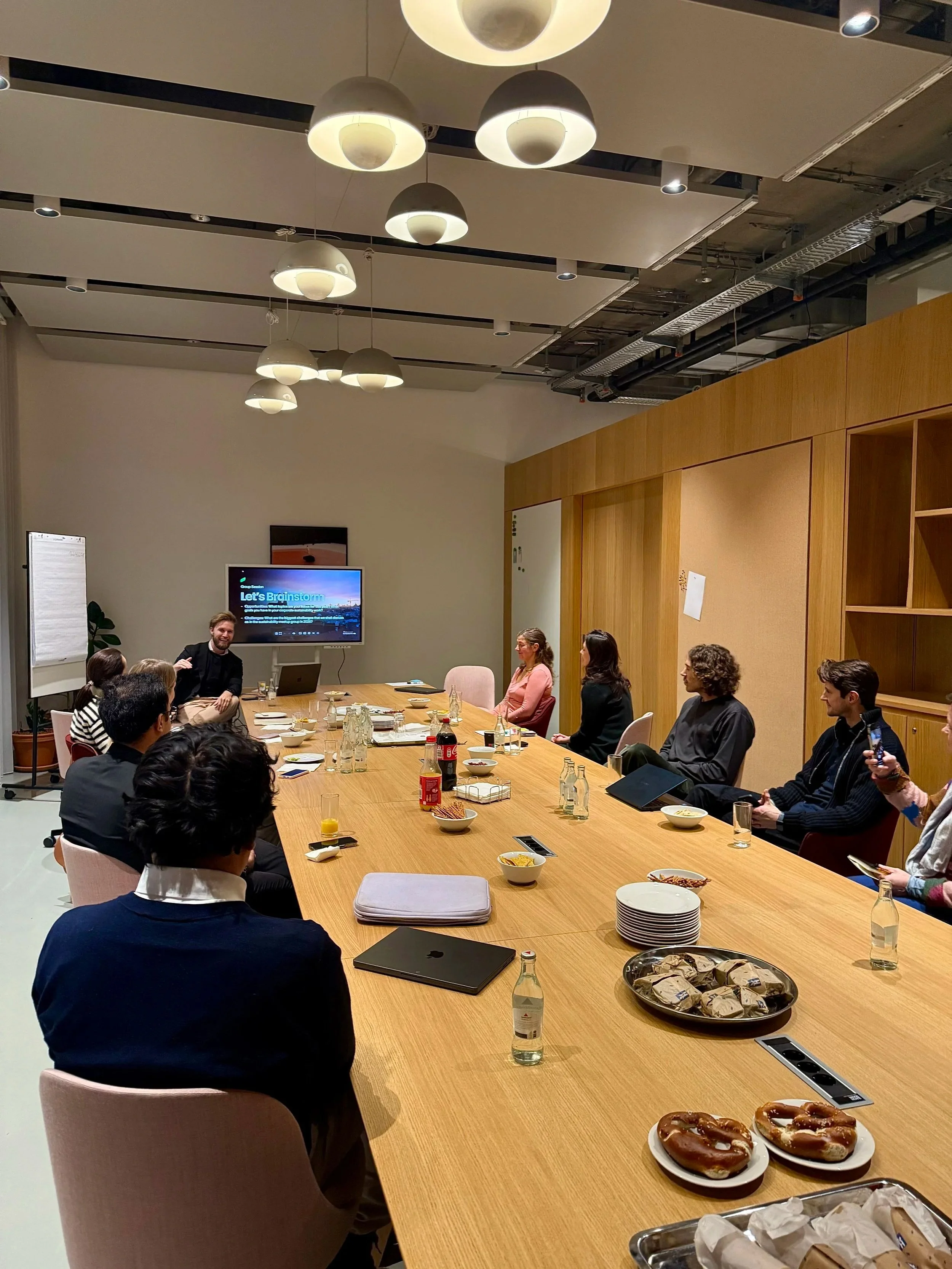
On 27 January 2026, twelve leading sustainability experts came together in Munich for our latest Sustainability Roundtable. In a collaborative discussion, we explored the key priorities, persistent blockers, and strategic levers shaping corporate sustainability in 2026. This article highlights the most important insights and takeaways from these conversations: from emerging trends to actionable recommendations for organisations navigating the rapidly evolving ESG landscape.
From “Reporting” to Resilience and Value Creation
The experts described 2026 as a year in which sustainability is simultaneously a requirement, a risk-management discipline, and a competitive factor. The centre of gravity is shifting away from “ESG compliance as an end in itself” toward governance, reliable data, investment and risk decision-making processes, and credible communication. Key drivers include evolving European regulation, intensifying physical and transition climate risks, geopolitical and macroeconomic volatility, and rising expectations from capital markets, customers, and employees.
Core Challenges for Companies in 2026
1. Regulatory uncertainty and fragmentation
The roundtable repeatedly returned to a “regulatory jungle,” not only due to the number of requirements, but because timelines, interpretations, and enforcement expectations can shift. In Europe, ongoing debates about simplification and potential adjustments to scope and timing have added uncertainty for corporate planning.¹ This increases the risk of misallocation, such as investing too much or investing in the wrong place, and complicates internal prioritisation.
Practical implication: Don’t wait for perfect clarity. Prioritise regret-free moves: data governance, clear internal responsibilities, robust risk processes, and auditable documentation.
2. Sustainability deprioritisation in SMEs and the organisational “middle”
Several experts noted that in smaller and mid-sized organisations, sustainability is still often perceived at C-level as a cost centre unless the value contribution is made tangible. Resource constraints and short-term performance pressure can push ESG down the agenda, despite long-term exposure to climate, supply chain, and regulatory risks.
Practical implication: Progress accelerates when sustainability is managed as a business case, focusing on risk, cost, revenue, and financing, not as a “CSR project”.
3. Data availability, data quality, and auditability
Data was framed as a persistent bottleneck: inconsistent definitions, fragmented systems, limited supplier transparency, and unclear data ownership. The problem is often insufficient controls, traceability, and audit trails. When underlying data is weak, both reporting credibility and the connection between sustainability and financial steering suffer.
Practical implication: Treat data quality as a governance topic: defined data owners, standardised definitions, plausibility checks, version control, and documented assumptions including the controlled use of estimates and proxies where appropriate.
4. Greenwashing risk and the rise of “greenhushing”
Experts described a growing communication dilemma: fear of legal challenges, reputational risks, or regulatory non-compliance can lead companies to under-communicate even genuine progress, a phenomenon known as greenhushing. At the same time, the EU is tightening the rules on environmental claims, including through the Directive (EU) 2024/825 (“Empowering Consumers”).²
Practical implication: Avoid the extremes (“loud” vs “silent”). Use evidence‑based, well‑substantiated, transparent environmental claims to prevent misleading practices and align Sustainability, Legal, and Communications in a clear approval process.
5. Short-term decision pressure amid political and economic volatility
The experts highlighted how macroeconomic uncertainty and political polarisation can crowd out long-horizon transition investment. The consequence is often a retreat into short‑term optimisation, even as structural climate and supply chain risks continue to rise.
Practical implication: Reframe sustainability investments explicitly as resilience investments in energy, raw materials, supplier and site risk, climate exposure.

Strategic opportunities and levers for 2026
1. Reframing sustainability as a business case
A core message: sustainability gains traction when it is managed as financially material and linked to cost, risk, capital, and growth. Empirical research shows that the relationship between ESG performance and financial outcomes varies across contexts and measurement approaches, yet a growing body of evidence suggests that robust ESG practices, including structured due diligence, are associated with reduced operational risk, improved risk profiles, and enhanced long-term financial performance, making them strategic levers for corporate value creation.³
Practical approach: Quantify the “cost of inaction”, including energy and commodity risk, downtime, and regulatory exposure, and connect ESG metrics to finance metrics, such as capex discipline, risk-adjusted returns, and total cost of ownership.
2. Using regulation as a roadmap
Even amid simplification debates, the experts argued that European requirements can be used as a structure: prioritising topics, clarifying responsibilities, and embedding KPIs into management processes. The CSRD remains a reference point for more decision-useful and assurance-ready sustainability information, even as details continue to evolve through political and legislative processes, including ongoing adjustments to the ESRS.⁴
Practical approach: Use CSRD/ESRS as your operating framework by assigning clear topic and data owners and selecting a small set of decision-critical KPIs, such as procurement, capex, and risk, to prioritise first. Then embed these KPIs into existing management routines, including budgeting, risk committees, and procurement reviews, with a light controls layer, covering definitions, evidence, approvals, and audit trails, to make them assurance ready.
3. Governance and cross-functional integration
The roundtable stressed that sustainability only scales when it is operationalised across procurement, finance, risk, R&D, operations, and communications. What matters in 2026 is less “new topics” and more organisational execution: accountability, incentives, escalation paths, and management control.
Practical approach: Anchor ESG steering with Finance and Risk, define responsibilities per key data domain, and establish internal controls comparable to financial reporting logic, including materiality, evidence, and approvals.
4. Consumer choice and strategic storytelling
Experts saw continued market potential: consumers and B2B customers can reward sustainability when tied to quality, ethics, and transparency. At the same time, willingness to pay is highly context-dependent, depending on product category, price pressure, and trust. Surveys suggest many consumers claim willingness to pay a premium for sustainably produced goods, while also highlighting cost-of-living constraints.⁵
Practical approach: Substantiate claims with data and disclose limits, and tell impact stories anchored in concrete product and service levers such as durability, repairability, traceability, circularity.
5. Circular business models as a resilience strategy
Circular economy strategies were framed not as “nice-to-have,” but as responses to resource risk, cost volatility, and strategic autonomy. European assessments underline that circular measures can reduce pressure on climate, pollution, and biodiversity, while improving resilience and resource security.⁶
Practical approach: Prioritise circular levers with strong unit economics, such as material cost reduction, take-back schemes, repair services, design-to-last strategies, and second-life models.
6. AI and digital innovation
The experts viewed AI as a lever for harmonising data, identifying risk signals earlier, and improving efficiency, especially in supply chains.
Practical approach: Deploy AI where it demonstrably reduces workload or improves decision quality in areas such as data capture, anomaly detection, and supplier risk screening, and manage the organisation’s own digital footprint in parallel.
7. Monetising risks and opportunities: translating ESG into P&L, CapEx, and risk models
A recurring theme: without financial translation, sustainability remains “parallel” to core decision-making. With risk metrics, scenario analysis, and transparent assumptions, ESG becomes part of core steering. In climate-risk framing, risks arise from interactions between hazards, exposure, and vulnerability, a useful structure for robust corporate assessments.⁷
Practical approach: Focus on a small set of decision‑relevant metrics across energy, materials, suppliers, and sites, connected to investment logic such as NPV/ROI, risk premia, and downtime costs
Conclusion
The experts characterised 2026 as a proving ground: sustainability teams must move from “report production” toward decision-grade data, governance, risk management, and value-oriented transformation. Regulation remains important but a durable advantage comes from companies that treat sustainability as a resilience and performance discipline and communicate progress credibly and verifiably.
Sources
European Commission. Corporate sustainability reporting (CSRD) — overview and timeline. European Commission, Directorate-General for Financial Stability, Financial Services and Capital Markets Union (DG FISMA). Retrieved January 29, 2026, from https://finance.ec.europa.eu/capital-markets-union-and-financial-markets/company-reporting-and-auditing/company-reporting/corporate-sustainability-reporting_en
European Parliament and Council of the European Union. (2024, February 28). Directive (EU) 2024/825 amending Directives 2005/29/EC and 2011/83/EU as regards empowering consumers for the green transition through better protection against unfair practices and through better information. Official Journal of the European Union. EUR-Lex. Retrieved January 29, 2026, from https://eur-lex.europa.eu/eli/dir/2024/825/oj
Wang, K., Bai, Y., Dong, Z., & Zhu, J. (2025). Heterogeneous impact of ESG Disclosure: A meta-analysis. Journal of Cleaner Production, 516, 145804. https://doi.org/10.1016/j.jclepro.2025.145804
EFRAG. (2025, December 3). EFRAG provides its technical advice on draft simplified ESRS to the European Commission [Press release]. European Financial Reporting Advisory Group (EFRAG). Retrieved January 29, 2026, from https://www.efrag.org/en/news-and-calendar/news/efrag-provides-its-technical-advice-on-draft-simplified-esrs-to-the-european-commission
PricewaterhouseCoopers (PwC). (2024, May 15). PwC 2024 Voice of the Consumer Survey: Consumers willing to pay 9.7% sustainability premium, even as cost-of-living and inflationary concerns weigh. PwC (Press release / survey summary). Retrieved January 29, 2026, from https://www.pwc.com/gx/en/news-room/press-releases/2024/pwc-2024-voice-of-consumer-survey.html
European Environment Agency. (2025). Benefits of a circular economy. In Europe’s environment 2025: Thematic briefings — Circular economy and other enablers of transformative change. European Environment Agency (EEA). Retrieved January 29, 2026, from https://www.eea.europa.eu/en/europe-environment-2025/thematic-briefings/circular-economy-and-other-enablers-of-transformative-change/benefits-of-a-circular-economy
Intergovernmental Panel on Climate Change (IPCC). (2021). The concept of risk in the IPCC Sixth Assessment Report. IPCC (Technical note). Retrieved January 29, 2026, from https://www.ipcc.ch/site/assets/uploads/2021/01/The-concept-of-risk-in-the-IPCC-Sixth-Assessment-Report.pdf