The EU Packaging and Packaging Waste Regulation (PPWR)
The EU Packaging and Packaging Waste Regulation (PPWR) took effect on 11 February 2025 and will apply across all EU Member States from 12 August 2026. It replaces the former Packaging Directive and sets up a unified legal framework for all packaging placed on the EU market. It covers every material type, every sector, and every point in the packaging lifecycle from design to disposal.
The scale of what it addresses is significant and needed. In 2023, 79.7 million tonnes of packaging waste were generated in the EU — equivalent to 177.8 kg per person [Eurostat]. Despite improvements in recycling rates, the EU's packaging waste problem has not reduced meaningfully over the past decade, which is what makes this new regulation necessary. The PPWR is the legislative response to this waste: mandatory recyclability targets, reuse requirements, redesigned labelling, and extended producer responsibilities that place new obligations on every actor in the supply chain.
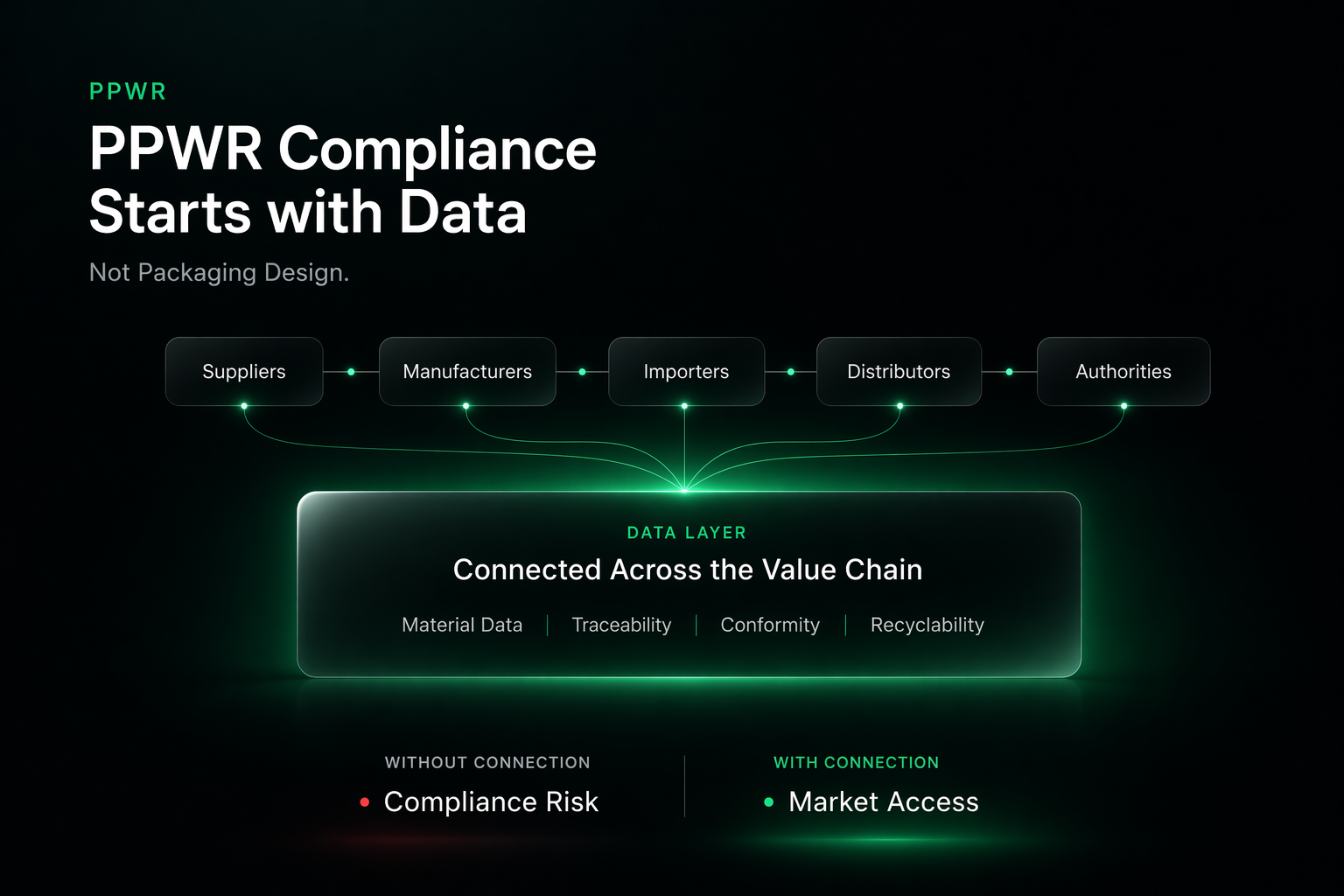
For most businesses, the temptation is to read the PPWR as a design challenge — a question of what to put on a label or what materials to use. That framing misses the harder problem, which is reporting. The regulation's real demands are about data: what information you hold, how accurately it reflects your supply chain, how quickly you can produce it, and how well it holds up under scrutiny years after it was first collected.
In this article, we break the regulation down so that you can understand how it applies to your business and how best to tackle the reporting challenges that come with it.
Who Does the PPWR Actually Apply To - And What Are The Duties?
The PPWR distinguishes between four categories of economic operator, each carrying specific obligations. Understanding which category applies to your business and where your supply chain contacts sit is the starting point for any compliance programme.
Producers
Producers bear the broadest responsibility under the PPWR. They are accountable for the entire packaging lifecycle, including waste management — an approach known as extended producer responsibility. This means financial contributions to cover the costs of collecting, sorting, and recycling packaging waste, with those contributions expected to reflect the actual environmental cost of the packaging placed on the market.
Financial transparency is key here. The PPWR pushes producers to incentivize sustainable packaging and cover the necessary cost of collecting, sorting and recycling, and all of these financial decisions must be transparent and traceable through effective reporting. Producers must register in national producer registers and report on the packaging they place on the market. As requirements tighten through 2030, 2035 and beyond, the accuracy and granularity of that reporting will matter more, so it is important that the reported data is high quality and easily auditable.
Manufacturers and Importers
Manufacturers must conduct conformity assessments and issue an EU Declaration of Conformity confirming that their packaging meets the regulation's requirements. Importers must verify that these assessments have been carried out before their products enter the EU market. Both must keep technical documentation for between five and ten years — a retention window that makes data quality a long-term liability, not just a point-in-time concern.
Labels must include the identification of the manufacturer and, if any, the importer of the packaging, as well as the type, batch, serial number or other identifier that allows for traceability [UL Solutions]. This is not optional information: it is the audit trail that connects a product to its compliance record.
If non-compliance is suspected, manufacturers and importers must take corrective action and document it. This corrective action may be recall, withdrawal, or notification to authorities. The combination of long documentation retention periods and corrective action obligations means that gaps in data quality, or records that can't be retrieved quickly, carry real operational risk.
Suppliers
Suppliers must provide manufacturers with all the information and documentation needed to demonstrate compliance. This covers material composition, chemical safety data, recyclability performance, and any other properties relevant to the regulation's sustainability requirements.
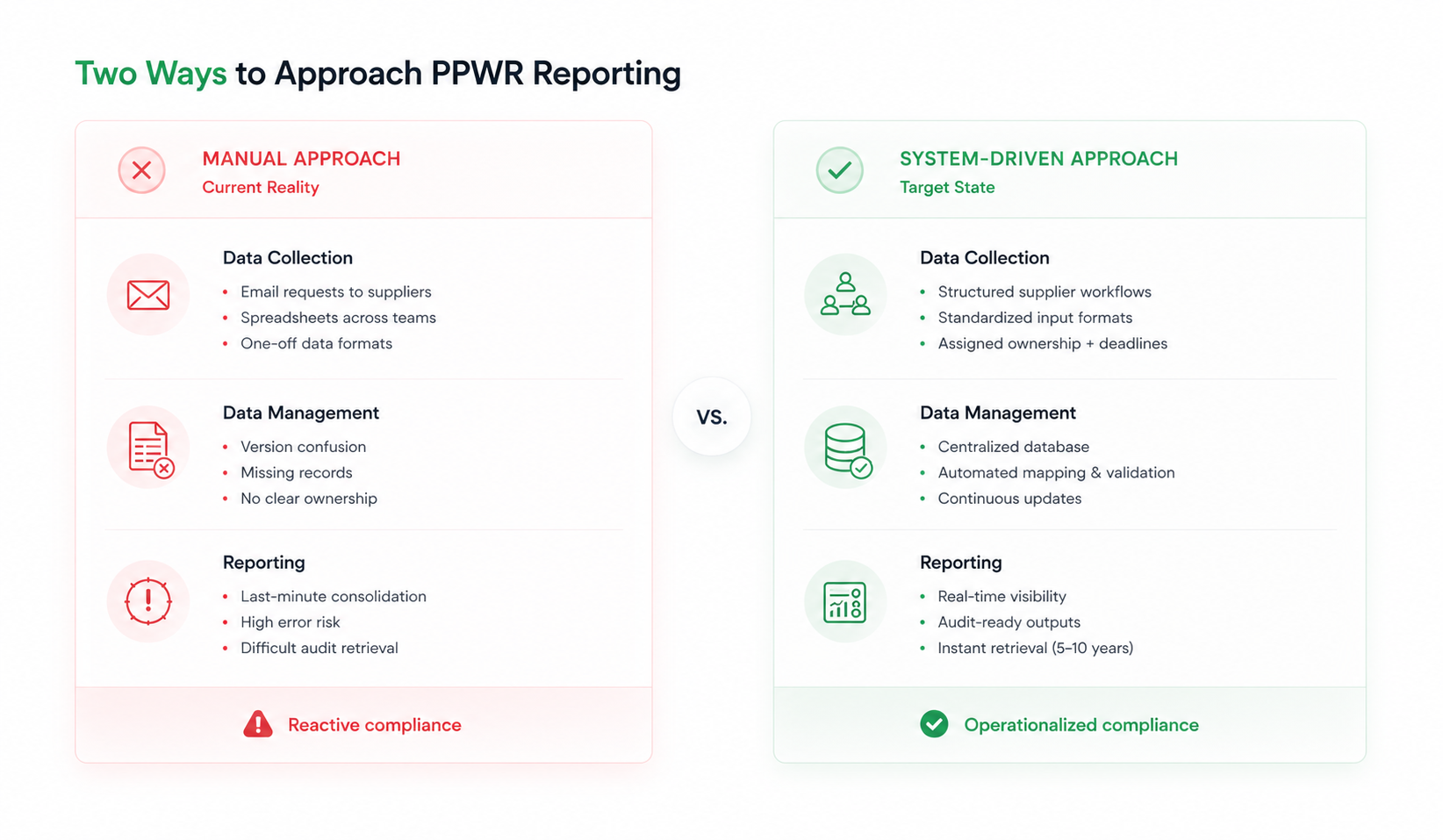
This role is about providing the right data, in a usable form, consistently across reporting periods. Manual reporting systems such as email chains, spreadsheets, and one-off supplier requests tend to produce inconsistencies that stack on top of each other over time. A batch of data that satisfies a manufacturer's requirements in 2026 may not be sufficient to answer an auditor's question in 2030 if it was collected without a structured, traceable workflow.
Distributors
Distributors must verify that packaging complies with EU rules and that manufacturers and importers have met their obligations, providing relevant information to authorities upon request [EUR-lex]. This verification role places distributors in a position of dependency: their ability to respond to a regulatory inquiry is only as good as the data they have received from upstream in the supply chain. Effective collaboration and communication within this supply chain is crucial for distributors to be able to perform their role successfully.
Speed matters here. Authorities do not give advance notice of information requests, and market access restrictions can follow quickly from non-compliance findings. Distributors operating across multiple EU member states face additional complexity, as enforcement remains in the hands of national competent authorities, each of which may interpret and apply the regulation differently.
What Should the Reporting Process Look Like?
The four-actor structure of the PPWR creates a data coordination challenge as much as a compliance challenge. Information about materials, conformity assessments, labelling specifications, and waste management contributions originates at different points in the supply chain and needs to flow between them accurately and on time.
Platforms like Footprint Intelligence, built to manage supplier data collection, assign tasks with deadlines, track completion, and maintain auditable records over time, address exactly this kind of multi-actor reporting challenge. The practical shift is from fragmented manual outreach to structured, system-driven supply chain intelligence. The regulation is demanding, which means additional activities like chasing suppliers for documentation by email, reconciling spreadsheets at reporting time will likely end up wasting time and slowing down compliance. When data from different parts of the supply chain is split across different formats and mediums, a centralized system can also help convert and consolidate it into a single, usable record.
There are several specific requirements that shape what that system needs to be capable of.
Data needs to map onto material transactions. Conformity assessments, labelling records, and waste reporting are only useful if they can be connected to specific packaging units, batches, and supply chain contacts. Disconnected records create reconciliation problems at audit time. The Footprint Intelligence platform allows suppliers to input data directly into one centralized system, reducing the risk of fragmented data.
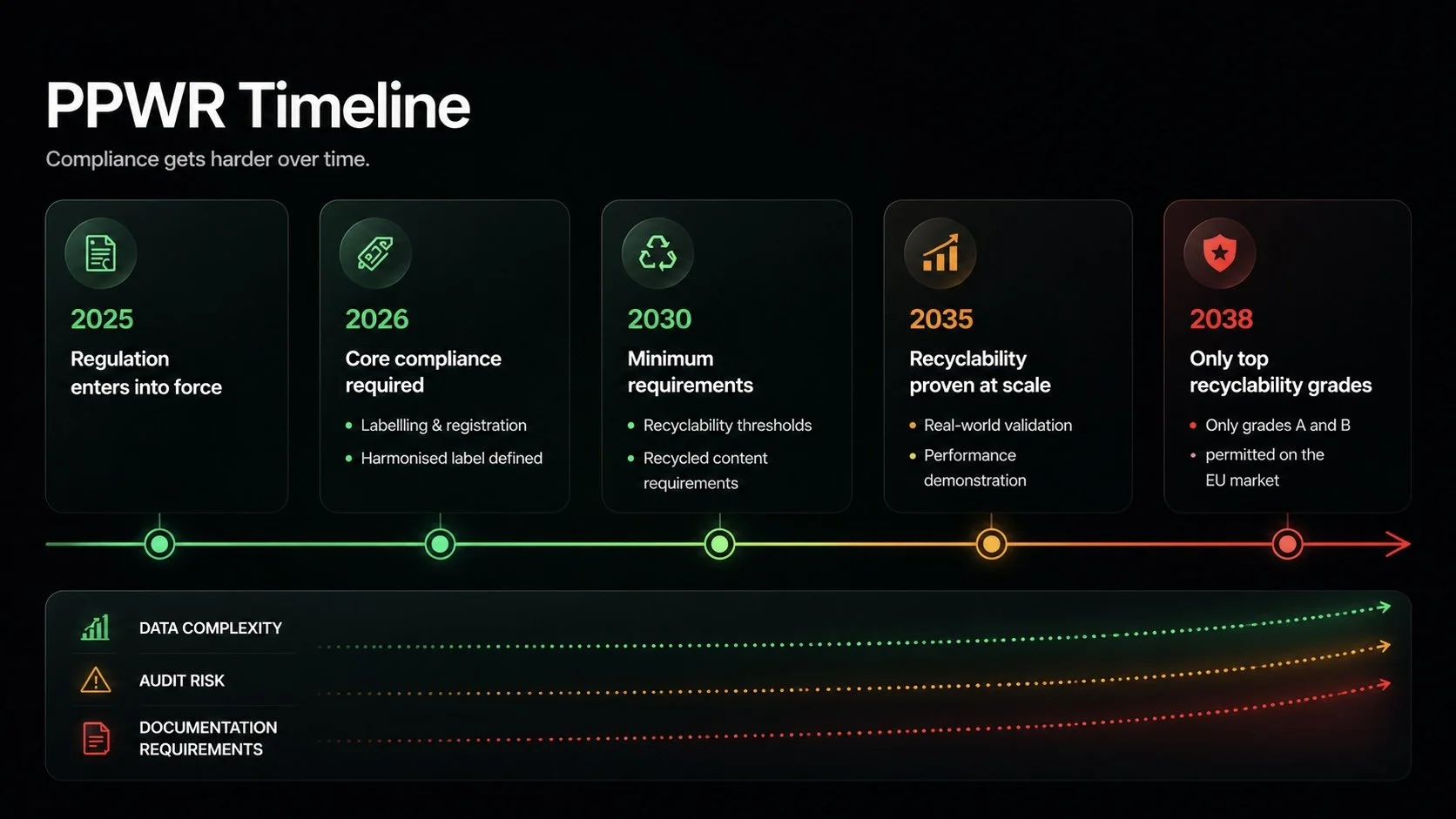
The system needs to support ongoing compliance, not just initial registration. The PPWR's requirements tighten progressively. From January 2030, the first major obligations take effect — only packaging with recyclability grades A to C may be marketed, and minimum recycled content thresholds for plastic packaging apply. By January 2035, recyclability must be demonstrated in practice at scale, and by January 2038, only grades A and B will remain permitted [Circularise]. Each of these milestones requires updated documentation, not a one-off upload and reporting systems need to accommodate this scaling.
Records need to be accessible years after they are first created. Technical documentation for manufacturers and importers must be retained for five to ten years. Authorities may request it at any point in that window. Manual reporting systems that disperse important data into different locations make this process more difficult. Systems that centralize and index documentation rather than leaving it distributed across email inboxes and individual spreadsheet files make retrieval reliable.
The Timeline Is Already Moving
The core application date — August 2026 — is close. But the obligations that follow extend well into the next decade:
By August 2026, businesses must comply with the regulation's core design, labelling, and registration requirements
By August 2026, the European Commission must adopt an implementing act establishing a harmonised packaging label, including standard pictograms and detailed labelling specifications
From 2030, all packaging must achieve at least 70% recyclability and meet minimum recycled content thresholds for plastics
From 2035, packaging must be recycled at scale — demonstrating recyclability in practice, not just in design
From 2038, only the top two recyclability grades (A and B) will be permitted on the EU market
Companies that treat 2026 as the finish line rather than the starting point will find themselves implementing corrective measures under pressure rather than building toward the next phase of requirements.
Key Points: PPWR at a Glance
For businesses navigating the regulation for the first time, the core points are:
The PPWR sets out sustainability and labelling requirements for packaging throughout its entire lifecycle — production, use, and waste management — and applies to all packaging regardless of material or origin
It aims to contribute to the circular economy and climate neutrality by 2050
Packaging that complies with the regulation can be freely marketed across the EU; member states cannot impose additional conflicting requirements
Packaging must be designed to minimize harmful substances and protect human health and the environment
All packaging must be recyclable by 2030 and recycled at scale by 2035
Producers are responsible for the full lifecycle of their packaging, including waste management costs
Manufacturers must issue a Declaration of Conformity; importers must verify that it has been completed
Technical documentation must be retained and accessible for five to ten years
A harmonised EU packaging label is due to be established by August 2026
Conclusion
The PPWR is not primarily a design regulation. It is a data and accountability regulation — one that requires every actor in the packaging supply chain to know what they are placing on the market, document it accurately, and keep that documentation accessible for years. A streamlined, centralized reporting platform such as Footprint Intelligence software is likely better equipped to handle these challenges than a fragmented manual reporting system. The four-actor structure creates real coordination demands: producers, manufacturers, importers, suppliers, and distributors all need to contribute to, and rely on, information that flows consistently across the supply chain.
Manual outreach does not scale to those demands. Chasing suppliers for documentation by email, reconciling spreadsheets at reporting time, and storing records in individual inboxes are all activities that eat into company time and money. The companies that avoid operational risk under the PPWR will be those that move to centralised, system-driven reporting: data collected at source, mapped to specific transactions, maintained over time, and retrievable on demand.
That shift from fragmented manual processes to structured supply chain intelligence is the practical work that compliance requires. The August 2026 deadline is the starting point. Everything after it depends on how well that foundation has been built.