The EU Deforestation Regulation (EUDR): Why Compliance Is a Data Problem, Not a Policy Problem
The EU Deforestation Regulation (EUDR) came into force on 30th December 2025. It requires companies placing or exporting a certain set of commodities — wood, rubber, palm oil, soy, beef, coffee, and cacao — in or from EU markets to prove those products have not contributed to deforestation or forest degradation after 31st December 2020. This is a huge issue in the sustainability landscape that needs tackling urgently, as last year it was estimated that the EEA imported around €70 billion worth of EUDR-regulated products [Factlines].
On paper, the EUDR sounds like a compliance checkbox. But in practice, it is one of the most demanding data collection and supply chain traceability challenges most affected businesses are facing right now. The companies that struggle with EUDR won't struggle because they lack the right policies, but because they can't produce the right evidence. It can be difficult to know where to start with reporting on relatively new regulations and the task may raise questions such as:
What data does the EUDR need from my business?
What are the consequences of delivering low-quality data?
How should I structure reporting for the EUDR?
In this article, we’ll unpack these questions and suggest ways that EUDR reporting can be made easier for your business.
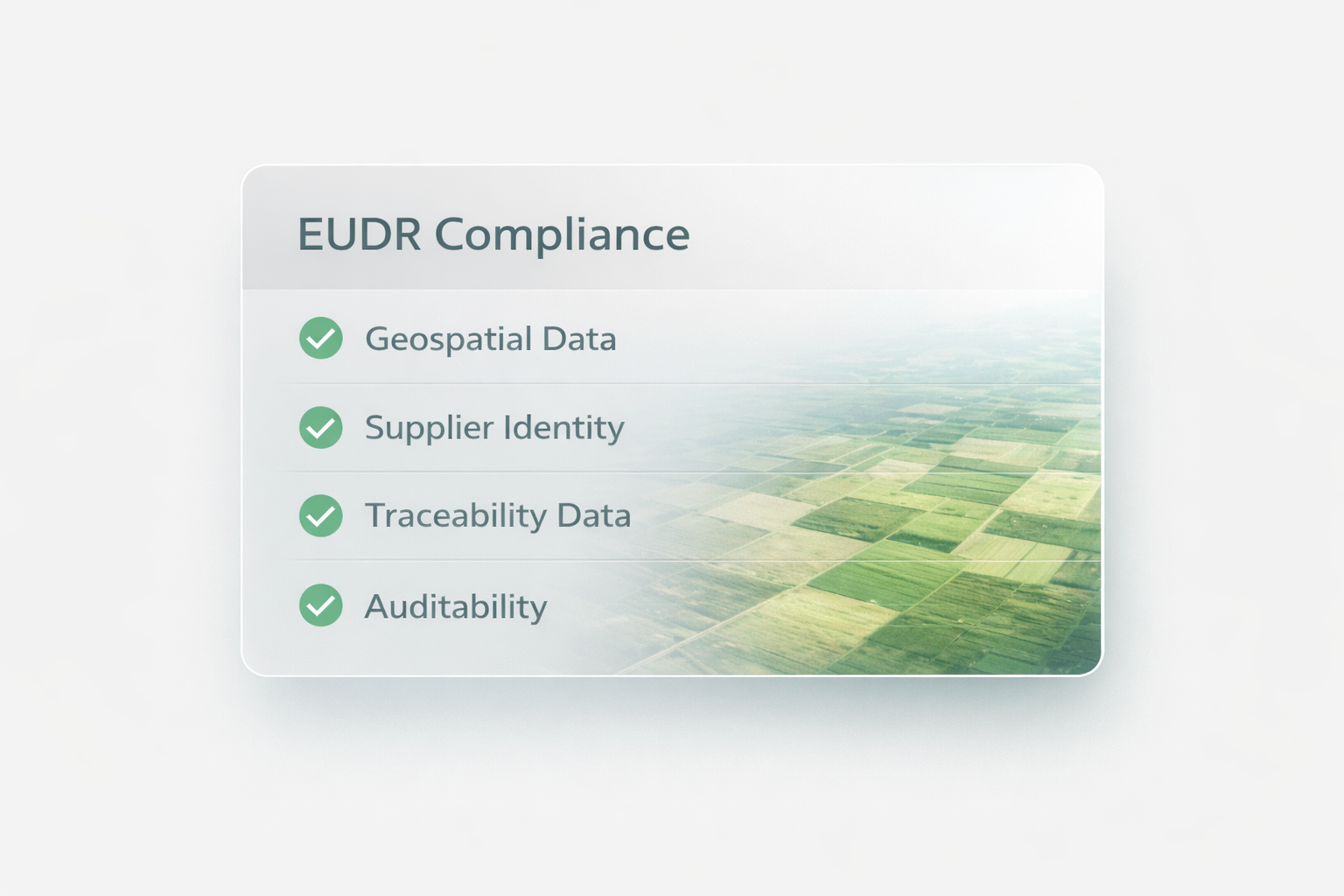
What Data Does the EUDR Actually Require?
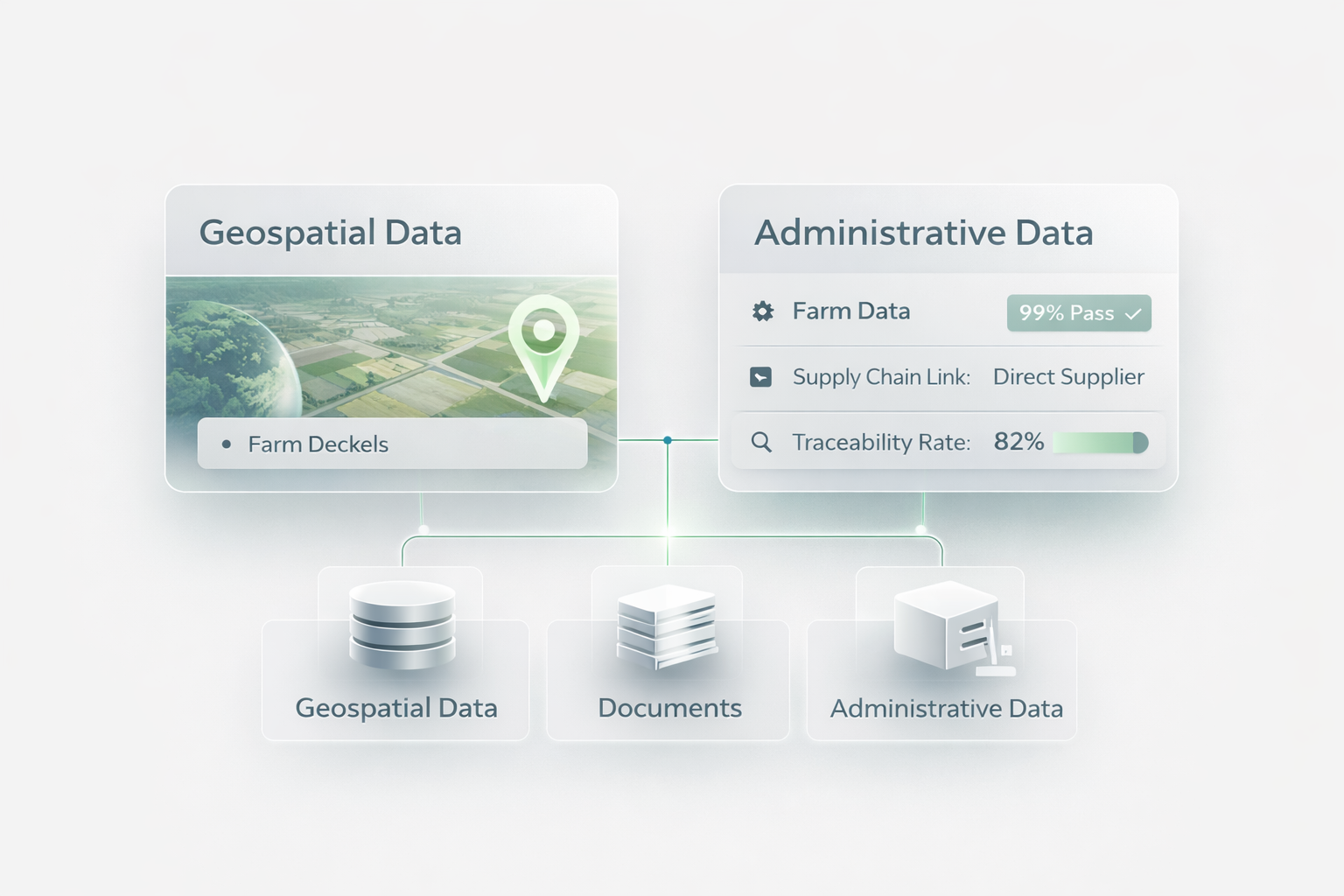
Reports show that only 30% of upstream actors and 12% of downstream actors have systems in place to trace deforestation, which is what the EUDR aims to rectify through strict regulations [AG Tech Navigator]. These regulations then set up two mandatory reporting categories - geospatial, and administrative. Reporting accurately within both of these areas is incredibly important as the European Commission will reject reports that contain anomalies or low-quality data with poor auditability.
Geospatial data is the more technically demanding of the two. Companies must trace products back to the specific plot of land where they were produced and confirm that plot was not subject to deforestation or forest degradation after December 2020. This means plot-level geolocation — coordinates precise enough to be cross-referenced against satellite imagery and land-use records. Broad regional data is not sufficient and sometimes contact with suppliers is necessary to ensure the reported coordinates are as accurate as possible. As noted above, the EUDR information system will automatically reject datasets with anomalies, including incorrect locations and topological errors.
Administrative data covers the documentation and certification trail: supplier records, chain-of-custody documents, evidence of compliance with the production country's legislation, and verification that human rights and Indigenous People's rights have been respected throughout the supply chain. This is a task a manual reporting system may struggle with as it often involves multiple layers of supplier interaction and data entry to build a comprehensive report.
The challenge is not simply collecting both types. It is collecting them consistently, linking them to specific transactions, and maintaining the quality needed to survive regulatory scrutiny. Existing sustainability certifications — no matter how credible — are not accepted as substitutes for meeting these due diligence requirements.
Several friction points compound the difficulty:
Multi-tier supplier complexity. Most affected companies don't source directly from the land. Products pass through multiple tiers of intermediaries before reaching an EU importer. The result of this process is that each tier introduces new gaps in traceability and new opportunities for data inconsistency.
Scale of documentation. For companies managing hundreds or sometimes even thousands of supplier relationships, collecting plot-level geolocation data from each one is not something that lends itself well to manual collection and reporting — at least not in a way where it can be done accurately at volume.
Ongoing monitoring, not one-time reporting. The EUDR is not a static one-time submission and it requires continuous due diligence as new shipments occur. Land use status changes, suppliers change, and a compliant supply chain in January is not automatically compliant in October. This is one of the points where it diverges from conventional ESG reporting and can become more of a challenge.
Data quality as a compliance risk. Unlike many regulatory frameworks where imperfect data can be explained or supplemented, the EUDR information system operates on automated validation. Errors mean rejection, not a follow-up request for clarification. This means all data that’s reported and submitted needs to be high quality and easily auditable.
Considering all of these factors, the task of reporting may appear daunting. However, with the right processes in place, it doesn’t have to be. Here are some suggestions for how an intimidating task can be made more easily achievable.
What Should the Reporting Process Look Like?
Looking at the strict and demanding requirements, the question isn't whether to build a structured data process — it's what that process needs to be capable of. Non-compliance resulted in a fine of at least 4% of EU-wide turnover in the previous financial year, and repeated infringements can increase the penalty further, so it’s important that reporting systems are streamlined and efficient from the start [Food Navigator] .
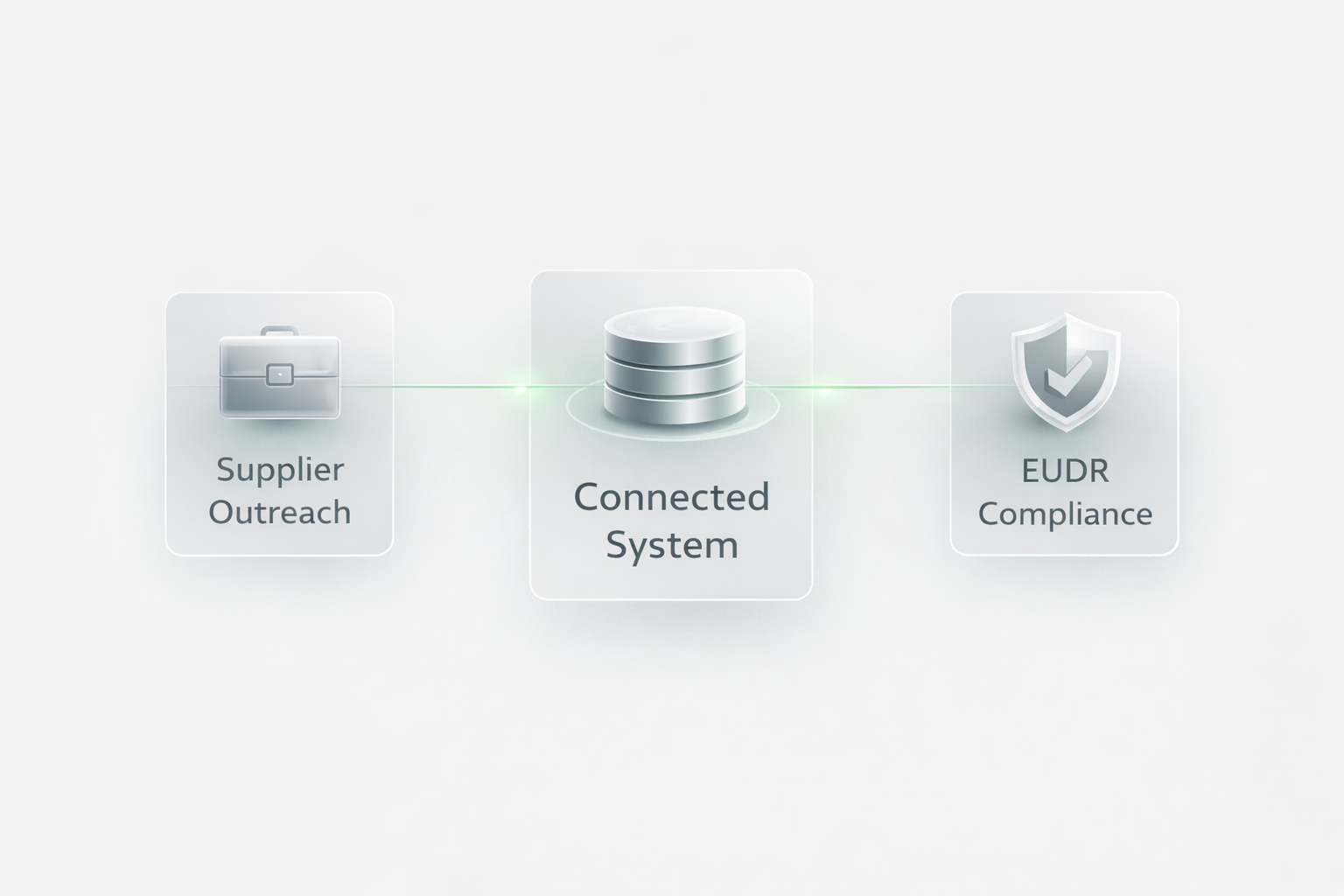
A functional EUDR reporting system needs to do several things that manual processes and spreadsheet-based approaches cannot reliably do at scale.
First, geospatial and administrative data need to live in the same system. When these data types are managed separately — coordinates in one place, documentation in another — linking them accurately to individual transactions becomes a significant manual burden. As is typically the case with manual reporting systems, errors easily accumulate and audit trails can fragment, especially when working at such a large scale. A centralized system that holds both data types in relation to each other reduces reconciliation work and makes anomalies visible before submission rather than after rejection.
Second, suppliers need to contribute data directly. The alternative — sustainability teams manually collecting, formatting, and chasing geolocation data and documentation from dozens or hundreds of suppliers — is not a scalable model which is a problem considering these regulations are more likely to grow in scope than they are to shrink. One study found that sustainability managers spend around 85% of their time on data collection activities where it could be spent on making decisive emission cuts [TripShift]. The EUDR adds significant new data requirements on top of existing reporting obligations which a manual reporting system would likely struggle to sustain. A centralized system such as the Footprint Intelligence platform that assigns specific data requests to suppliers, sets deadlines, tracks completion, and sends automated reminders shifts the burden appropriately and creates a documented record of the engagement.
Third, the system needs to support ongoing compliance, not just one-off uploads. Transaction-linked traceability means that every new shipment should clearly and easily map to verified origin data. When supplier information changes, or when new land-use risk assessments become available, those updates need to flow through to compliance records automatically — not trigger a new round of manual outreach which will cost more time, and therefore more money.
This is the core shift the EUDR demands of affected businesses: moving from manual supplier outreach to structured, system-driven supply chain intelligence. Platforms like Footprint Intelligence, built to manage supplier data collection, geolocation linkage, and ongoing monitoring in a single system, are better positioned to support this than tools designed for periodic reporting cycles.
Conclusion
EUDR compliance will be determined by data quality, not by the strength of a company's deforestation policy. Plot-level geolocation, multi-tier supplier documentation, transaction-linked traceability, and continuous monitoring are operational requirements — and they demand operational solutions.
Companies that approach EUDR as a documentation exercise will find themselves building manual processes that don't hold up under regulatory scrutiny. On the other hand, those that treat it as a data infrastructure challenge — investing in systems that collect, structure, and maintain supply chain evidence at scale — are better placed to meet current requirements and adapt as the regulatory landscape continues to tighten.
The question now is whether your reporting process can produce the evidence when it's asked for.