The 5 Most Expensive Mistakes Companies Make When Choosing ESG Tools
Environmental, social, and governance (ESG) software is a tool designed to collect, display, and transform reporting data into actionable insight for businesses. It has become essential infrastructure for companies navigating sustainability reporting and compliance and has the power to streamline internal workflows when correctly implemented. But with hundreds of vendors on the market and regulatory pressure mounting, many buyers rush into selections they later regret.
The wrong tool can create operational risk that builds up over time: manual work that stays manual, weak data quality that undermines audits, software being a poor fit with internal workflows, and platforms that demo well but break in implementation. There are many other queries related to ESG software that can build up and become overwhelming to address, such as:
Do I need ESG software?
What does ESG software actually do?
How much does ESG software cost?
How do I use ESG software?
This article looks at these questions in more detail and examines what companies consistently underestimate when evaluating ESG software—and how to avoid costly selection mistakes.

The ESG Software Landscape
The market for ESG and sustainability software has grown rapidly over the past few years, driven largely by regulatory expansion. The global ESG reporting software market was valued at approximately $1.24 billion in 2025 and is projected to grow at a compound annual growth rate of around 20.1% from 2026 to 2033 [grandviewresearch.com]. The EU's Corporate Sustainability Reporting Directive (CSRD) has been a primary catalyst, requiring detailed sustainability disclosures from approximately 50,000 companies. ESG software has the potential to help businesses meet th1ese demands in a way that saves both time and money - assuming the choice of software is considered carefully.
Most ESG platforms fall into different functional categories:
Carbon accounting and emissions tracking — focused on Scope 1, 2, and 3 greenhouse gas calculations
Supply chain sustainability — supplier assessments, risk mapping, and traceability
ESG data management — collection, validation, and storage of sustainability metrics
Compliance and reporting — frameworks like GRI, CSRD, SASB, and CDP
Performance dashboards — KPI tracking and benchmarking
The limitation buyers often discover too late is that most vendors specialize in just one or two of these areas. A platform strong in carbon accounting may lack robust reporting capabilities, and a compliance-focused tool may not handle supply chain data well. This fragmentation forces companies into workarounds—or the purchase of multiple tools that don't communicate with each other. It’s also worth noting that this is not the only problem companies tend to run into when choosing what software to purchase. Here are some other issues that companies underestimate:
1. Data Collection Disconnected from Business Goals
Many ESG platforms function as glorified spreadsheets. Data goes in, but the system doesn't connect inputs to strategic objectives or surface actionable insights. A 2024 study shows that 70% of sustainability leaders believe that the time and cost spent on manual reporting admin has led to decarbonisation delay, which also leads to wasted money. [Source]
The symptom: your sustainability team spends most of their time collecting and formatting data rather than analyzing it. Manual processes that were supposed to be automated remain manual. The platform becomes a repository, not a decision-support tool.
What to evaluate instead:
Ask how data enters the system. Flexible integration matters—APIs, AI-assisted bulk imports, and template-based uploads accommodate different data sources and contributor capabilities. Platforms like Footprint Intelligence emphasize this adaptability because real-world sustainability data comes from procurement systems, supplier submissions, utility bills, and dozens of other sources that rarely share a common format.
Also ask how the platform connects data to outcomes. Can you track progress against specific targets at the data-point level? Can you identify which business units or suppliers are driving emissions changes? If the answer is "you'll need to export to Excel for that," the tool hasn't solved the underlying problem.
2. Incomplete Coverage of ESG Needs
Some vendors split horizontally—covering one function (like reporting) across industries. Others split vertically—serving one industry deeply but only addressing part of the ESG workflow. Either approach can leave gaps.
A platform that efficiently handles data management may not generate compliant reports, the same way a reporting tool may not track performance over time or manage supplier contributions. Purchasing multiple platforms without considering whether their features are compatible with each other can often intensify these problems rather than solve them. Companies end up stitching together multiple systems, creating integration headaches and data inconsistencies.
What to evaluate instead:
Map your full ESG workflow before evaluating vendors. Consider:
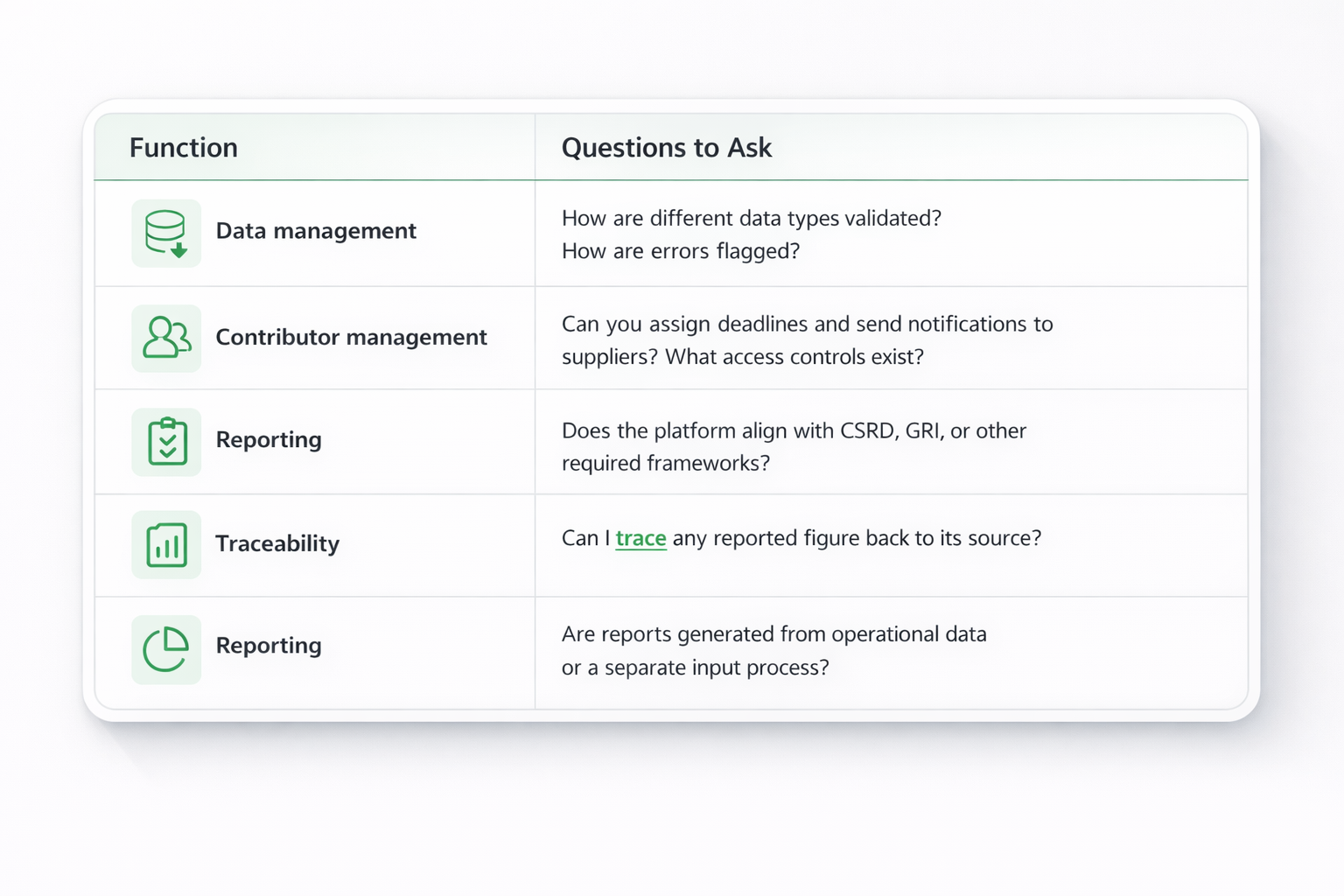
Footprint Intelligence, for example, combines data management, reporting, and performance tracking in a single platform. This approach reduces the need for manual data transfers between systems and keeps audit trails intact.
3. ESG Tools Treated as Workflow Add-Ons
A common implementation pattern: the sustainability team adopts a new platform, but it sits alongside existing processes rather than replacing them or interacting meaningfully with the data. Contributors log into the tool occasionally. Data still flows through email and spreadsheets. The platform captures some information but doesn't drive operational improvements.
This happens when software doesn't fit internal workflows—or when buyers don't plan for change management. The tool becomes overhead rather than infrastructure, which can slow down crucial decision-making as well as general operations.
What to evaluate instead:
Ask how contributors interact with the system. Can suppliers be assigned specific data requests with deadlines and automated reminders? Can different user roles see only what's relevant to their responsibilities?
Also ask how reporting connects to the underlying workflow. Platforms that build reports directly from operational data—rather than requiring a separate reporting layer—maintain traceability and reduce manual conversion and reconciliation. If reports are generated from the same data used for day-to-day tracking, discrepancies become visible immediately rather than at audit time.
4. Avoiding Investment Because "The Software Is Too Expensive"
Budget constraints are real. But the calculation often underestimates the cost of the status quo.
Manual sustainability reporting consumes significant staff time—time that doesn't scale as reporting requirements expand. In fact, a TripShift study shows that sustainability managers spend around 85% of their time collecting data. [Tripshift]. software can deliver accurate,gaps or reconstructing missing information. The CSRD alone requires detailed disclosures across environmental, social, and governance dimensions, with supply chain traceability requirements that spreadsheet-based processes struggle to meet.
Beyond labor costs, poor data quality creates downstream problems. Auditors will flag inconsistencies and stakeholders may lose confidence in reported figures. This means that opportunities to reduce operational costs—visible through better emissions data or supply chain analysis—go unnoticed.
What to evaluate instead:
Frame the decision in terms of operational risk, not just software cost. Consider:
How many hours per month does your team spend on manual data collection and formatting?
What happens when an auditor asks for the source of a specific data point?
Can you currently identify which parts of your supply chain drive the most emissions?
ESG software that surfaces these insights can pay for itself through operational improvements it makes visible—not just through time savings on reporting.
5. Procrastinating on Software Selection
Regulatory timelines are fixed. CSRD reporting requirements began phasing in for large companies in 2024, with subsequent waves covering smaller entities. It is likely that these requirements will only become stricter going forward, as even now non-compliance with the CSRD can incur penalties of up to €375,000. [Novata] Companies that delay software selection often find themselves implementing under pressure, without time for proper configuration or staff training.
The broader trend is clear: more governments and stakeholders are demanding increased transparency. Net-zero commitments create accountability expectations that require auditable, traceable reporting. This all means that brand reputation and market position increasingly depends on demonstrated progress, not just stated intentions.
What to evaluate instead:
Start evaluation early enough to allow for implementation, testing, and workflow integration before reporting deadlines. Factor in:
Time for data migration and validation
Training for internal staff and external contributors
At least one reporting cycle to identify gaps before high-stakes submissions
Making a Better Selection
The buyers who avoid costly mistakes typically ask different questions during evaluation:
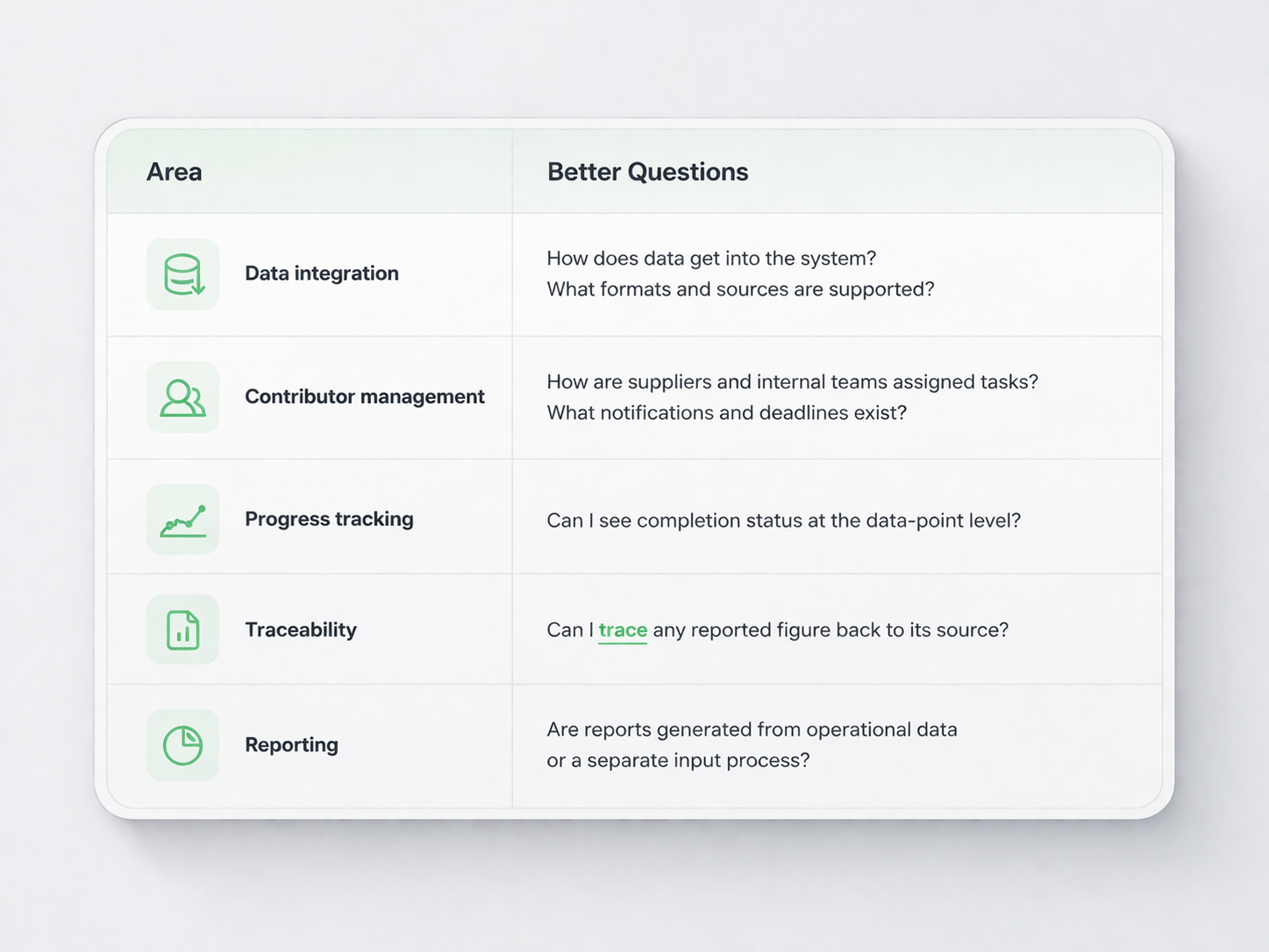
These questions shift focus from feature lists to operational reality. A platform might claim to support CSRD reporting, but the real question is whether it supports your CSRD reporting—with your data sources, your contributors, and your internal review processes.
Conclusion
ESG software selection is a decision that compounds. The right tool reduces manual work, improves data quality, maintains auditability, and surfaces operational insights. But the wrong tool creates friction that can persist for years—wasted budget, reporting gaps, and missed opportunities to demonstrate progress.
The decision-making process should start with how work actually happens: how data enters the system, how contributors are managed, how progress is tracked, and how reports connect to underlying workflows. Platforms that answer these questions well—using the approach of combining data management, reporting, and performance tracking—tend to create less operational risk than tools optimized for demo day but not for implementation.
The cost of delay is real, but the cost of a poor selection is often higher.