ESG software has shifted from optional infrastructure to operational necessity. As regulations expand in scope and complexity, companies are no longer asking whether to adopt a reporting platform - they are asking which one will hold up over the next decade of disclosure requirements, audit cycles, and supply chain scrutiny.
The selection matters more than most buyers realise. The wrong tool quietly compounds risk over time: hours lost to manual data wrangling, audit trails that fall apart under scrutiny, suppliers who cannot contribute data in usable formats, and a platform that becomes another silo rather than the backbone of sustainability reporting.
This article addresses the questions companies are asking before they commit:
What is ESG software, and what does it actually do?
Why is it now necessary rather than optional?
What regulations does it need to cover - and what happens if it falls short?
How should it handle data quality, supplier collaboration, and workflow integration?
Will it scale as reporting requirements grow?
What Is ESG Software?
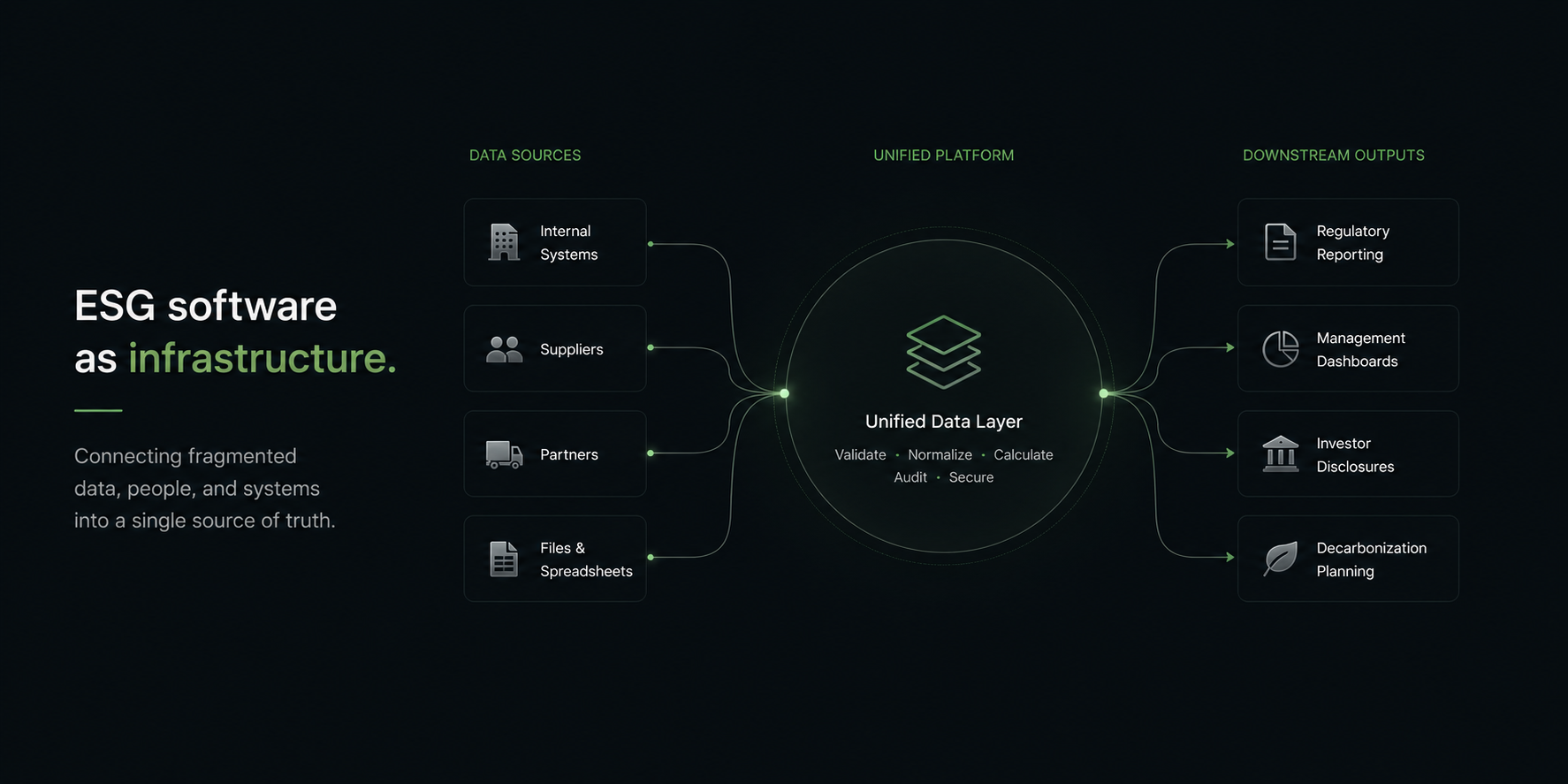
ESG (environmental, social, and governance) software is a category of platform built to collect, structure, validate, and report on sustainability data across a business and its value chain. At minimum, it handles emissions accounting, regulatory disclosures, and the storage of evidence behind every reported figure. At its best, it turns ESG data into operational insight - identifying where emissions are concentrated, which suppliers carry the most risk, and where investment in decarbonisation will produce measurable returns.
Most companies approaching ESG software for the first time share the same set of concerns:
Will it actually integrate with our existing systems, or sit on top of them?
Can it handle the data formats our suppliers and internal teams already use?
How long will implementation take - and how disruptive will it be?
Is it worth the investment when spreadsheets currently get the job done?
These are reasonable concerns, but the underlying question is the wrong one. Spreadsheets do not "get the job done" once disclosure requirements move beyond Scope 1 and 2 emissions, demand auditable data trails, and require supplier-level information collected on regulatory deadlines. The cost of staying with manual systems is not visible until an audit, a missed deadline, or a regulator request makes it visible.
Successfully implemented, ESG software produces compounding gains rather than stacked losses: fewer hours spent on manual reporting, cleaner data for decision-making, faster audits, and the ability to translate sustainability performance into commercial advantage - whether through investor reporting, customer requirements, or eligibility for green finance.
The wrong choice produces the opposite. Selection mistakes are well documented and expensive - we cover the most common in The 5 Most Expensive Mistakes Companies Make When Choosing ESG Tools.
Regulation Coverage: A Moving Target
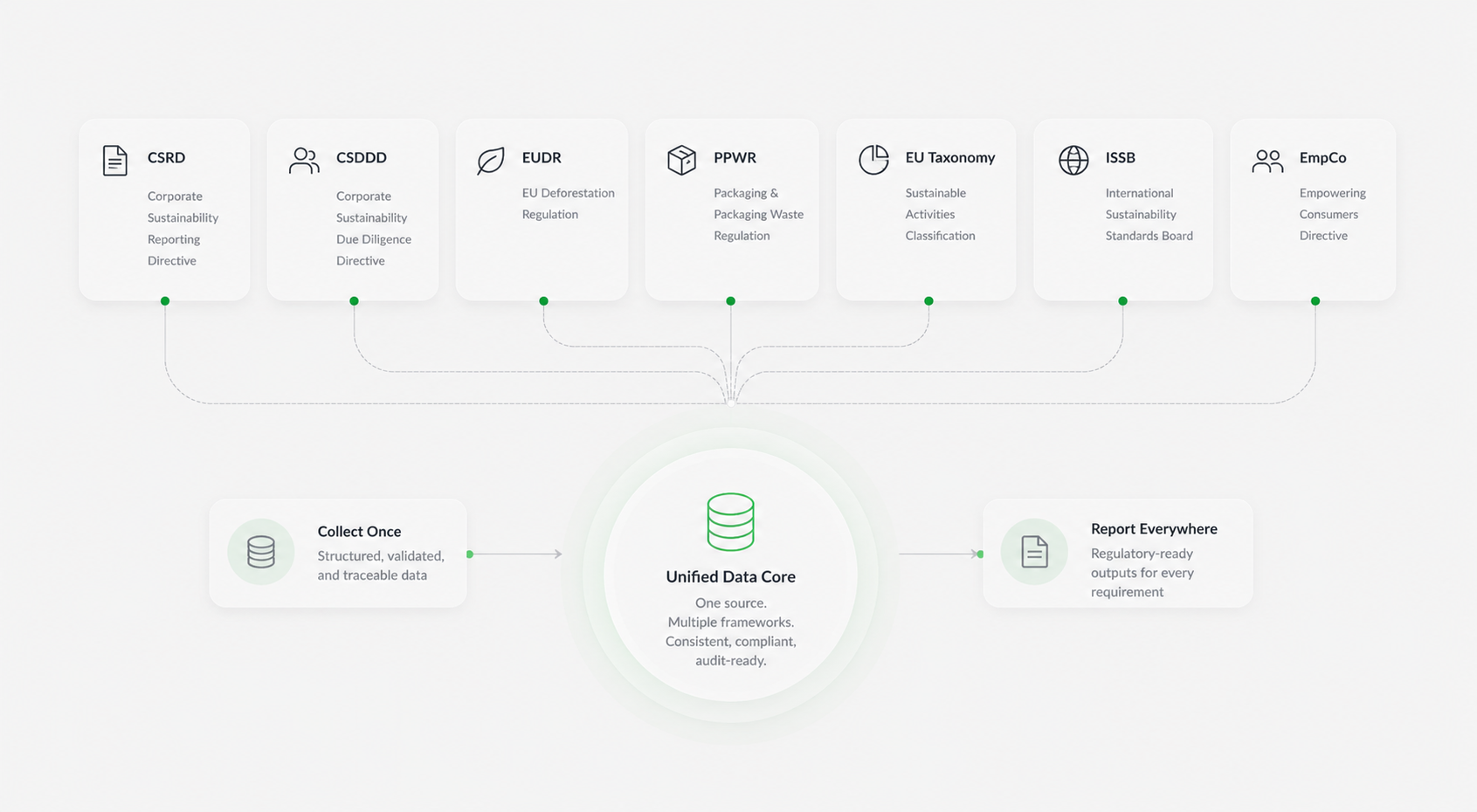
The regulatory landscape is expanding in three directions at once: more regulations, broader scope per regulation, and stricter enforcement. The CSRD, CSDDD, EUDR, PPWR, EU Taxonomy, EmpCo Directive, and ISSB standards all carry their own data structures, formatting requirements, and submission cycles. None of these are slowing down. According to a Deloitte survey, 62% of executives are either prepared or undertaking extensive preparations for the expected increase in reporting requirements - meaning the companies that delay are already behind their peers.
The Cost of Non-Compliance
Non-compliance is no longer a reputational risk on the margin. CSRD penalties alone can reach €375,000 per breach, and supply chain regulations like the EUDR carry fines of up to 4% of EU annual turnover. Beyond direct penalties, non-compliance creates secondary costs: lost contracts with customers who require compliant suppliers, exclusion from public procurement, reduced access to sustainable finance, and downgrades from ESG rating agencies. Brand damage tends to be the most lasting consequence, and the hardest to quantify.
What the Software Needs to Do
Different regulatory frameworks demand different output formats - XBRL tagging for CSRD, geolocation data for EUDR, supply chain mass balance for PPWR. Software needs to ingest data once, store it in a normalised structure, and convert it to whatever format a given regulator requires. Doing this manually across frameworks is where teams lose entire quarters.
The bigger challenge is Scope 3. Once reporting moves beyond direct emissions (Scope 1) and purchased energy (Scope 2) into value chain emissions (Scope 3), the data volume increases by orders of magnitude. Suppliers, logistics partners, product use, end-of-life - each contributes data points that need collecting, validating, and tracing. Spreadsheets cannot version-control this, cannot maintain audit trails across years, and cannot manage the contributor permissions required to gather supplier data at scale.
Manual reporting was viable when disclosure was voluntary and narrative-driven. It is not viable now.Different regulatory frameworks demand different output formats - XBRL tagging for CSRD, geolocation data for EUDR, supply chain mass balance for PPWR. Software needs to ingest data once, store it in a normalised structure, and convert it to whatever format a given regulator requires. Doing this manually across frameworks is where teams lose entire quarters.
The bigger challenge is Scope 3. Once reporting moves beyond direct emissions (Scope 1) and purchased energy (Scope 2) into value chain emissions (Scope 3), the data volume increases by orders of magnitude. Suppliers, logistics partners, product use, end-of-life - each contributes data points that need collecting, validating, and tracing. Spreadsheets cannot version-control this, cannot maintain audit trails across years, and cannot manage the contributor permissions required to gather supplier data at scale.
Manual reporting was viable when disclosure was voluntary and narrative-driven. It is not viable now.
Data Quality: The Audit-Defining Variable
Every regulatory framework eventually comes down to one question: can you defend the numbers?
Data quality is not a back-office concern. It determines whether disclosures pass audit, whether decarbonisation targets are credible, and whether ESG ratings reflect actual performance. Gartner estimates that poor data quality costs organisations an average of $12.9 million annually, and ESG reporting is one of the areas where that cost lands hardest - because the data is scrutinised externally, not just internally.
The downstream effects of weak data are predictable:
Failed audits - inconsistent figures, missing source documentation, or untraceable calculation methodologies
Time loss - sustainability managers spending the majority of their week reconciling data rather than acting on it
Compliance failures - misreporting that triggers penalties or restatements
Erosion of trust - investors, customers, and regulators discount future reports once credibility is damaged
ESG software addresses this by enforcing data quality at the point of entry: validation rules, mandatory source attribution, version history, and audit-ready evidence trails. Spreadsheets cannot enforce any of this. They store whatever is typed into them and offer no way to verify, years later, who entered what and on what basis.
Accommodating Collaboration: The Scope 3 Reality
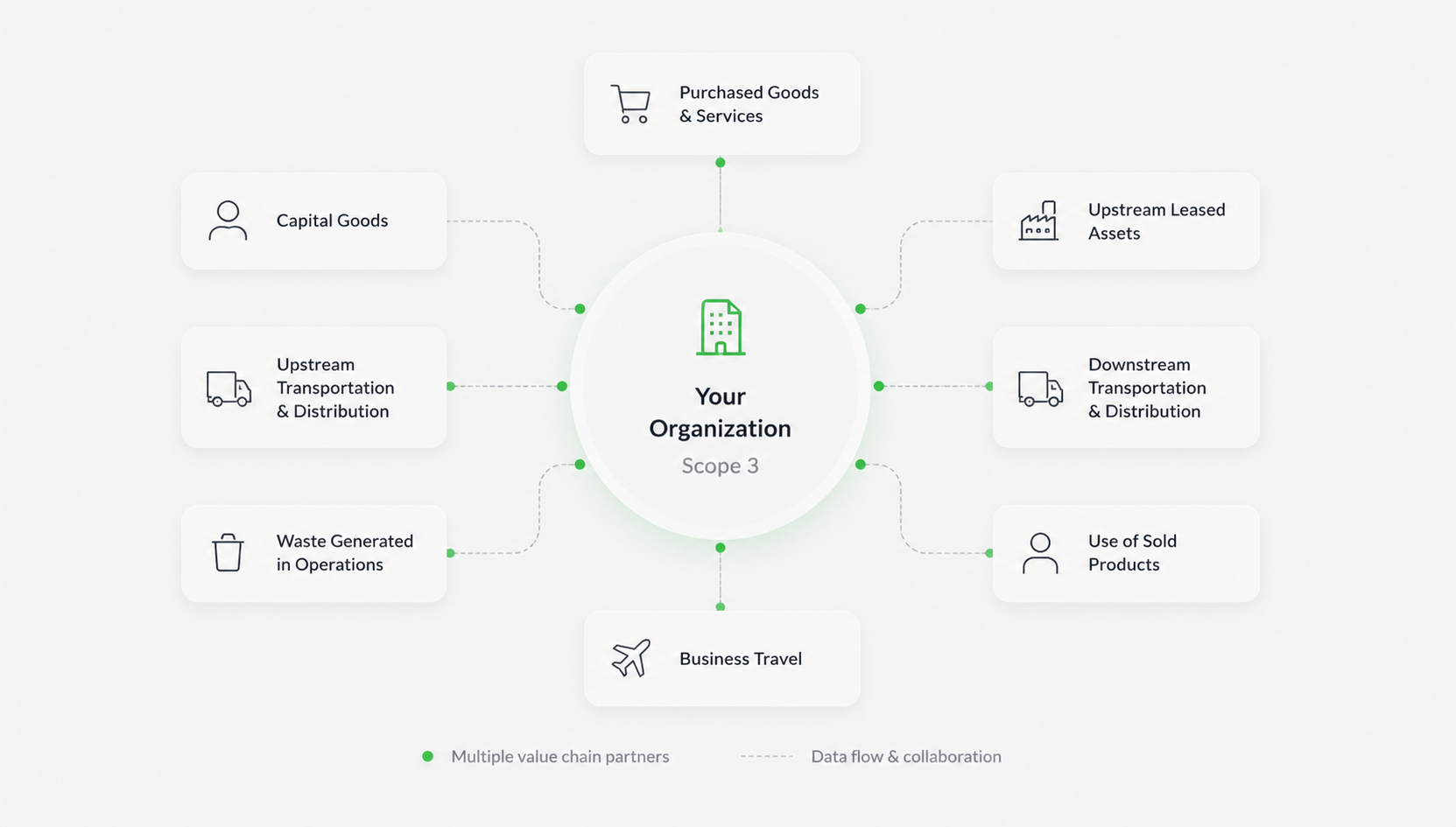
Scope 3 emissions typically represent the majority of a company's total footprint - and they are almost entirely outside direct operational control. Reporting on them requires data from suppliers, logistics partners, and downstream users, often spanning hundreds or thousands of contributors.
Regulations are accelerating this. The EUDR requires geolocation data for every plot of land producing relevant commodities. The PPWR requires packaging data submitted by producers across the value chain, with traceability obligations that extend a decade beyond initial reporting. Both make supplier collaboration a compliance requirement, not a nice-to-have. We cover the operational dimensions of this in Supply Chain Decarbonization: Turning Strategy Into Action.
The collaboration problem is what breaks spreadsheet-based reporting. Emailing templates to suppliers, chasing responses, manually consolidating returns, and reconciling inconsistent formats does not scale - and it leaves no audit trail.
ESG software should remove this entire workflow:
Suppliers contribute directly through their own portal access, with role-based permissions
Data requests are tracked, with automated reminders and deadline management
Inputs feed directly into centralised reporting structures - no manual transfer, no copy-paste errors
Every data point is traceable to its source and timestamped, satisfying audit requirements years later
Software like the Footprint Intelligence Platform uses these features to prevent compliance risk and needles time wasting. This is the difference between collecting data and managing data.
Workflow Integration: Software, Not Add-On
ESG software fails most often not because the platform is bad, but because it is treated as an add-on rather than infrastructure. A team buys a platform, the sustainability function logs in, but operational data still flows through spreadsheets and email. The platform becomes another silo - and the investment underdelivers.
Spreadsheets are passive. They store what is entered. ESG software is active - it should validate, route, alert, and connect data to outcomes. Treating it like a spreadsheet wastes its core value.
The selection should start with workflow, not features. Where do the bottlenecks actually sit? Is the problem data collection from suppliers, formatting for multiple frameworks, audit trail integrity, or insight generation for the management team? The right platform addresses the specific obstacles in the existing workflow rather than adding another layer to navigate.
Where modern ESG software produces step-change value is in capabilities spreadsheets fundamentally cannot replicate:
AI agents that automate data extraction, classification, and validation
Forecasting to project emissions trajectories under different decarbonisation scenarios
Insight generation that surfaces hotspots, anomalies, and opportunities without manual analysis
Continuous compliance monitoring rather than periodic reporting cycles
The Footprint Intelligence platform builds these into the core workflow rather than offering them as separate modules - the goal being that the same data used for day-to-day tracking also drives reports, audits, and strategic analysis.
Scalability: Built for the Next Decade
Regulatory complexity is not plateauing. The CSRD will be followed by sector-specific standards. The EUDR will likely be a template for further commodity regulations. The PPWR requires data to remain accessible and auditable up to 10 years after submission. Whatever a company adopts now needs to function under requirements that do not yet exist.
Scalability has two dimensions:
Data volume and structure - the platform must handle exponential growth in data points (especially from Scope 3), accommodate new frameworks without re-architecting, and maintain performance under audit and analysis loads
Data integrity over time - data submitted today must remain queryable, defensible, and traceable years later, with no degradation in audit trail quality
Manual systems fail both tests. Spreadsheets become unmanageable as data volume grows, version control breaks down, and the institutional knowledge required to interpret historical data disappears with staff turnover. A 10-year audit window in a spreadsheet-based system is not a reporting strategy - it is a future audit failure.
The right ESG platform absorbs new regulatory requirements as configuration rather than rebuilds, preserves data quality across years, and scales with the business rather than constraining it.
Conclusion
ESG software selection is daunting because the market is fragmented, vendor claims are difficult to verify, and the operational implications of a wrong choice are not always visible until audit or regulatory deadline. But the choice has to be made - and made well.
The companies that get this right approach selection as an infrastructure decision, not a software purchase. They evaluate against actual workflow obstacles rather than feature lists, prioritise data quality and auditability over dashboard polish, and choose platforms that scale with regulation rather than against it. The Footprint Intelligence Platform is an example of software that can cut time and cost rather than compounding it.
The cost of the wrong choice is high, but the cost of staying with manual systems, once disclosure requirements pass a certain threshold, is the highest of all.