Ute Haedke: Why the Chemical Industry Is An Underrated Enabler Of Sustainability
The chemical industry is often filed under sustainability's problem column. Ute Haedke, sustainability manager at Tosoh Europe N.V., makes the opposite case, and she has the vantage point to back it. She runs sustainability operations across roughly seven business lines and three sites with a team operating inside a company of around 200 people, spanning everything from ceramics to clinical diagnostics.
On paper, chemistry reads as the thing to decarbonize away from. In practice, Ute argues, it is the discipline that makes decarbonization possible at all — through the products it supplies and, just as importantly, the processes it chooses. The European chemical sector is a key player here: it turns over €635 billion a year, employs 1.2 million people directly, and spans around 31,000 companies, 97% of them SMEs. What that scale enables, and how a sustainability manager turns it into commercial and societal value, is what this conversation with Ute unpacks.
This article tackles three key questions: why Ute reframes the industry as an enabler rather than a polluter, how she converts sustainability into value for customers without losing on price, and what regulation and internal culture really demand of a lean sustainability function.
1. The Enabler, Not the Polluter: Reframing the Chemical Industry
The necessity of this reframe stems from a stubborn perception problem. Many people tend to associate the chemical industry with pollution — a reputation Ute traces to the industry's own history coupled with a reluctance to look at the trade-offs honestly.
“I think it dates back to a time where chemistry was by default super polluting. If I interpret this emotionally, I think people want to just not be bothered with all the negative sides of chemistry. However, I am convinced that this statement ignores the transformative power of the chemical industry. In almost every part of life, there's products coming from the chemical industry. There's chemistry in anything we do and anything we use. So really that determines our lives. We are an enabler of sustainability. And also, I want to stress really that it's through the products, but it's also through the processes that we use. You can make the same product by different processes. There's a polluting process and a clean process. There is a high emission emitting process and a low emitting process. But also it's about economy. We have a huge part when we look in Europe or in Germany in particular, it's really a huge part of the economy, we generate taxes, we create jobs. All this is a part of what how society and economy functions.”
The economic weight Ute points to is significant here. Germany alone accounts for roughly a third of European chemical sales, and across the EU the sector underpins three to five times more indirect jobs than the 1.2 million it employs directly. Her "same product, different process" point is important too: the European industry has already improved its energy efficiency by 40% since 1990 . The lever she describes, which here is choosing the low-emission route to an identical end product, is one the sector has been pulling for a long time.
This process is particularly clear in plastics, which Ute uses as her worked example of what transformation actually requires.
“For example, if you look at plastics, most of the plastics today are fossil-based. So the chemical industry really covers a great deal of the value chain from the crude oil to the final product. There's all kinds of processes involved that enable it, that make that transformation to the final plastics product. But there's also alternatives out there. Now we need to develop, first of all, the substances, now the origin, where do those substances and the incoming products come from. Then we need to make sure that there's actually no contamination. And then we need to also look at how energy intense are those processes. All this is the really the product side, right? Really just the substances, how do we transform them and which do we use as origin or what do we use as origin? For all of this, we need a lot of expertise in plenty of fields. There's the chemistry knowledge itself, but it's a lot also about data, about AI and modeling, process modeling and all this. So if we transform all this, which the chemical industry actually is working on a lot already, so this transformation is kind of laying the basis for the same product, the same use in our everyday lives, but manufactured in a different way and still maintaining people's well-being both on the user side and also on the producer side. And I'm using this example because a great title for all of this is Circular Economy. Circular economy really is one of the main fields of action that we need in sustainability, because we need to transition from a linear economy that just uses the fossil-based materials and dumps them in the waste at some point to not dumping them in a waste, but really reusing the materials that were used at once and funneling them back into the used circle.”
The data shows how early this transition still is. Circular plastics (recycled content plus non-fossil feedstocks) account for just 13.5% of new plastic products made in Europe, against an industry target of 25% by 2030 . And the loop Ute describes needs to be better secured: Europe's plastics recycling rate reached only 29.6% in 2024, with more than 70% of collected plastic waste still going to incineration or landfill. Her point about feedstock origin and process energy is not abstract chemistry, it is the specific bottleneck standing between a linear system and a circular one.
Ute places the chemical industry at the centre of the transition rather than the edge of it.
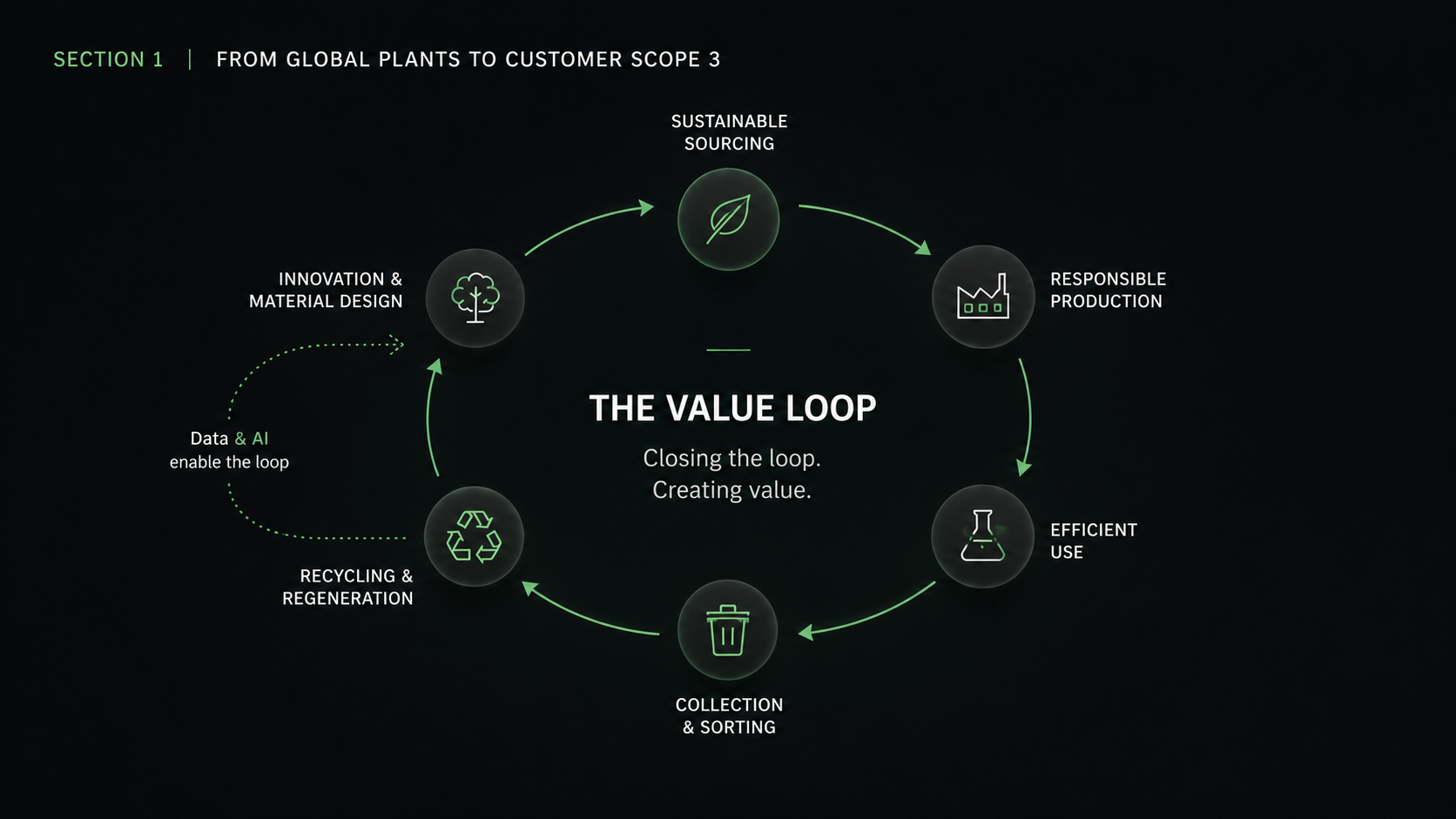
“To me, this is pretty much what I replied to before. I gave you the example of the circular economy and the chemical industry is a key industry of that. Without the chemical industry, we will never get to a circularity. We need to recycle every single material that we have in this country or in this world. And as I said, this not only requires the expertise and the materials and the technologies, but also the political decisions enabling those. There's so many obstacles that companies need to overcome if they want to contribute to this, right? Because if you look at this value chain, that's actually a closed loop value chain. It's like a value loop. And every company provides one step in that value loop. Maybe there's companies that contribute more than one step, but every single step needs materials, needs technology, needs knowledge, will provide jobs and will provide income. And I think this is a combination of factors that makes us key for this whole transition.
I really see that there's so much to gain, and I am in this industry that is key, and I just think that there's so much to gain, but also to develop. So really we can build this future together. And that's what I like. Sustainability is a bit under threat. To me, this is a political thing because the causes that we have, we have climate change, we have biodiversity crises, we have crises in biogeochemical flows, we have political things like the decline of democracies and the rise of autocracies. All this to me comes together and to me the answer is sustainability. So we can build a society and an economy that is there for people, for every single being.”
The "value loop" framing is the strategic core of the argument here. Circularity is not one company's project, but a chain where each link supplies materials, technology, knowledge, and jobs. This idea of a value loop reframes the industry's economic footprint from a liability to defend into the infrastructure the transition from linear to circular runs on.
2. From Global Plants to Customer Scope: Where Sustainability Becomes Value
If the industry is the enabler, the sustainability manager's job is to find the enabling levers inside an unusually fragmented business. Ute explains that the diversity which makes the work interesting also makes it hard.
“I think I touched on this already and in a certain way, the chemical industry is one of those few industries that is super diverse. If you look at the value chain that I just described, the many steps that are involved in the transformation, each of the steps requires a whole range of expertise, fields of expertise. And so the diversity is super beautiful and it makes it intellectually stimulating. But really also, as for me as a sustainability manager, that requires both a deep understanding of how the industry functions and also a good network of people that know their special fields. So really, this is a key thing. Have a good network of people that know what they're doing and that care about the cause. That brings me to my role within Tosoh. We in a way are representative of the diversity of that industry because, as I said, we cover or I am responsible for about seven business lines, that really looking from the outside have nothing to do with each other. So really we make ceramics, we make chemical reagents for rubber creation, we make a lot of chemical reagents, but we also make diagnostic instruments for the healthcare and clinic industry, but also pharma industry buys products for their manufacturing processes. The diversity of the product is one end, but it reflects also the diversity of the markets that we sell to. And within Tosoh, we really have a really deep understanding of those markets. And I have to have the overview and extract the key levers for where can we support our customers to be more sustainable and how can we get all this information from our customers to communicate internally for product development, for service development, all this.”
This positions sustainability as an interface that links what global operations produce to what specific customer markets need, and we can examine this further through looking at the carbon version of this interface.
“If you look at the sustainability-related activities and efforts that our mother company in Japan does, this is really substantial. So there is a huge decarbonization plan that is backed up by 600 million EUR investments. In order to transform all the hard manufacturing sites, all the plants and all that, to emit less carbon and to use less power input. Of course, this translates to a lower carbon footprint of our products. Now, I'm using the carbon example, right? But as I said, for the circularity example, it exemplifies the processes that apply to other aspects such as sustainable materials or you name it. Now get back to the carbon thing. It translates to a lower carbon footprint of our products, which now we sell in Europe. And that lowers the carbon footprint of our customers in their scope three. Both actually scope 3 and scope 2 because they also need to buy the energy to make their processes running. And that's how I see our role, really. We sell those products and we enable our customers to become more sustainable themselves. And that's really the interesting part. And now my role is, where are the priorities? Where can we really make the biggest impact? Second is how do we communicate this to our business partners? Because they need to know and it needs to be de-complexified because otherwise it's really too much to take usually. And the challenge now is to remain price competitive. Because when people hear sustainability or sustainable products or whatever it is, then they think of higher prices. Now, that might look like it at first glance, but if you take the entire calculation of your process costs into account, then a product that uses less energy, a product that uses less water, a product that has a lower carbon footprint and that lowers your entire scope two and three carbon footprint, that will actually bring a lot of cost savings at the end.”
The parent-company investment Ute references is important to consider here. Her insight is that those plant-level reductions do not stay with the producer, but instead flow downstream into customers' Scope 2 and Scope 3 accounts. A lower-carbon input is, mechanically, a lower-carbon customer footprint.
That is where the "de-complexified" point takes center stage. A product's carbon advantage lacks value to a buyer who cannot see it in their own data. Translating a manufacturer's process improvements into the Scope 3 line items a customer actually reports is precisely the kind of task that platforms built to manage product- and supply-chain-level emissions (Footprint Intelligence among them) exist to handle. The harder a sustainability claim is to verify, the less commercial value it carries.
Ute's view on price is an interesting moment in the conversation, and she returns to it with a clear playbook for making the green transition less risky.
“To be profitable and to maintain your business operations as a company, we need to ensure a cash flow. So that's what I would advise to any company. Maintain your existing product portfolio as is and continue selling it because that's how you lay the basis for everything else. Now, you can, for example, start developing a green line. That has so many advantages. First of all, you can gather experience. How do I develop this? What is it actually about? How do I define a green line for my products? Maybe there is one aspect that's green for this very alternative product, but all the rest is as the existing products. And then I add features over time. And then I also gain experience by selling them, what sells well. What do customers actually appreciate or not? The price question is often oversimplified, I think. Yes, I do acknowledge price sensitivity is really at the forefront and that's what essentially determines the decision of the purchaser. But if you look at the entire process efficiency, then a product that has a higher price to start with might come in cheaper because the use of energy, the use of water, the use of other ingredients for the process are lowered through that product. Now, the beauty is to start that conversation with a customer. So you have a lot of internal education to do. You need to make your own sales people aware. How do I start that conversation? How do I identify the levers that are relevant for my customer beyond the price? And that requires really great customer intimacy.”
The advice here is practical: protect the cash-generating core, build a "green line" alongside it to gather real market feedback, and shift the buyer conversation from sticker price to total process cost. This discipline’s internal elements are significant: a process of equipping the sales team to argue total cost of ownership, not just unit price. Sustainability value that cannot be articulated commercially is often more difficult to realize.
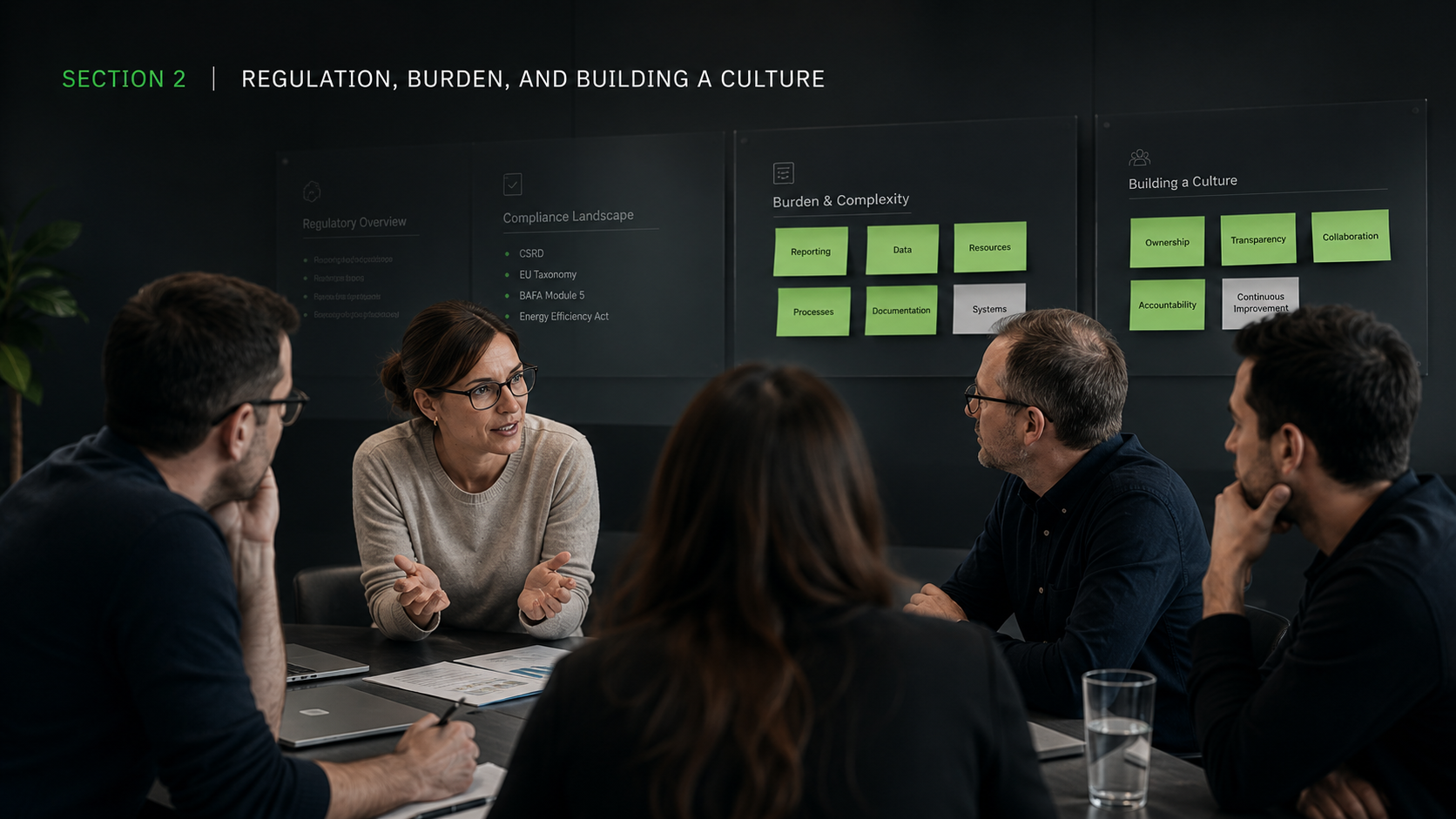
3. Regulation, Burden, and Building a Culture That Lasts
Ute explains that her role was, in large part, created by regulation, and then reshaped by the rollback of it. Her account of the CSRD and the omnibus package is a clarified read on what reporting rules cost a small, complex business.
“As I said, my role was inspired a lot by the reporting requirements through the CSRD. And then we were kind of stopped in the middle of this run because the omnibus package arrived. It's not like it arrived all of a sudden, but still we saw it coming and then we saw, okay, there is probably going to be substantial changes in the scope and the companies having reporting requirements. So we said, okay, let's wait. What is actually required from us? Like you have to take into account that we are both a small company or small set of companies, I should say, and have a complex structure. I said there's three sites and there are seven business lines, and we are managing all this with 200 people. So this is a challenge to do a double materiality analysis, to manage all the data, to first of all understand which part is actually applicable to us. That's the main question usually. So that's why we decided, okay, so far this has been more of a burden and a workload rather than a positive and valuable output for us. And that's why we said, okay, we stop here, we wait, and then we see if we're still in scope of that regulation. If we're not, then we can actually focus on other stuff. And that's what happened. So we had invested a lot of time doing the double materiality analysis, and then we said, okay, let's stop, and then there's no need to do this anymore. Of course, there will be a voluntary report, but there are so many other regulations that push themselves into priority that this is the main driver. And I really am one of the people that is quite convinced that the CSRD is very useful, actually. But it's very stakeholder driven and creates a lot of burden for small companies.”
Here Ute’s judgement call was vindicated by the policy itself. The omnibus package raised the CSRD threshold to companies with more than 1,000 employees and over €450 million in net turnover. These changes were estimated to remove around 80% of previously in-scope companies. A roughly 200-person business is now almost certainly out of mandatory reporting scope. The strategic lesson Ute models is timing: when a regulation is visibly in flux, completing a full double materiality analysis on the old thresholds can mean concentrating effort into a deliverable that later disappears.
But the regulatory engine switching off raises the harder question: without a compliance mandate, what keeps sustainability alive inside a company? Ute's answer is one that centers culture and is anchored to value.
“It comes down to sustainability needing to bring value for the company. So as a sustainability manager, I'm an idealist. I really want to bring value to society and to the world, and I care. And I've come to understand that this also translates to value for the company. Because we, first of all, we provide, we make great products really, and those products are needed for this world. But how we can bring that value to society beyond what we already do and combine that with not doing any harm? That's really the tough question. And the value for the company is really the lever that makes people listen. Because not everybody is like me and not everybody needs to be like me, really be an idealist, but people need to listen and start thinking about this. How do you do this? I started doing internal workshops just to start a conversation internally. What do we actually talk about? And I think this needs to be done on a regular continuing basis. And then in parallel, try to provide information, how do we deliver this value? How can we maybe access other customers that used to be less interested in our products? And they might be more interested because we provide an extra value through sustainability. These are the kinds of things. And then once people have started thinking about it, they can actually come up with ideas. And then you also hear complaints about, oh, we've been doing this for a long time, but actually we shouldn't. So this is what they do. And then I end up not having all that much time to do all this. And that's actually the next step that I would like to implement at some point, to kind of create a mindset within people so they can actually take action themselves. It's not all on me. It's about a business culture that I want to establish.”
The closing ambition is the one most sustainability managers will recognise: distributing ownership so the function does not live or die with a single person. Workshops, value-framed business cases, and a steady flow of internal conversation are how Ute moves from being the sustainability bottleneck to building a culture where colleagues surface ideas and inefficiencies themselves.
When mandatory reporting recedes, the data discipline it requires should not. The double materiality analysis Ute paused still represents a clear map of where a company's impact and risk concentrate. Whether pursued for compliance, a voluntary report, or simply better decisions, doing that work on lean infrastructure rather than reconstructing it from spreadsheets each cycle is what keeps a 200-person team from drowning in it.
Ute's through-line is consistent from chemistry to culture: sustainability earns its seat when it is framed as a value. The industry she works in is, by her account, structurally central to the transition. The central question now is how to prove the enabler case. Who makes that case inside your company when the regulation is no longer making it for you?