EmpCo Explained: What You Need To Know To Protect Your Business
This September the EU Empowering Consumers Directive (EmpCo) comes into application for the first time, regulating the environmental claims of B2C businesses in Europe and cracking down on corporate greenwashing. EmpCo has been in the works for a while now, having been conceived and first published in 2024 and integrated into EU Member State laws this past March. However, what the regulation is asking for is significant, and many questions remain:
What types of claims are punishable?
How will invalid claims be punished?
What are companies allowed to claim about their sustainability?
What do companies have to do to prepare for the implementation of these rules?
The article will tackle these questions and provide you with an overview of the EmpCo regulation, from what it’s is asking for to what it will punish. Keep reading to find out how you can protect your business and streamline the task of EmpCo compliance.
What Is EmpCo Asking For?
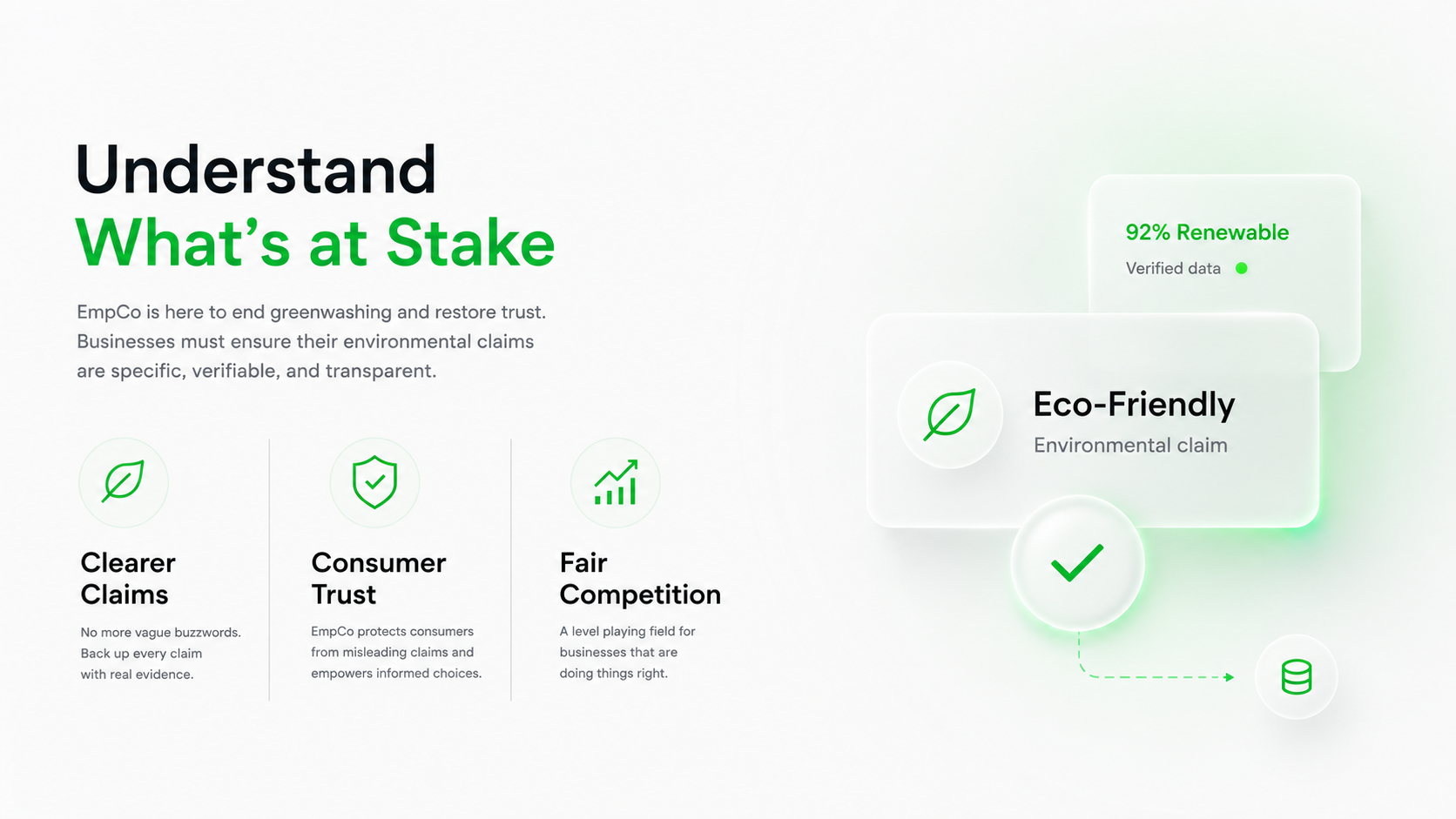
The primary objective of EmpCo is to tackle corporate greenwashing claims that mislead customers into believing that they are buying from a sustainable business. To execute this, the regulation forces businesses to replace any generic claims with specific ones that can be backed up with verified data. This means that vague buzzword phrases such as “green”, “eco-friendly”, and “low carbon footprint” have to be either axed from company copy, or edited in a way that makes them purely evidence-based.
There are three distinct areas that need review and amendment:
Un-evidenced claims: as mentioned above, buzzword terms such as “eco-friendly” cannot be used unless substantiated with real evidence. In a recent FAQ, the EU Commission defined what an environmental claim is to make it easier for businesses to identify the areas they need to review:
An important detail here is that environmental claims are not exclusively written text. In order to properly comply, businesses also have to review any diagrams or graphics with environmental implications and evidence them with verifiable data.
Labels and badges: any environmental labels or badges must be verified by either a public organization or a reputable third party organization. All labels should be audited and any that are self-made or from an uncertified scheme should be erased from company copy and content.
Future promises: these refer to claims such as “net-zero by 2030” or “100% climate neutral by 2027”. Promises like these are only permissible if they are backed up by a clear implementation plan alongside a transparent criteria constructed for measuring the success of and progress of said plan.
Still sounding vague? Here are some examples:
A claim that is not allowed:
“Our company prides itself on being eco-friendly and sustainable”
Here, “eco-friendly” and “sustainable” are not backed up with verifiable sources or data. EmpCo would classify this claim as too generic and potentially misleading to customers, as it’s too broad for them to verify.
A claim that is allowed:
“Our company prides itself on matching 92% of our energy to renewable resources”
The figure is specific and can be checked against mandatory annual reports.
A claim that is not allowed:
“All of our packaging is sustainable”
This is a vague statement lacking evidence. Here, “sustainable” is also too broad of a term.
A claim that is allowed:
“Since March of this year, all of our packaging has a minimum Grade C recycling performance”
Focused, time-specific claim that can be checked against publicly available information on the materials that go into the company products.
The Consequences of Non-Compliance
Complying with EmpCo is mandatory for all B2C businesses in the EU, and as with all legislations, non-compliance comes at a cost. Claims that cannot be adequately substantiated should be reviewed and may need to be revised or removed.
Punishment varies depending on the member state. Each state is responsible for enforcing EmpCo in line with existing national laws and regulating the claims of its businesses. Broadly speaking, consequences of non-compliance include the following:
Fines - depending on national implementation and the circumstances of an infringement, companies may face fines or other enforcement measures under applicable consumer protection laws.
Reputational damage - the regulatory landscape is expanding and it is the businesses that keep up that will have a stronger market position going forward. Falling behind can negatively impact a company’s reputation and dissuade customers and investors from engaging.
Legal action - civil courts are permitted to take action against companies who do not comply with the regulation.
Removal of claims and products - false and misleading claims may be removed. This also extends to products that are marketed with these false claims.
In Germany specifically, competitor companies, civil courts, Wettbewerbszentrale, and any qualified consumer organization are also permitted to take legal action against a non-complying company.
These consequences can have significant long-term impacts on the success of your business and seriously threaten the strength of your market position. With under three months now until formal implementation, preparing your business for EmpCo should be a top priority. However, with the significant scope that it requires companies to review and the specificity needed for compliant claims, the task of compliance can feel overwhelming.
Taking Action - And Automating It
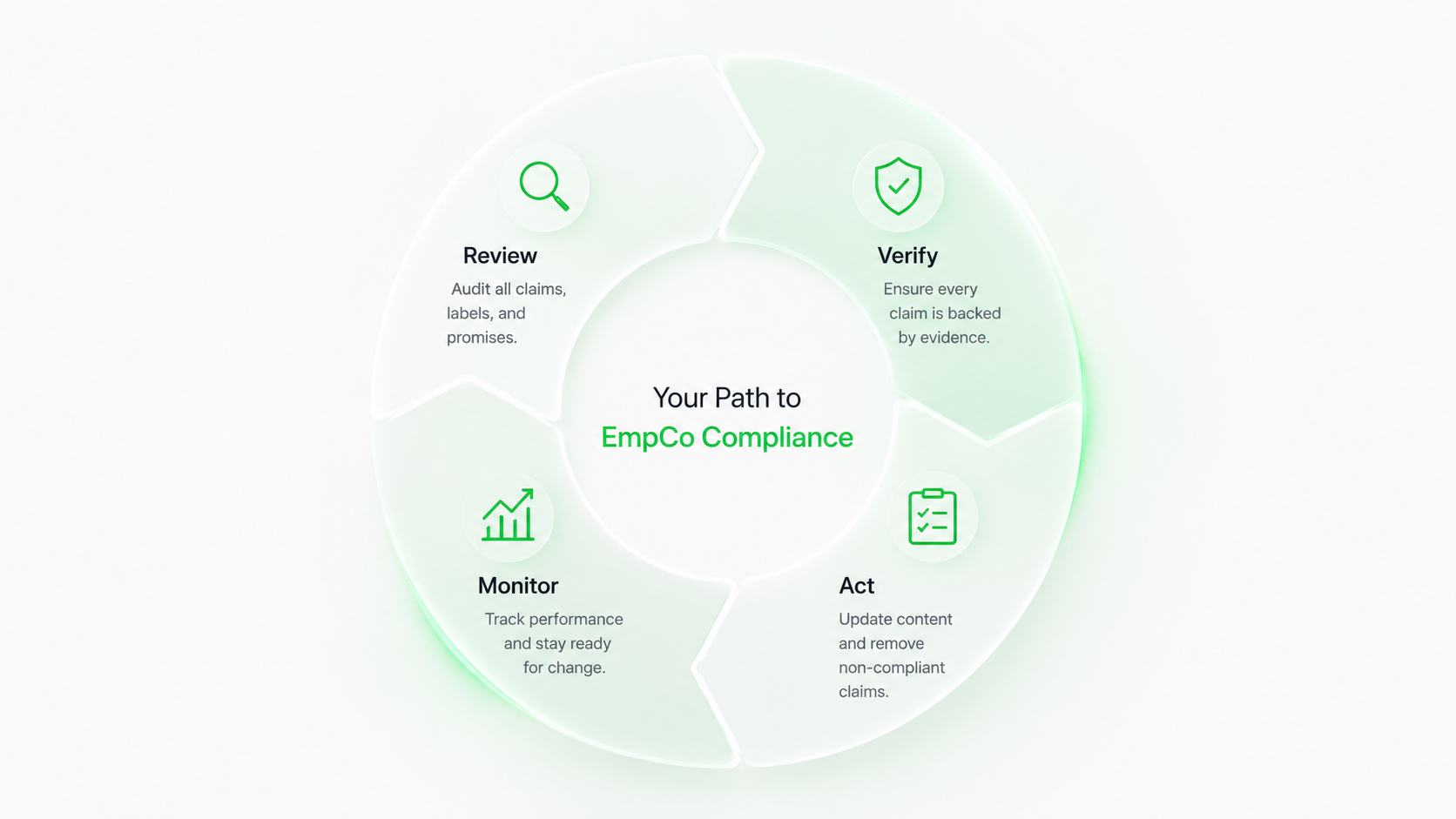
The task businesses are faced with now is one of inventory and audit. Companies need to trace every environmental claim they have made to easily accessible and high quality data points in order to protect themselves from the consequences of non-compliance. The magnitude of the task will depend on how many insufficiently evidenced claims have been made and how accessible the necessary evidence is.
In order to prepare for the regulation coming into full force, companies need to:
Check all the claims that they have made and find the data that can back them up. Keep an eye out for common sustainability buzzwords such as “green”, “eco-friendly”, and “”sustainable” and flag them immediately. These are the words that are most typically associated with broader conceptual claims, so they should almost always be edited out of company copy unless they can be concretely verified. A centralized reporting system or platform lends itself well to this task. Fractured data stored in isolated spreadsheets will slow down the verification process and make your evidence more difficult to audit.
Emphasize focused, verifiable targets. These should be time-bound, evidenced by publicly available sources and documents, and the verification methodology should be consistent. Focus on areas with the highest exposure first, such as best-selling product pages, the initial company landing page, or social media content with high engagement rates. These will likely also be the highest risk areas, as the greater the exposure the more frequent consumer engagement will be.
Set up a measuring and verification system in line with other regulations. Many regulations already require a public audit trail, such as the CSRD, EUDR, and PPWR (check out our other blog insights for in depth breakdowns on these regulations). Use mandatory reporting as a starting point to organize evidence and make sure any data referenced in copy or content lines up with what has been publicly submitted to these regulations. Claims that are inconsistent, insufficiently substantiated, or potentially misleading may attract scrutiny from regulators, competitors, or consumer organizations.
Secure the reporting process so that evidence data is easily retrievable. Independent spreadsheets and data buried in lengthy email chains are only going to make the task more difficult. A reporting platform that stores everything in the same place will have the opposite effect. High quality data is the key to concrete verification. When that data is easier to trace, access, and audit, EmpCo compliance becomes easy.
The timeline is shrinking, and audits now need to be carried out with speed. Manual review and retrieval processes are going to slow this task down significantly and may not suffice for the nearing September deadline.
Our specialized EmpCo Agent has been designed to support your business’ preparation for the approaching deadline. It works across the reporting platform, sourcing the data you need to verify environmental claims and ensuring any sustainability statements align with EU requirements. Its abilities also include:
Answering questions specific to your company.
Checking your claims against EmpCo regulations.
Building comprehensive future implementation plans that will hold up.
This cuts the task in half. Rather than taking inventory of all of your company’s data and selecting the relevant figures manually, our agent takes control of the retrieval process and provides you with the evidence you need immediately.
A TripShift study exposed that sustainability managers currently spend 85% of their time collecting and cleaning data for review. This leaves only 15% to make decisive emissions reductions and properly push sustainable development goals forward. An intelligent reporting system that can take care of the collection process for you leaves your business in a stronger position to make real progress.
Conclusion
EmpCo has set up a significant task for B2C businesses, but it is a task that can be made easier through intelligent reporting. The scope of what the regulation is asking for is relatively large, and the data it needs to be properly complied with is expansive. With the deadline drawing closer, manual retrieval and review is likely insufficient.
The question is now not of whether businesses have the resources to comply, but whether they can extract the necessary evidence from these resources in time.
To find out more about our EmpCo agent, visit our website today and avoid the cost of non-compliance.