SBTi Net-Zero Standard 2.0: What The Updated Framework Mean For Your Targets
The SBTi published Version 2.0 of the Corporate Net-Zero Standard on 11 June 2026. It’s set to formally take effect on 1 February 2027, though Version 1 will stay open for target setting until the end of 2027. The definitive deadline is 2028, when all companies will be required to use V2.0. Today more than 11,000 companies and financial institutions have set targets through the SBTi system, and they will now need to come up with a transition plan to prepare themselves for the V 2.0 takeover.
The SBTi's own framing is that the standard has moved from ambition to implementation. They describe the new standard as “an action framework built to support decision-making” rather than a scoring system oriented around pledges before progress. The updates reflect the problem areas that have appeared over the years, tending to concentrate themselves in the delivery phase rather than the planning phase. The objective is to create a standard that encourages action even if that action begins on a smaller scale.
At first glance, V 2.0 looks strict. The criteria has expanded, scopes have been separated, and there’s more to report. However, it is actually more forgiving than it first appears. The “catch” is that the obligation to evidence targets and how they fit into a company’s operational reality has grown. V1.3.1 interrogates the targets themselves and looks at a company’s ambition to cut emissions. V2.0 looks at what has been put in place to achieve those targets, with audited data taking center stages. Struggles with V 2.0 will likely correlate to struggles with evidence rather than ambition.
The complexity is deliberate and reflects a new flexibility when it comes to defining targets. Obligations now differ by company size and by the income classification of the country your parent company is incorporated in. Two companies in the same sector can face different requirements under V 2.0. This raises three questions:
What has actually changed between V1.3.1 and V2.0?
Which set of obligations applies to my company?
When do we have to move, and what does the switch cost?
This article works through each one.
What's New?
Targets are now pursued on a best-efforts basis. Under V1.3.1, a target was set and then pursued in a straight line. The predictable result was a large number of headline pledges (net-zero by 2030, 50% cuts by 2028) that companies set in good faith and then ended up missing as supply chain complexities, technology availability, and investment cycles refused to cooperate. The new standard endeavours to decrease this figure through focusing on tailored goals and verifiable progress.
V2.0 destabilizes the “straight line” target trajectory. Companies are expected to use all available levers to reduce their emissions and to disclose any dependencies. This might be things like technology constraints, supply chain capacity, policy, finance, etc. Progress is assessed at the end of each five-year cycle, barriers have to be explained, and higher emissions in the target year simply mean steeper reductions in the next cycle. With this new system, effort comes before achievement.
Scope 1 and Scope 2 have been separated. V1.3.1 allowed a combined Scope 1 and 2 target which was a convenient detail, and one of the reasons V1 remains attractive for many. It also let cheap grid-electricity gains cover up a potentially flatter operational trajectory. V2.0 requires separate Scope 1 and Scope 2 targets from every company, and separate Scope 3 targets from Category A companies. This runs line with the increased focus on effort and transparency and highlights a recognition that Scope 1 and 2 often require different implementation pathways for emissions cuts and sit on different timelines.
The two scopes now run on different logics. Scope 1 near-term targets must cover 100% of emissions and reach residual levels by 2050 at the latest. There are three routes through which this can be achieved: absolute linear reduction, sector emissions-intensity pathways, or asset transition targets for companies whose capital stock doesn't run in a totally linear manner. Scope 2 targets, also covering 100% of emissions, run on low-carbon electricity alignment or absolute reduction, with contracting rules tied to deliverability regions. Hourly matching of contracts to consumption is strongly encouraged here. Companies with significant electricity use are required to report the share of consumption matched hourly, though this is also promoted to companies who don’t fit within that bracket.
Ongoing Emissions Responsibility gives carbon credits a defined role. Under V1.3.1, credits sat outside the target entirely. They were reported separately and didn’t really count for anything against near-term or long-term targets. Their purpose was only to neutralize residual emissions or fund mitigation beyond the target. V2.0 shows some continuity as it also keeps credits out of the target; however, this new standard builds voluntary recognition program around them that will put companies who use credits for reduction in a more advantageous position.
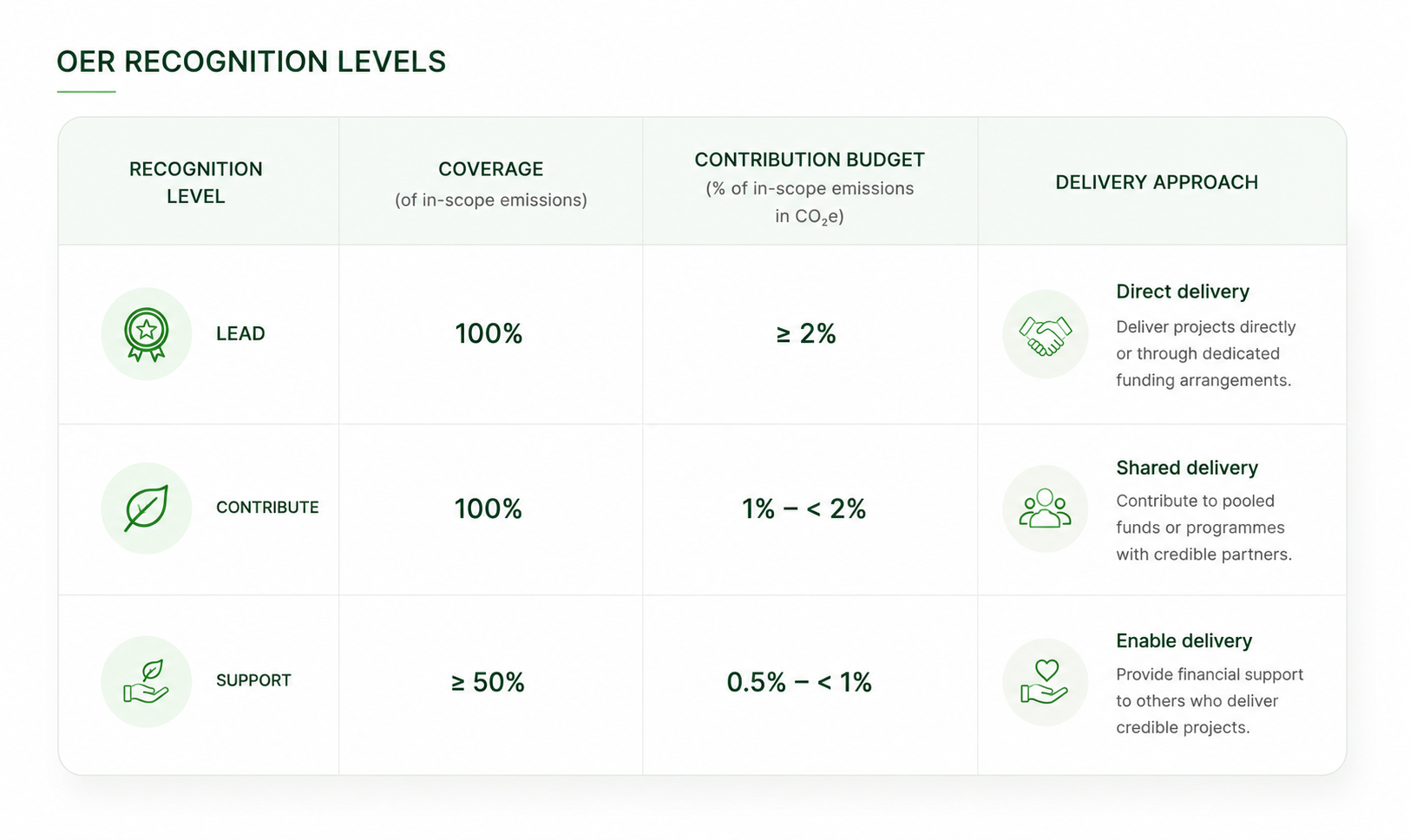
Coverage is calculated on the physical GHG inventory across five consecutive years of Scope 1, 2, and 3 emissions, and assessed at end-of-cycle. There are three levels:
Engaged - cover at least 1% of total ongoing emissions, either through verified mitigation outcomes equal in volume to emissions covered, or a contribution budget based on those emissions (SBTi recommends at least $20/tCO₂e, but sets no mandated price).
Advanced - cover 10% of total ongoing emissions including 100% of Scope 1 and 2, through equivalent verified mitigation outcomes or a contribution budget of $20/tCO₂e.
Leadership - for Category A, cover 100% of total ongoing emissions with a contribution budget of $80/tCO₂e, use it to support verified mitigation equal to emissions covered, and direct any remaining funds to further verified mitigation or other eligible climate action. Category B companies can reach Leadership at 10% coverage including 100% of Scope 1 and 2, at the same $80 benchmark.
Participation is optional, but declining must be formally explained. Every company must declare its intent at Target Validation and submit an explanation to the SBTi if they choose to opt out. A separate post-2035 requirement increases the pressure. From this year, support for eligible carbon removals should be equal to 1% of ongoing emissions, rising to 100% by the net-zero year and no later than 2050.
Obligations now split by company category. Category A companies must set near-term Scope 3 targets, obtain at least limited third-party assurance of target base year data and of the data substantiating progress assessments, and disclose a transition plan when targets are validated (with up to 15 months' flexibility). For Category B, Scope 3 targets, assurance, and transition plan disclosure are optional - though the SBTi encourages them to go further than the minimum.
V1.3.1 placed the heaviest burden onto the submission. It was important to get the methodology right, show clear target validation, and publish the number. V2.0 places this burden on the near-term timeline, or five years that follow. The flexibility of the new standard is a significant positive addition. With three Scope 1 routes and justified Scope 3 exclusions for categories under 5% of the inventory or activities you have no practical influence over, and credit for progress that falls short of the line, companies have a lot more space to set realistic targets. The constraint is that every piece of that flexibility has to be substantiated and disclosed, which puts more pressure on reporting.
Understanding the OER recognition levels
Where Does Your Company Fit In?
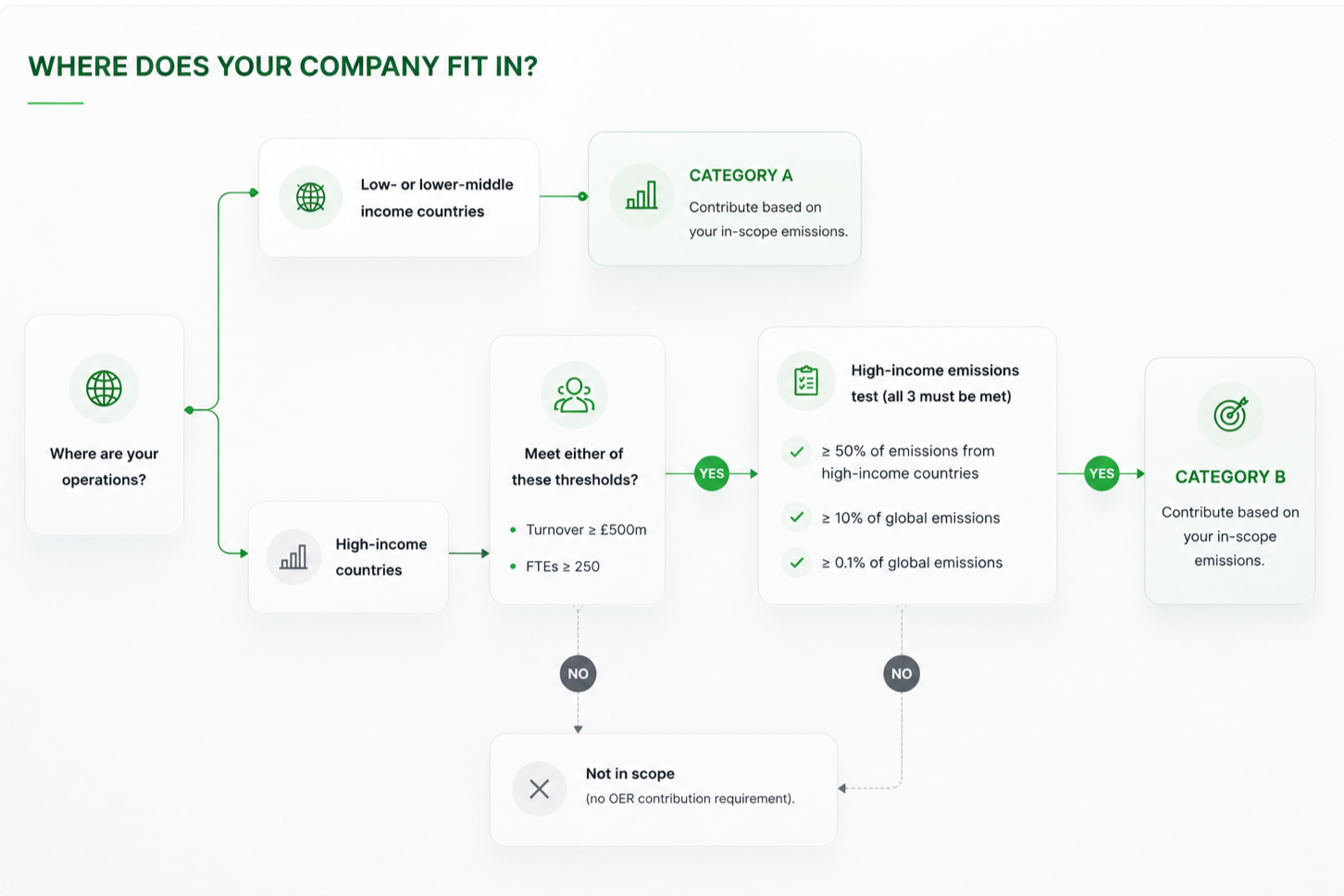
The category system exists because a €10 billion manufacturer and a 40-person consultancy do not have the same levers, and treating them identically produced a standard that was easy for some companies and near impossible for others. Category A covers large companies everywhere and medium-sized companies in high-income countries. Category B covers small companies everywhere and medium-sized companies in lower-income countries. The more resources a company has, the larger the obligation to decarbonize is.
The thresholds:
Any country. Category A if the company meets at least one of: net turnover ≥ €450 million, or FTEs ≥ 1,000.
High-income countries. Category A also captures companies with Scope 1 and 2 emissions ≥ 10,000 tCO₂e, or that meet at least two of: balance sheet ≥ €25 million, net turnover ≥ €50 million, FTEs ≥ 250.
Everything else is Category B.
Thresholds are assessed on consolidated group figures alone, so a small subsidiary of a large parent does not automatically get sorted into Category B. They are averaged across the two most recent financial statements and converted into euros if the company reports in a different currency. The category is assigned at registration, reconfirmed at validation, and will stay with a company for the full five-year cycle before being redetermined when new targets are set.
The emissions threshold is the criterion that can be confusing. A mid-sized company in a high-income country with 10,000 tCO₂e of Scope 1 and 2 emissions fals into Category A regardless of turnover or headcount. This could pull Scope 3 target setting and third-party assurance into scope for organizations that have limited experience with both.
How to figure out what category your company falls into
Accommodating the New Standard
A focus on action translates to a focus on evidence. Progress needs to be properly substantiated to have value.
V 2.0 sets out a long list of reporting obligations. Target base year data needs limited assurance for Category A companies. End-of-cycle progress assessments need assured data behind them. Full Scope 1, 2, and 3 inventories go in at the target year, not just the scopes you set targets against. Barriers to progress have to be identified and explained alongside the actions taken to address them.
The leeway that SBTi have allowed in keeping V 1.3.1 relevant until late 2027 reflects the size of the V 2.0 reporting task. It requires a comprehensive report on the base year that can be used as a secure starting point, a data trail that survives close scrutiny, and an ongoing view of the gap between trajectory and target while there's still time to act on it. Platforms such as Footprint Intelligence are built to manage inventory, targets, and progress in one system are better positioned to support this than spreadsheets that reconstruct history after the fact. Our targets and strategy capabilities are built around exactly this problem: setting SBTi-aligned goals and designing a clear, evidenced roadmap to reaching them.
Deadlines
The timeline allows some room, but transitions to V 2.0 still need to be planned now.
V2.0 is effective from 1 February 2027 while V1 remains open for target setting until the end of 2027. This means that companies mid-planning against V1.3.1 can still submit on that basis, and the SBTi actually encourages them to do this. Validated targets stay valid for their timeframe. The V2.0 innovations such as company categorization, flexible implementation approaches, progress assessment, and OER become available to V1.3.1 users from early 2027, so there is also the option to merge both standards if that will ease the transition.
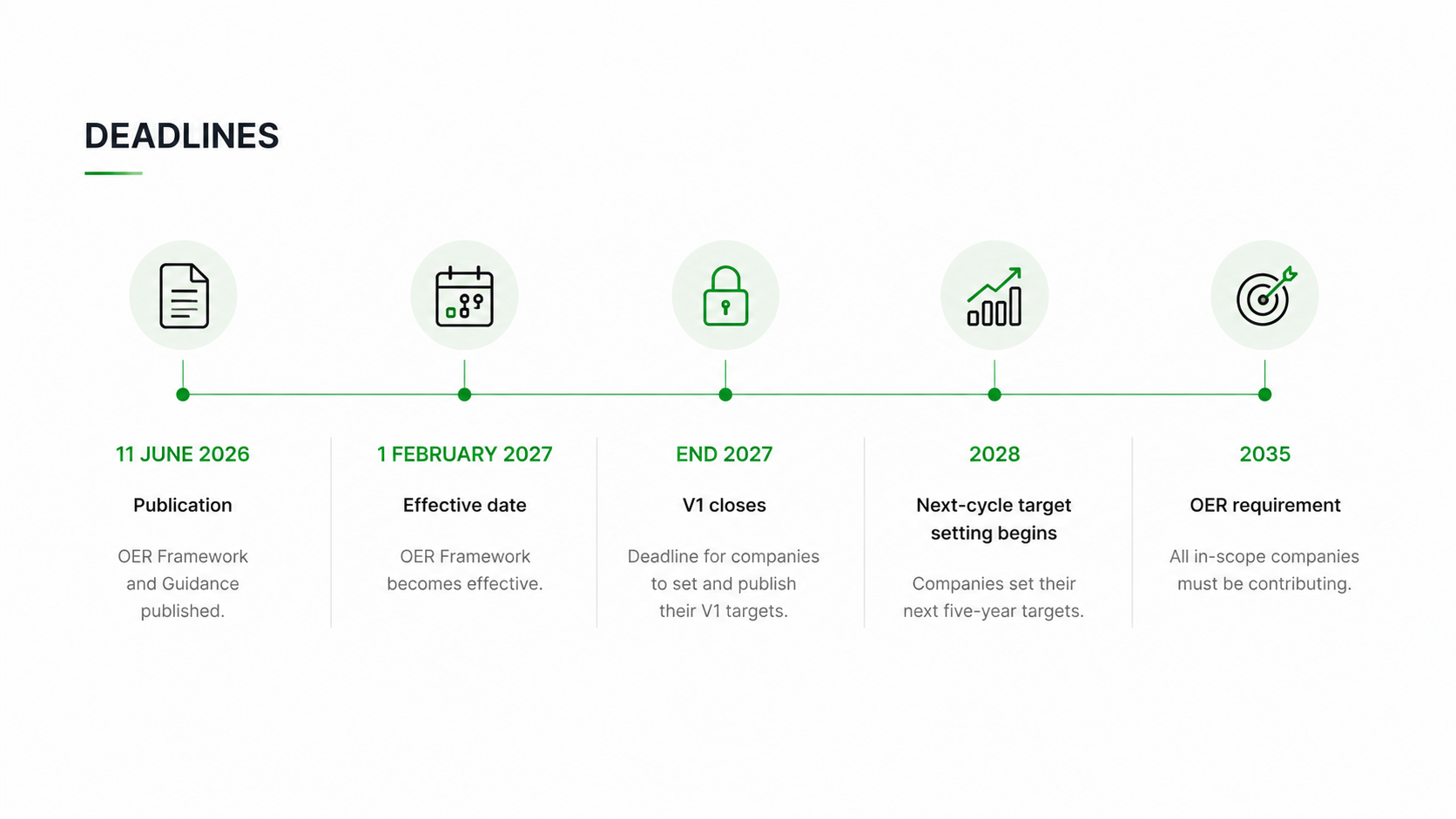
Companies with 2030 targets are recommended to keep using V1 for the current cycle and start setting 2030-2035 targets under V2.0 from 2028, to allow a good amount of time for efficient implementation.
For companies that want to stay ahead, 2027 is the year to confirm your category, get base year data to a standard an assurance provider will be satisfied with, find out whether Scope 3 target setting is now mandatory for you, decide your OER position before you're asked to justify it, and start building a transition plan. Companies that treat the transition as a 2028 problem will spend 2028 rebuilding data foundations instead of reducing emissions, and under a standard that assesses effort across a five-year cycle, a slow start is a disadvantage.
V2.0 judges you on what you can show rather than what you can promise. The question is now whether your company can produce that evidence in time.