Sustainability as a Business Driver: What the Hamburg Sustainability Event Revealed About the Next Phase of Corporate Sustainability
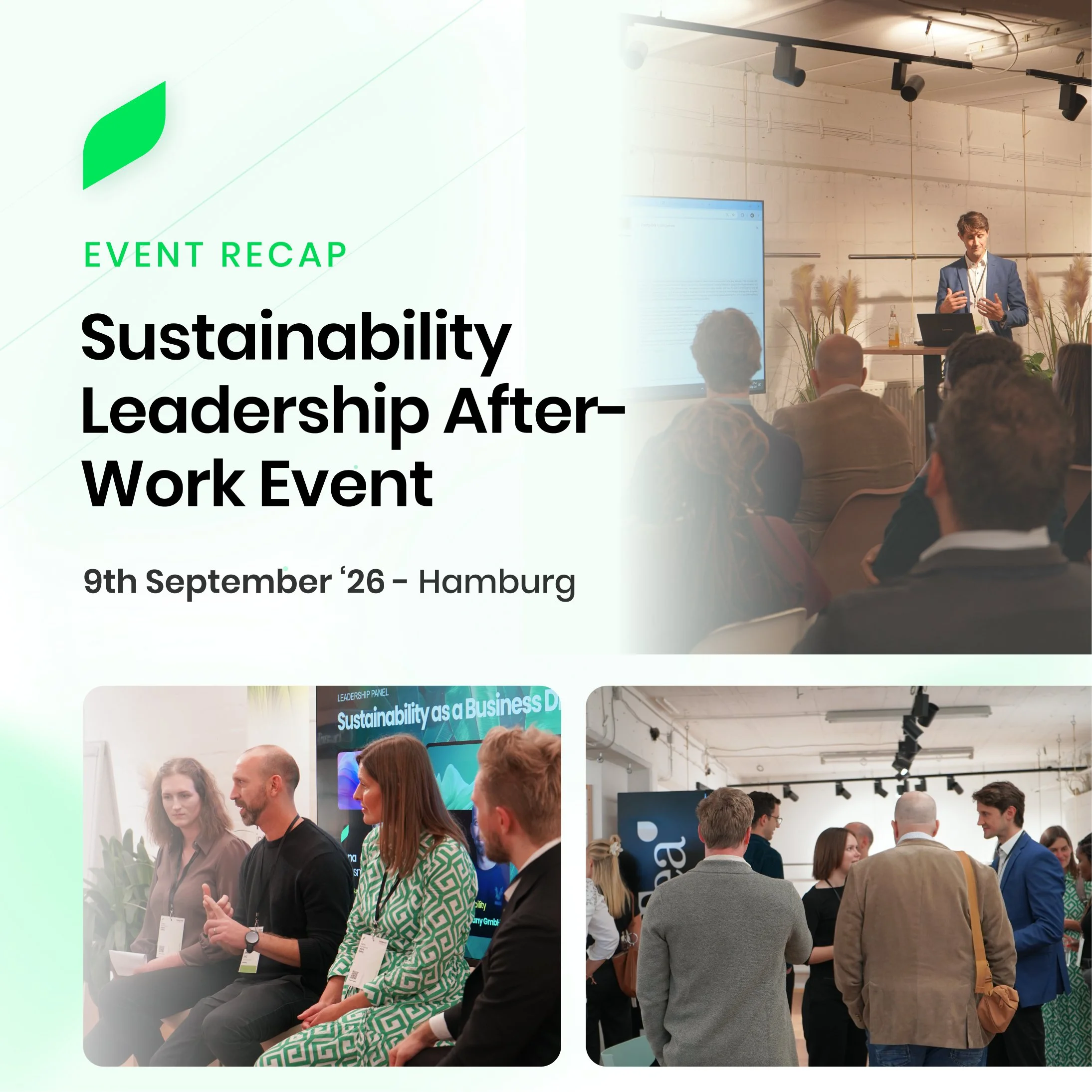
Event recap: Footprint Intelligence Sustainability Leadership After Work Event, Hamburg, 9 September 2026
Introduction: A room that looked like the future of sustainability work
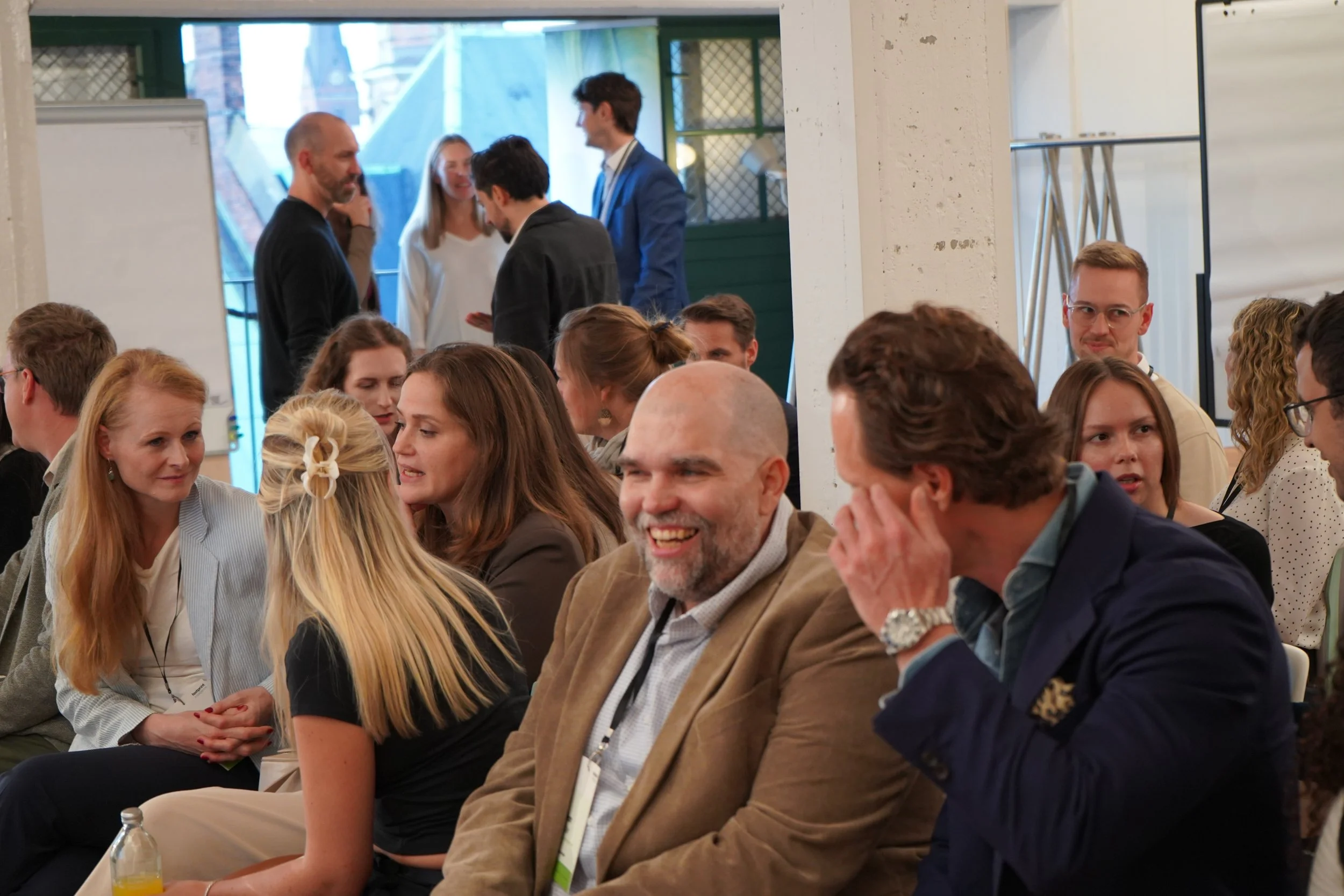
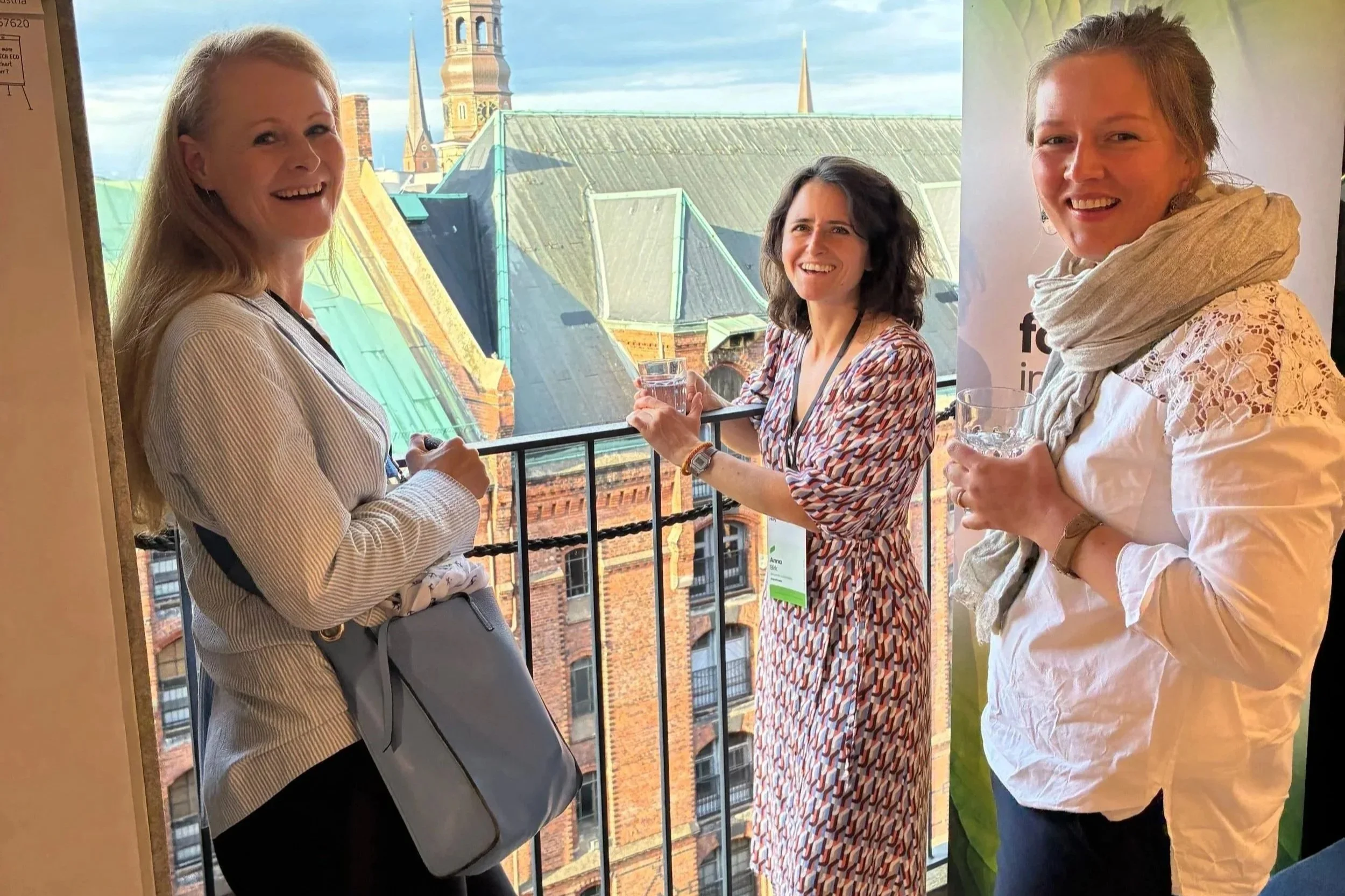
High above the red brick warehouses of Hamburg's Speicherstadt, Footprint Intelligence brought together around thirty leaders for an evening dedicated to a single question: how does sustainability move from the periphery of a company into its commercial and operational core?
What made the evening unusual was not the view but the composition of the room. Roughly a third of the guests did not come from a sustainability department at all. They came from procurement, supply chain, corporate strategy, compliance and risk management and product innovation. The industries represented ranged from consumer goods, food processing and packaging to semiconductors, aerospace, medical technology, diagnostics, biotechnology, energy, battery manufacturing, specialty chemicals, textile services, media and advertising, film funding, fashion, sports marketing, asset management, certification and assurance, and shared mobility.
This mix was deliberate. Sustainability has spent a decade being discussed as a reporting topic among sustainability specialists. In Hamburg it was discussed as a cost topic, a procurement topic, a tender topic, a risk topic and an innovation topic, by the people who own those agendas. The result was an unusually honest picture of where corporate sustainability stands in 2026, and where it is heading.
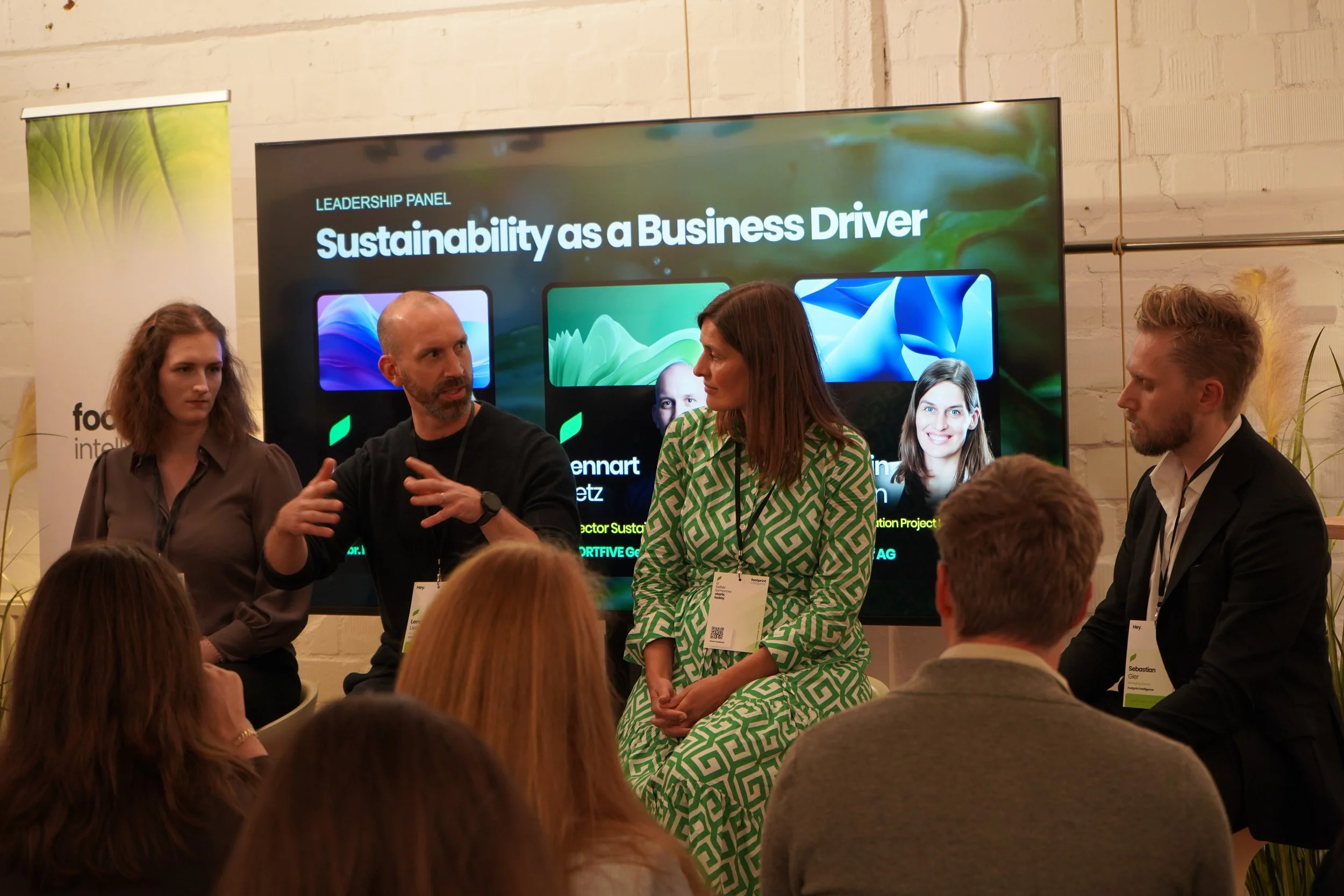
This article captures the evening along its three main parts: the live research on the state of sustainability leadership, the leadership panel with Lena Baasner (Gebr. Heinemann), Lennart Lietz (SPORTFIVE Germany) and Kathrin Hortian (Beiersdorf), and the expert table talks that followed.
The shared challenges in the room
The first half hour of any event is usually small talk. In Hamburg it turned almost immediately into a diagnosis of the same operational problem, told from many different industries.
Sustainability data remains the daily grind. Participants described fragmented systems, inconsistent data quality, suppliers who cannot or will not provide product level emissions, Scope 3 collection that still runs on manually maintained spreadsheets, and the effort of stitching data together across finance, procurement, logistics and operations.
Regulation has not gone away, but its role has changed. The Corporate Sustainability Reporting Directive and the European Sustainability Reporting Standards, the EU Taxonomy, the Packaging and Packaging Waste Regulation and the rules on sustainability claims were all present in the conversations. Yet the framing had shifted noticeably. The question was less "what do we have to report" and more "what risks does the business face, what do customers require, and what do we actually need to implement".
Two further patterns stood out. Participants from business to business industries described a communication problem that consumer brands rarely face: how do you make a technical sustainability improvement in a component, a chemical or an inspection system visible and valuable to a professional buyer, a tender committee or a downstream partner? And across all industries there was a clear maturity gradient. Organisations at an earlier stage are still building governance, compliance structures, tooling and internal ownership. More mature organisations have moved on to value creation, integration into operating processes, business cases and collaboration with customers and suppliers.
The State of Sustainability Leadership: live research across industries
As part of Footprint Intelligence's ongoing State of Sustainability Leadership research programme, which we run across our leadership events to build a comparable picture of how sustainability is organised and prioritised in practice, participants answered four questions live during the market and technology session. The Hamburg cohort was a cross industry group of practitioners in sustainability, procurement, supply chain, strategy, compliance, innovation and risk. Because it is a leadership cohort rather than a random sample, and because several questions allowed more than one answer, the percentages below refer to the share of all votes cast. They should be read as a signal from the people who actually run these agendas rather than as a representative statistic for the wider economy. That signal was remarkably clear.
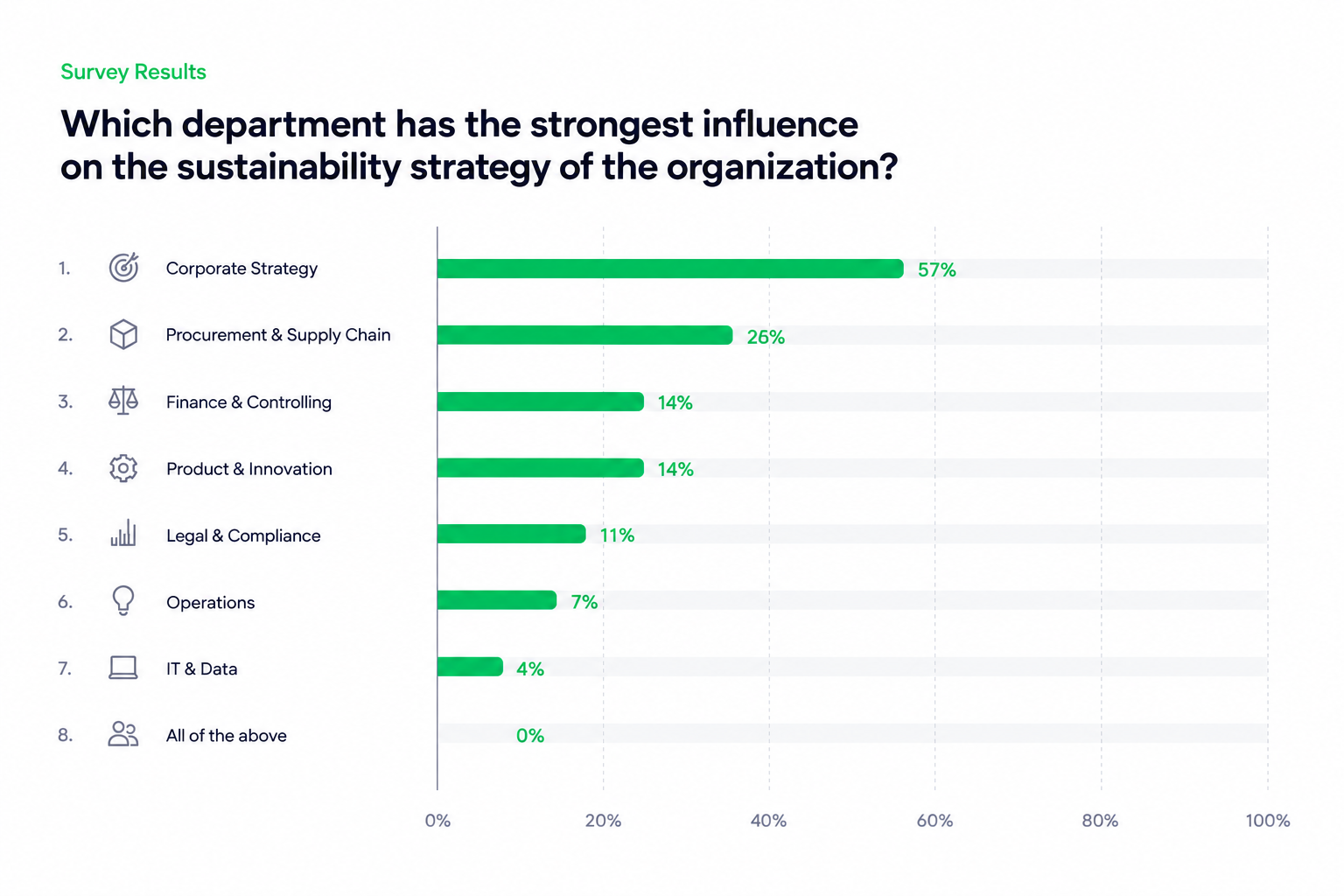
1. Who influences sustainability strategy?
Participants ranked corporate strategy first, ahead of procurement and supply chain in second place and finance and controlling in third. Product and innovation followed closely, then legal and compliance, then operations. IT and data ranked a distant seventh, and the option that no single function dominates, "all of the above", came last.
Two things stand out. The function seen as most influential is not a specialist sustainability unit but corporate strategy, which suggests that in this cohort sustainability is already being steered from the centre of the business. And the three functions at the top of the ranking, strategy, procurement and finance, are precisely the functions that own growth, supply and cost. Sustainability strategy is being shaped by the people who control the operating model, not primarily by the people who write the report.
The absence that the room noticed was sales. The commercial function did not appear among the options at all, and the discussion that followed treated this as telling. Sales is the function most directly exposed to customer questionnaires, tender criteria and supplier requirements, yet it is rarely thought of as a shaper of sustainability strategy. Several participants concluded that this is the next function to bring inside the tent.
2. Which topics are highest on the agenda?
Regulatory compliance dominated, with 32 percent of all votes, more than twice any other topic. Yet the topics one would expect to sit alongside it were near the bottom: sustainability reporting drew 7 percent and carbon accounting only 2 percent. Compliance, in this room, means something broader than the annual sustainability statement. It means packaging rules, claims rules, due diligence obligations, the taxonomy and sector specific requirements, obligations that touch products, suppliers and marketing rather than only the reporting department.
The second cluster is transformation. Strategy and business impact came second overall with 14 percent, and decarbonisation and product sustainability drew 11 percent each. Together these three transformation topics account for 36 percent of votes, slightly more than compliance itself. A third cluster, resilience, is smaller but clearly present: climate risk and resilience and suppliers and resilience drew 7 percent each, with Scope 3 and data quality at 9 percent.
Read as a whole, the agenda has a distinct shape. Roughly a third compliance, roughly a third transformation, and the remainder split between data and resilience. Reporting for its own sake has slipped to the margin.
3. Where do teams spend their time and resources?
Data validation and data quality is the single largest consumer of capacity at 23 percent, followed by coordination across functions at 18 percent. Internal data collection, reporting, and implementing and tracking measures drew 14 percent each. Audits and questionnaires and strategy and transition planning drew 7 percent each, and Scope 3 as a named category only 5 percent.
The aggregate is the most important number of the evening. Add together internal data collection, Scope 3, data validation, audits and questionnaires and reporting, and 61 percent of the capacity of the sustainability teams in the room goes into producing and checking data. Add coordination across functions, the work of aligning finance, procurement, operations and legal so that the data can be produced at all, and the share rises to 80 percent. Strategy and transition planning together with the implementation and tracking of measures, the activities that actually change emissions, account for the remaining 20 percent.
This is the two circles slide expressed in numbers: four fifths collection, validation, reporting and coordination, one fifth impact and transformation.
The low figure for Scope 3 deserves a note. It does not mean Scope 3 has become easy. It more plausibly means that Scope 3 work rarely appears under its own name. It shows up as data validation, as supplier questionnaires and as coordination across functions, which is exactly where the room placed its effort.
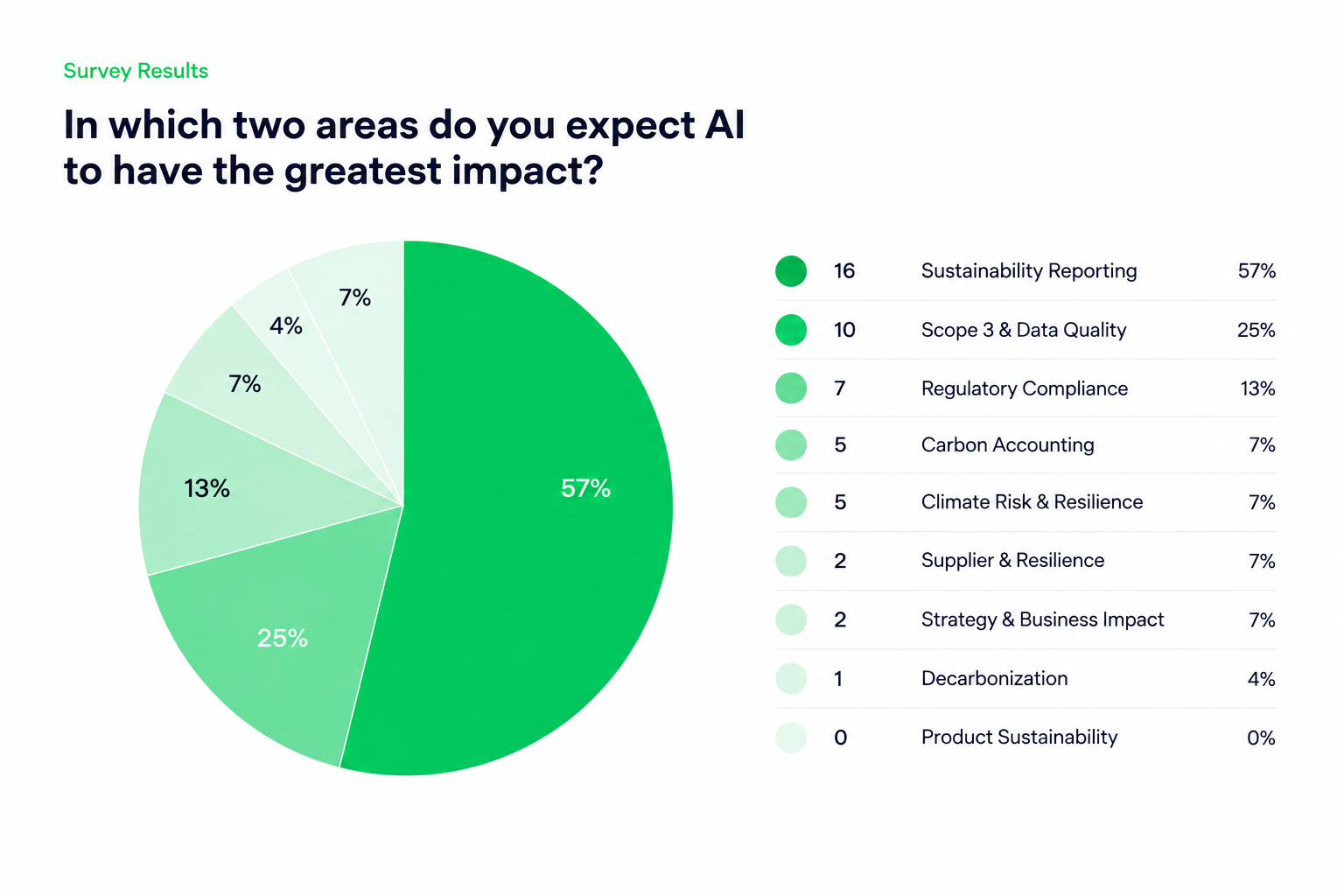
4. What do leaders expect from artificial intelligence?
Each participant chose two areas. Sustainability reporting led with 35 percent of votes, followed by Scope 3 and data quality at 22 percent, and carbon accounting and regulatory compliance at 15 percent each. Climate risk and resilience, strategy and business impact, and supplier resilience received 4 percent each. Decarbonisation and product sustainability received no votes at all.
87 percent of expectations therefore fall on reporting, data, carbon accounting and compliance, in other words on the large circle. Leaders expect AI to shrink the work that consumes their capacity, not to perform the transformation work they would rather spend that capacity on. That is a realistic and, in our view, healthy expectation. Emissions are reduced by changing packaging, energy sources, suppliers and products, not by software. What software can do is return the hours that those decisions require.
The discussion after this question added an important caveat. Reporting as the top expectation does not mean the room wants AI to author an audited sustainability statement unsupervised. Under the CSRD, sustainability statements are subject to limited assurance, which means an auditor must be able to trace every reported figure back to its source and method. Trust and traceability are therefore audit requirements, not preferences. The expectation is that AI makes preparation, data structuring and drafting faster, while humans retain responsibility for validation, particularly for assured disclosures, regulatory claims and anything communicated externally.
What the research reveals about market dynamics
Three developments emerge from the Hamburg data.
First, sustainability strategy is now owned by the business core. Corporate strategy, procurement and finance rank above every other function, which means sustainability is being negotiated where growth, supply and cost are decided. The remaining blind spot is sales, the function closest to the customer questions that increasingly drive the whole agenda.
Second, the agenda has split into two halves of roughly equal weight, compliance and transformation, while reporting itself has receded. Compliance has changed character: it is now driven by product, packaging, claims and supplier obligations rather than by the annual report. This is why the same room that ranks compliance first also ranks reporting near last.
Third, capacity is distributed 80 to 20 in the wrong direction, and AI is expected precisely where it could flip that ratio. Teams expect AI in reporting, data quality, carbon accounting and compliance, and expect almost nothing from it in decarbonisation, product sustainability or strategy. The topics rising on the agenda, strategy and business impact, decarbonisation and resilience, are therefore the ones where AI is least expected to help directly. That is not a contradiction. It is the argument for freeing capacity from the large circle so that the people who understand the business can finally spend their time in the small one.
Market and technology insights: where does technology actually remove friction?
Footprint Intelligence framed the survey findings around a simple imbalance: sustainability teams spend much of their capacity on collecting supplier data, validating spreadsheets, responding to questionnaires and coordinating across functions, leaving far less time for the work that follows — identifying hotspots, building business cases, implementing measures and steering progress. The image of an exhausted person in front of a laptop captured that imbalance immediately. It drew visible recognition across the room, with several participants commenting on how closely it reflected their own day-to-day reality.
The central thesis that followed was that AI is an enabler, not a starting point. The task is to shrink the large circle and grow the green one. The useful question is therefore not "where can we apply AI" but "where does technology remove friction from work that sustainability teams are already doing, and where does it free them for the impact work they were hired to do".
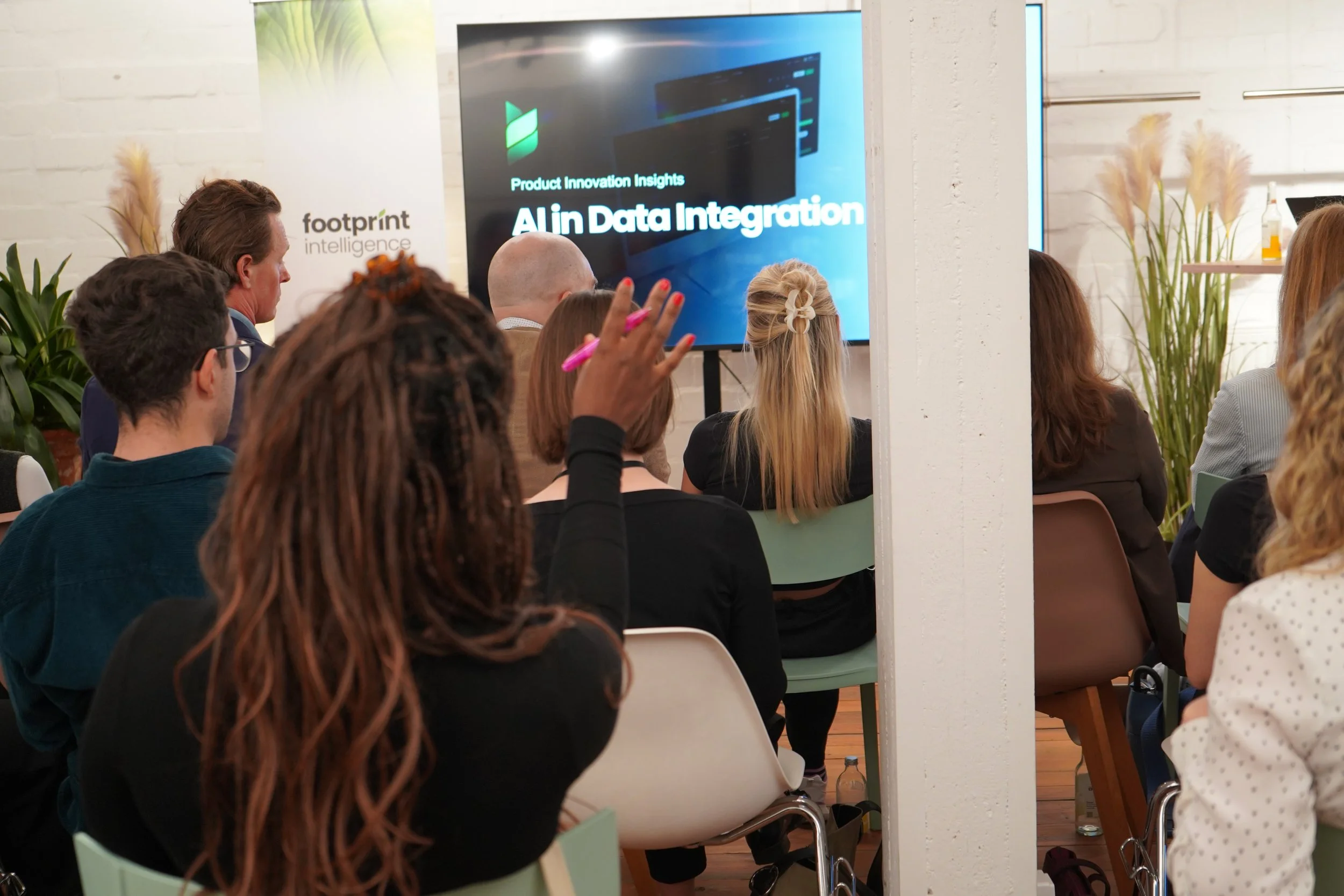
The use cases with the strongest resonance were data integration across systems, regulatory analysis, compliance support, supplier information management, decision support, prioritisation of measures and the development of business cases. These are exactly the areas that the research had identified as consuming most of the profession's time.
A recurring message was that technology only delivers when four conditions are met: the business problem is clearly defined, ownership is assigned, data quality is sufficient, and the output can be integrated into an existing decision process. Where those conditions are missing, tools add another layer of work instead of removing one.
Leadership panel: sustainability as a business driver
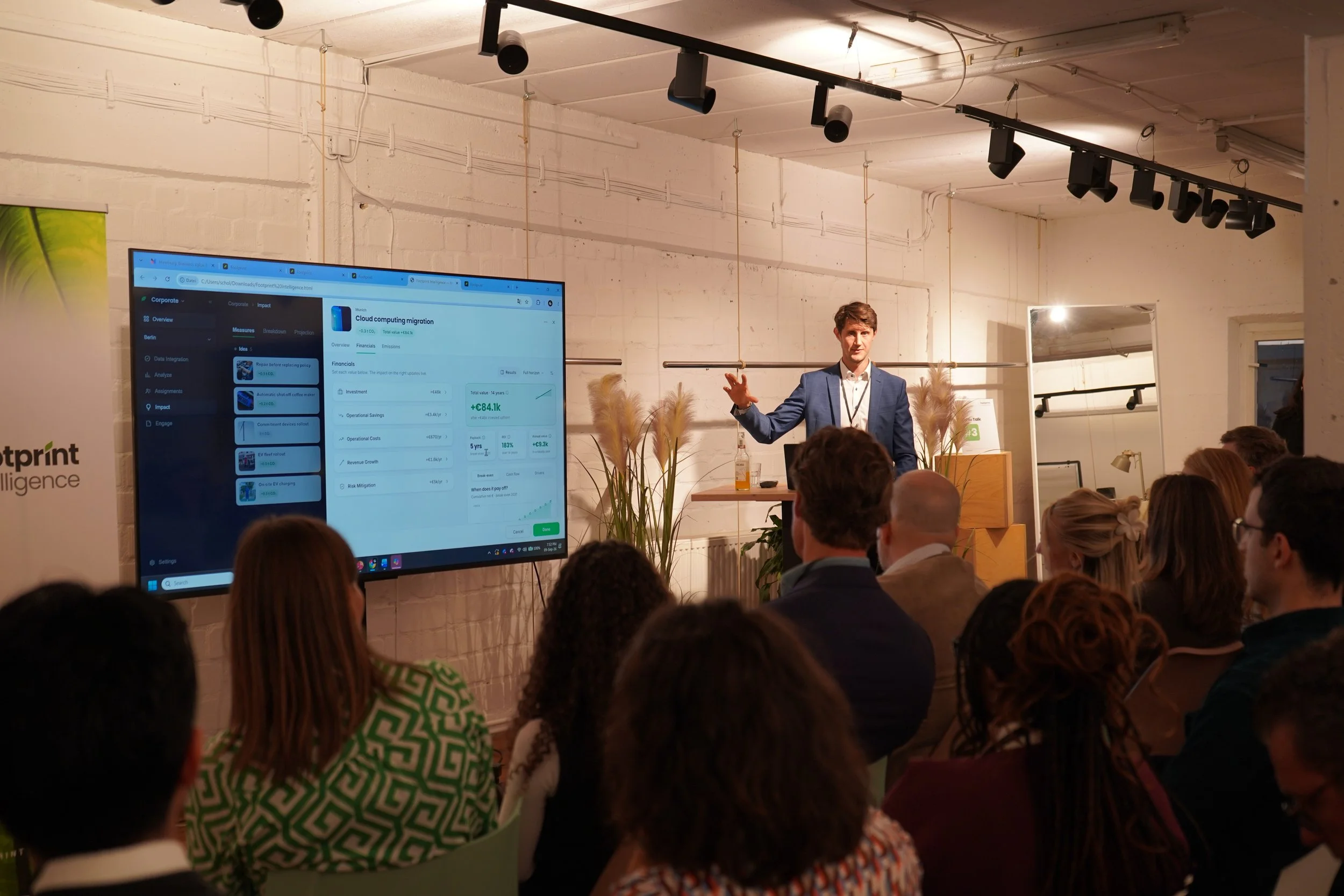
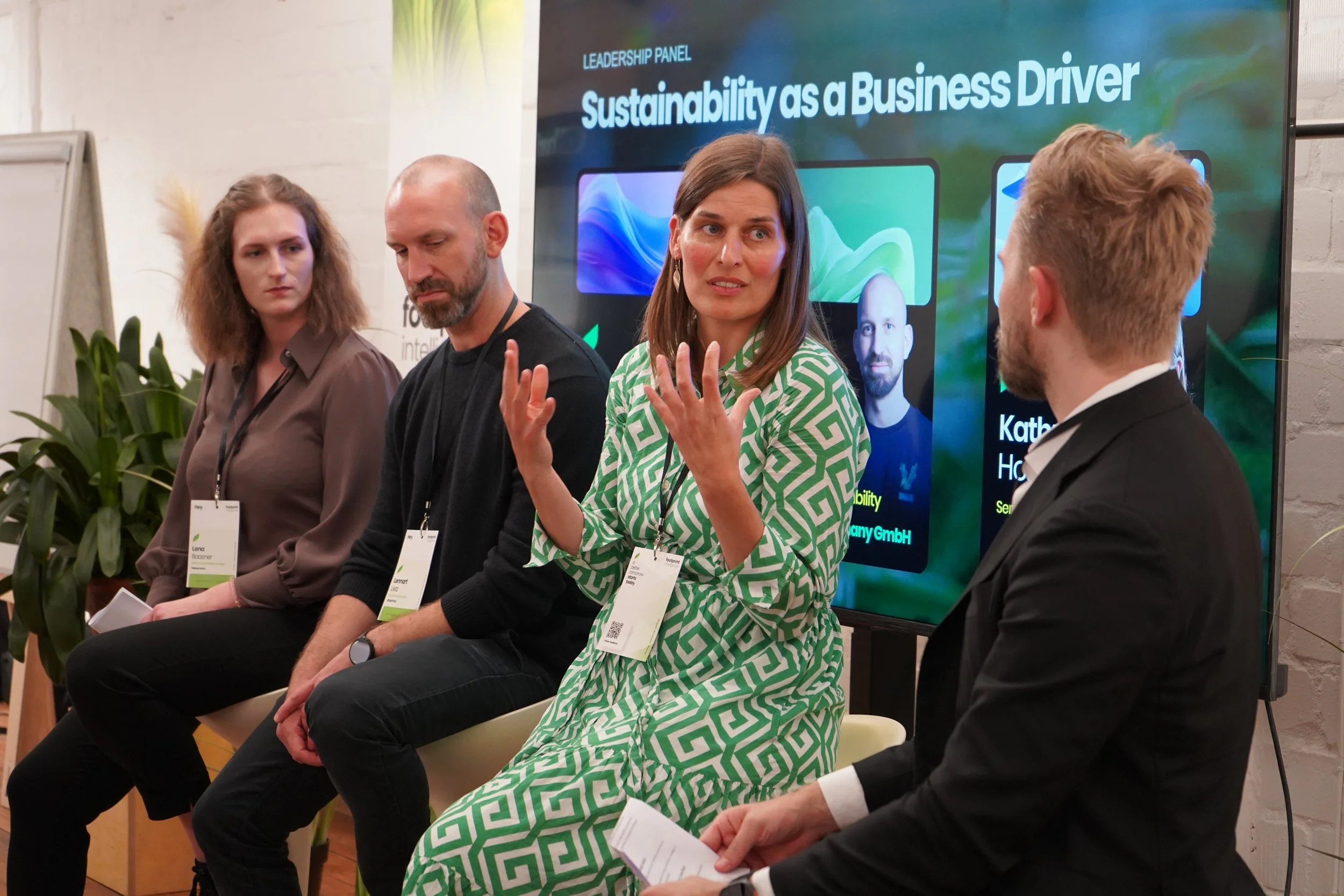
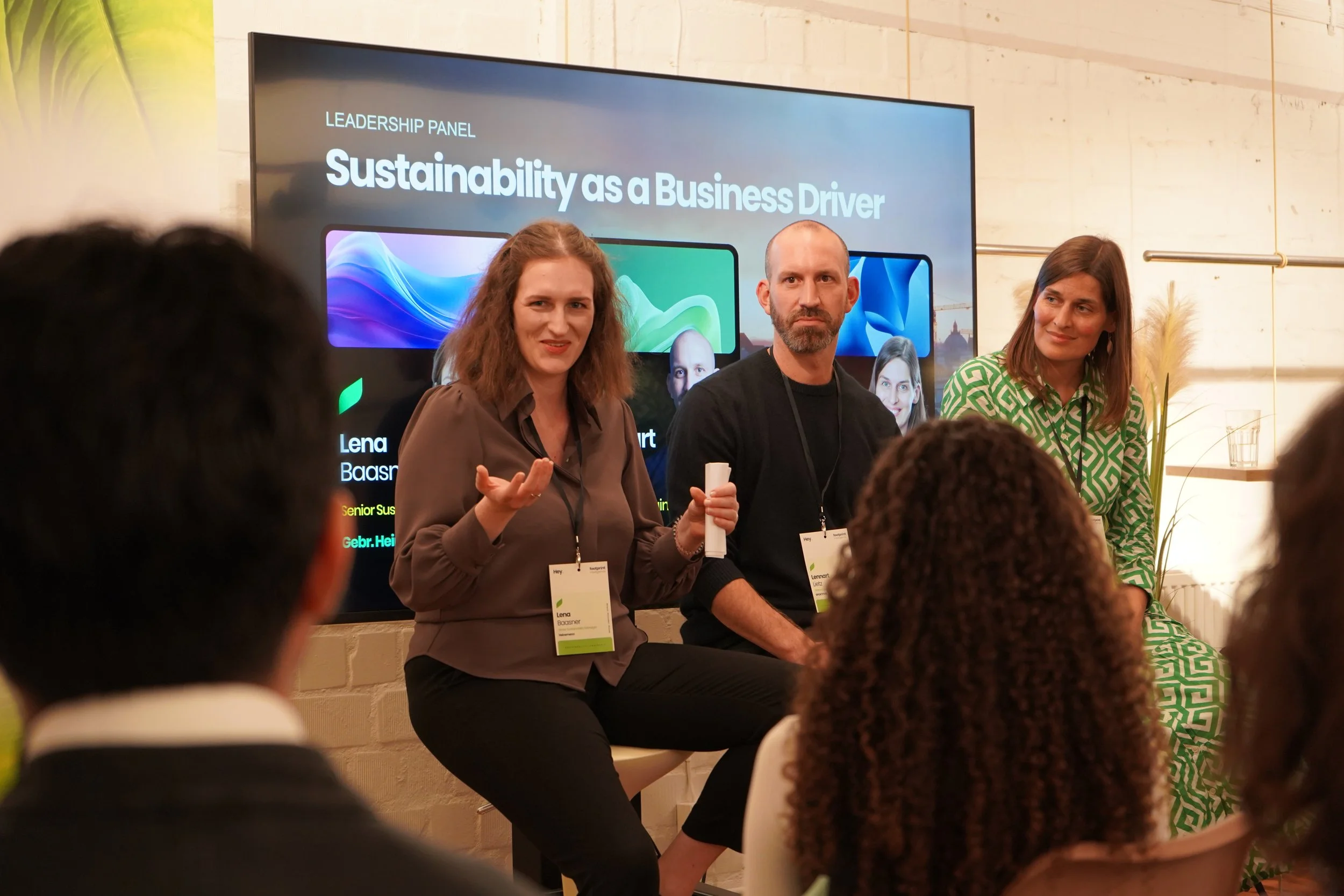
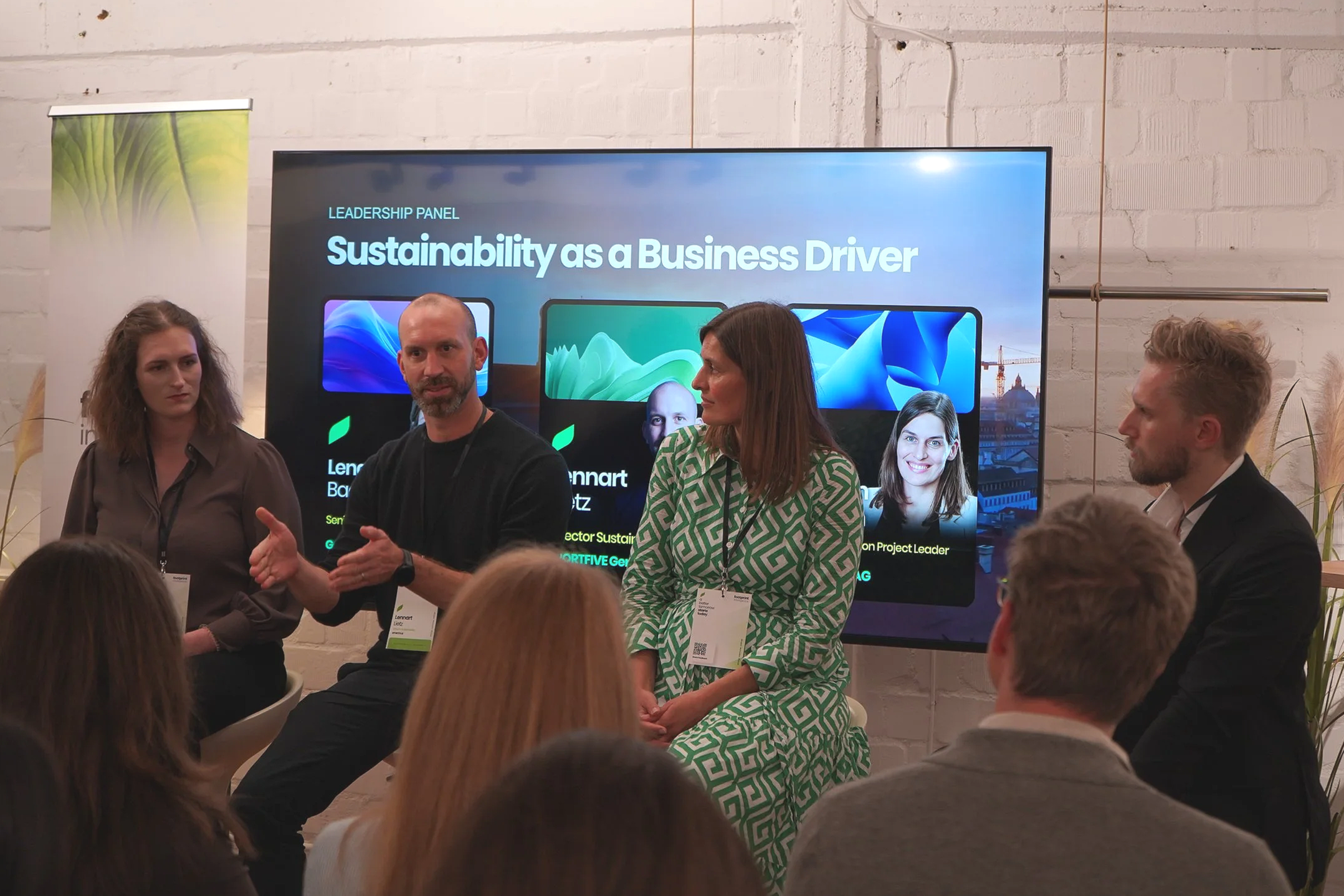
The panel brought together three deliberately different vantage points. Lena Baasner, Senior Sustainability Manager at Gebr. Heinemann, works in travel retail and global value chains, positioned between suppliers, airports, joint ventures and customers. Lennart Lietz, Director Sustainability at SPORTFIVE Germany, works in sports marketing, where sustainability lives inside partnerships, sponsorships and audience engagement. Kathrin Hortian, Senior Global Innovation Project Leader Derma at Beiersdorf, works in consumer goods product innovation, where sustainability is a design parameter alongside formulation, packaging and cost.
Together they made the evening's central question tangible: how does sustainability move closer to the commercial and operational core, and how does it create value rather than remain an isolated function?
How sustainability shows up in three very different businesses
For Lena Baasner, sustainability is increasingly a matter of customer relationships and tenders. A travel retailer sits at the intersection of suppliers, airport operators, joint venture partners, cruise and airline customers and local shop operations. Her team therefore functions as a strategic interface rather than a reporting unit. The hard part is translation: a group level strategy has to become practical action in locations where regulation, customer expectations and market maturity differ substantially.
For Lennart Lietz, the defining feature is that his organization controls very few of the operational levers. A sports marketing agency is rarely the event organizer. Clubs run stadiums, municipalities run transport, sponsors run brands, service providers run catering. Emissions from fan travel, for instance, cannot be managed by any single actor. The role is therefore inherently collaborative: bring the right actors together, identify shared interests, create partnership models that scale, and turn initiatives into something that can be communicated and activated. Because sport reaches enormous audiences and shapes behaviour, sustainability can become part of sponsorship strategy, brand positioning, fan engagement and employer branding. His broader point was that sustainability in sport works best when it is integrated into the commercial logic of partnerships rather than treated as a separate corporate responsibility layer.
For Kathrin Hortian, sustainability is embedded in the innovation process itself. Her work sits at the intersection of innovation, marketing, research and development, packaging, supply chain and corporate sustainability. Sustainability considerations enter at the concept stage and shape formulation, packaging, production decisions and project KPIs, rather than being added at the end of development.
What has actually worked: the double win
A concrete success story of the evening came from Kathrin Hortian. During the relaunch of a dermatological product line addressing acne, a team spanning innovation, marketing, packaging, formulation development, supply chain and sustainability redesigned the packaging, including a move from a dispenser format to tubes. The result was a reduction in packaging related emissions of around fifty percent, achieved together with lower cost.
The lesson she drew was precise. The measure did not succeed because it was sustainable. It succeeded because it was sustainable and made sense from a business and operational perspective at the same time. Fewer materials, lower cost, lower emissions and a format that consumers appreciate: that combination clears every internal hurdle at once.
The second lesson was about governance. Sustainability at Beiersdorf is supported through structures rather than individuals. A dedicated "Green Squad" focuses on sustainability across projects, sustainability criteria are embedded into the regular stage gate governance of innovation projects, projects must demonstrate that they remain aligned with sustainability targets, and KPIs are tracked through dashboards with decision points in each function. Because the process is standard, it no longer depends on one champion pushing in every meeting.
This led to one of the strongest practical insights of the panel: sustainability scales when it is built into existing business processes. It stalls when it depends on additional meetings, voluntary involvement, individual enthusiasm or a parallel ESG process running alongside the real one.
Collaboration across the value chain: capability, not just requirements
Lena Baasner described supplier engagement as the area where the compliance mindset most often fails. The instinct to ask suppliers for more information runs into practical limits: what data can a supplier realistically provide, what maturity level do they have, what can legitimately be required, and where should the company support rather than demand?
The company’s Supplier Enablement Program focused on emissions transparency in the value chain. Its aim is to improve the quality and comparability of product carbon footprint data, to support suppliers with methodology and training so that they can build their own competence, and to make data exchange scalable through established data standards rather than bespoke requests. The resulting data is used for hotspot analyses and targeted decarbonization, not merely for reporting. The principle underneath is simple: supplier engagement should create capability, not only obligations.
The same collaborative logic applies downstream. With customers such as cruise operators and airports, the company develops joint green business plans in which both sides define shared sustainability goals and measures. The shift, as Lena Baasner framed it, is from "what can we do alone" to "what can we solve together across the value chain".
Sustainability and commercial value
All three panelists agreed that the commercial case for sustainability is becoming more immediate than the compliance case, though it takes different forms.
In travel retail, sustainability performance increasingly influences tenders, customer selection and supplier relationships. Lena Baasner cited a regional sales director who directly benefits from sustainability inputs when responding to tenders. That example carries a broader message: sustainability teams need to understand what sales needs, what customers ask, and how sustainability can support a commercial argument.
In sports marketing, sustainability opens new sponsorship themes, strengthens brand positioning, creates content and storytelling, improves employer branding and deepens partnerships. Lennart Lietz was equally clear that not every initiative carries a strong financial case, and that tradeoffs between commercial value, reputation, integrity and actual sustainability impact are real. A purely quantitative measurement is often too ambitious in a marketing context; strategic fit, audience relevance and credibility matter alongside measurable KPIs. Successful concepts must work both strategically and commercially.
In consumer goods, product innovation follows the same logic. Sustainability becomes commercially relevant when less material is required, packaging becomes cheaper, emissions decrease, consumer expectations are met and products become easier to communicate credibly. The most convincing cases combine environmental and financial benefit.
Speaking the language of the business
Perhaps the theme that united the panel most strongly was the need for sustainability professionals to understand the world of the people they are asking for support. Before asking a colleague to back a measure, it pays to understand their responsibilities, their KPIs, their commercial pressure, their regulatory context and what their customers expect.
Different functions respond to different arguments. Sales responds to tender relevance and customer demand. Procurement responds to supply security and cost. Management responds to risk, growth and resilience. Innovation responds to product performance and differentiation. Sustainability therefore has to be translated into the language of each stakeholder rather than delivered in ESG terminology and left for others to decode.
Local implementation and organisational buy in
Lena Baasner described the reality of a relatively small central team influencing a much larger international organisation. Local sustainability action plans, targets that work at location level, and joint development of those targets with local teams proved more effective than centrally imposed requirements. Initial hesitation gave way once local teams saw that their priorities and ways of working were understood. Dashboards added a further lever: when locations can compare their performance, progress becomes visible and a degree of positive internal competition emerges. Sustainability turns from a corporate demand into something local teams own.
Lennart Lietz made a parallel point about sports organizations, where many decision makers come from sporting or commercial backgrounds and are not sustainability specialists. Sustainability has to be understandable, practical and relevant to the club and to the sponsor. Once again, the audience defines the language.
Regulation and the risk of going silent
The rules on sustainability claims featured prominently. The Empowering Consumers for the Green Transition Directive, now taking effect across the EU, tightens the requirements for environmental claims towards consumers and prohibits generic claims that cannot be substantiated. For consumer goods and for sports marketing alike, this has produced a careful, sometimes anxious approach to communication.
The tension the panel identified is subtle. Companies want to communicate real progress, but stricter regulation makes organizations more cautious, and excessive caution can lead to silence. Lennart Lietz observed the same effect among clubs and brands: heightened scrutiny of green claims can make organizations stop communicating sustainability altogether, even where meaningful initiatives exist. The challenge is therefore not only compliance. It is how to communicate enough, remain credible, and avoid disappearing from the conversation.
Expert table talks: the same challenge in many disguises
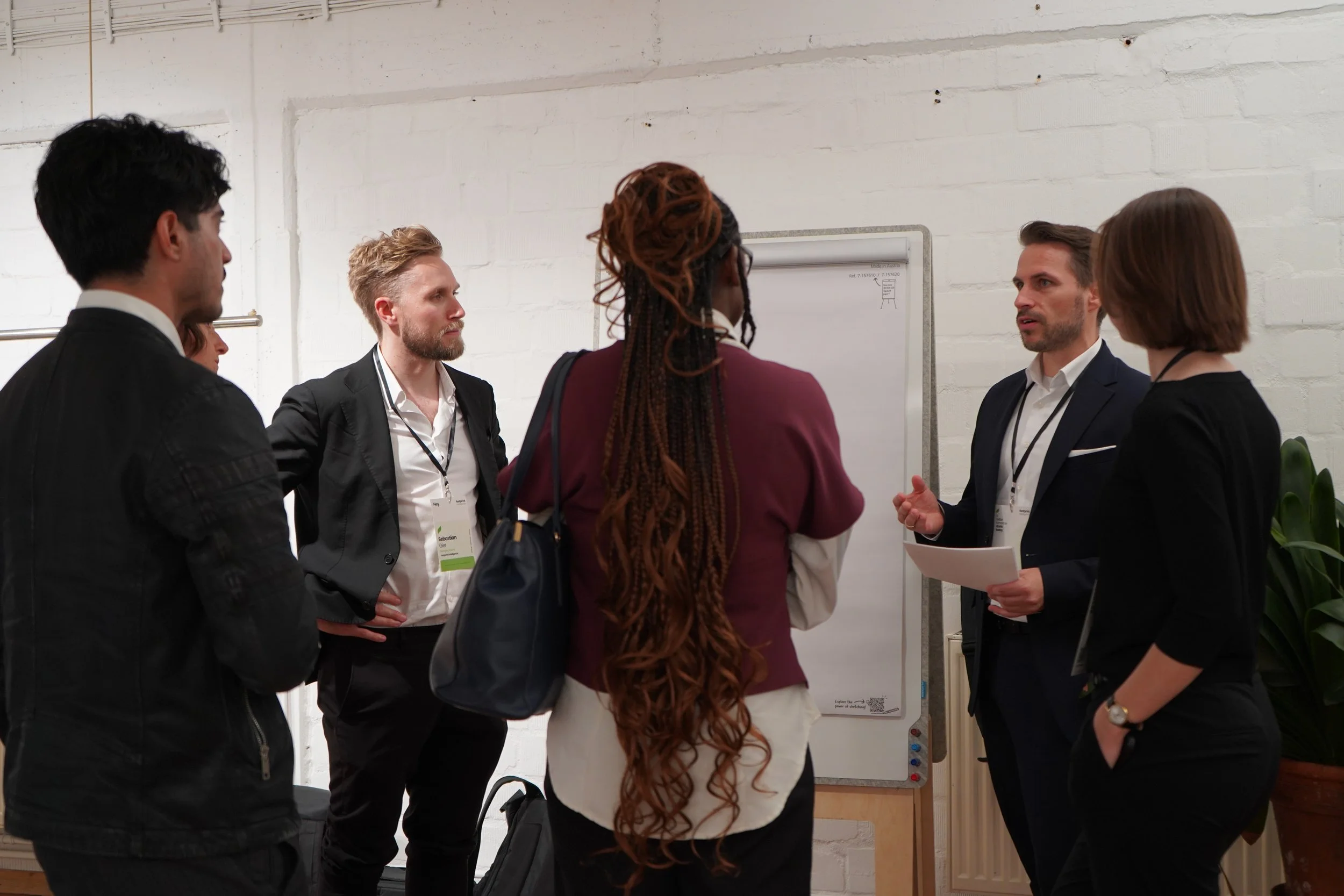
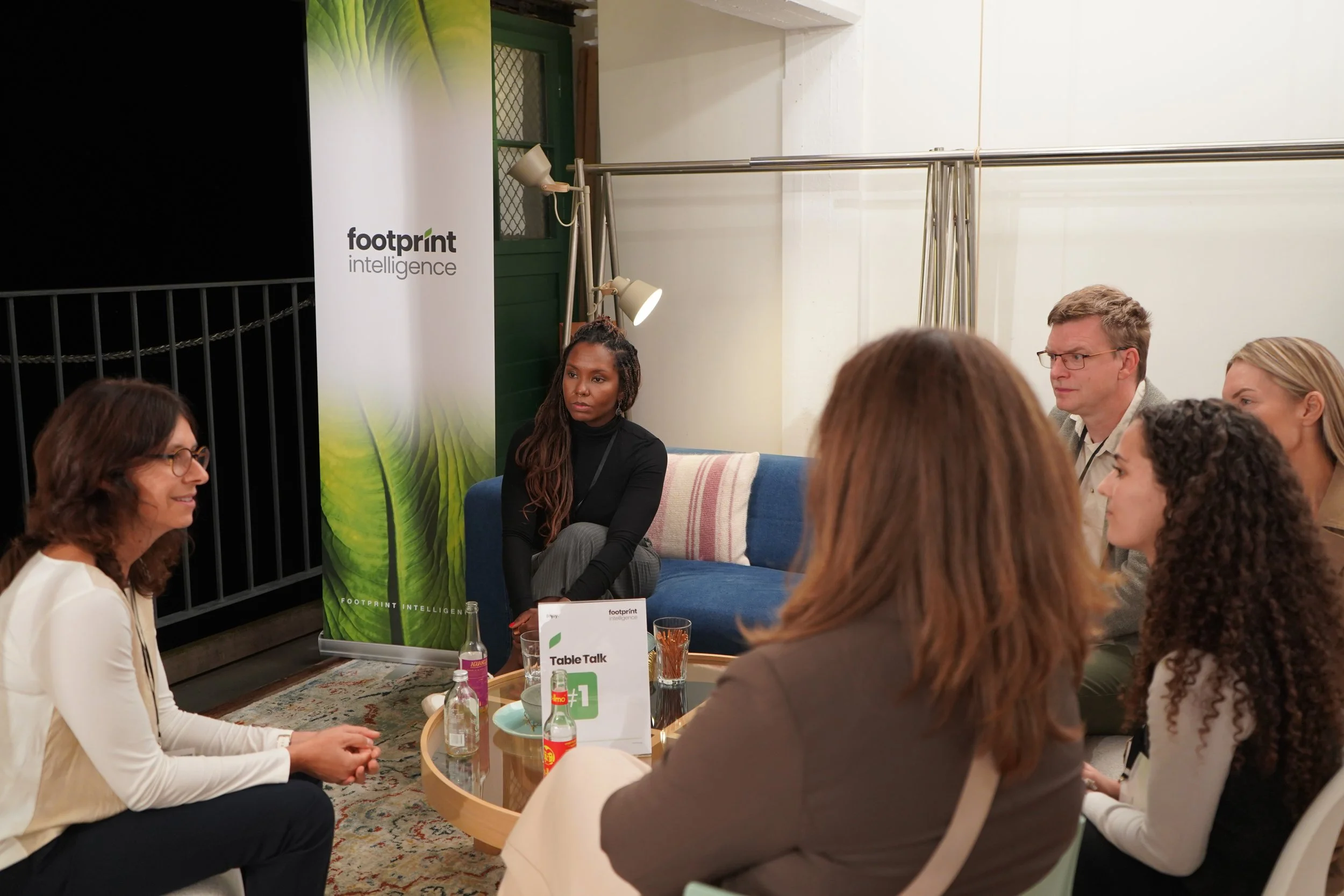
The evening closed with small-group deep dives hosted by Francesca Martinelli of Philips, Jan-Frederick Goettsche of Signal Iduna Asset Management, and Daniel Scholz of Footprint Intelligence. Their discussions explored circularity and viable business models, how ESG factors and climate risk shape long-term investment decisions, and how sustainability data and AI can help move companies from compliance towards resilience. Across the tables, participants connected these themes to the realities of their own industries.
Consumer goods companies were most affected by packaging, product innovation, claims and consumer expectations. Industrial and manufacturing companies focused on supplier data, procurement, Scope 3 and operational resilience. Energy-related companies faced regulatory complexity, physical climate risk and procurement considerations. Media companies were increasingly occupied with sustainable procurement, packaging, supplier resilience and the challenge of bringing sustainability back onto the strategic agenda. Semiconductor and business-to-business technology companies faced the translation challenge of turning technical improvements into customer value. Biotechnology and medical device companies had to manage multiple regulatory regimes across global operations. Certification and assurance participants brought the discipline of evidence: credibility, verification and data quality behind every claim.
The striking observation was that beneath these differences lay one shared question: how do we turn sustainability from an additional requirement into something operationally useful, commercially relevant and resilient enough to scale?

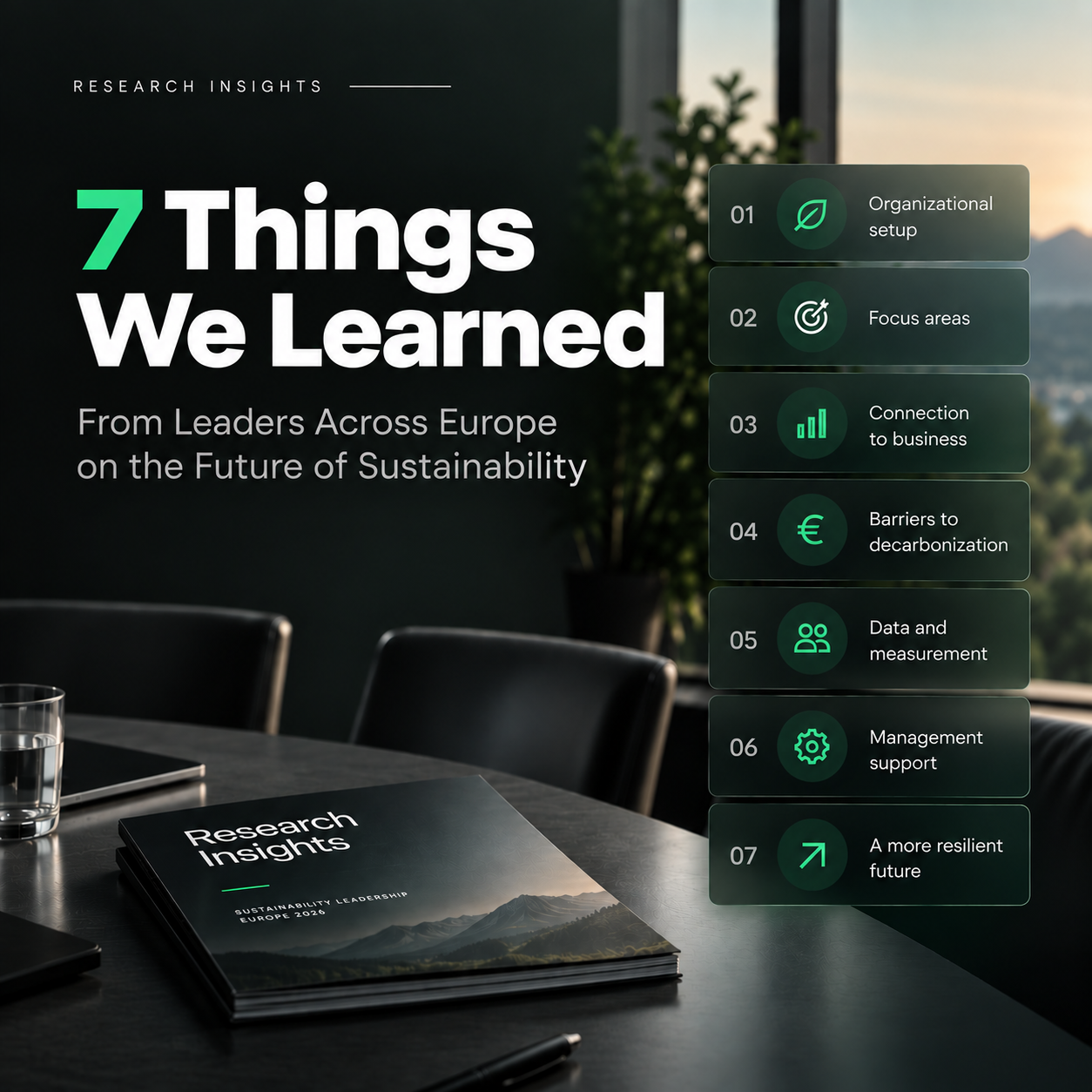
Summary: seven things Hamburg tells us about the next phase of corporate sustainability
Sustainability has become a shared function. The strongest discussions no longer happen inside sustainability teams alone. Procurement, supply chain, innovation, compliance, strategy and increasingly sales are central to implementation. The research shows procurement and HR already inside the strategy process, and sales as the most important function still missing from it.
Resilience is replacing reporting as the organising frame. Participants across industries described a shift from disclosure toward risk, resilience and long term value. Climate, suppliers, resource dependencies and regulation are now analysed together.
Scope 3 and supplier data remain the bottleneck, and collaboration beats requirements. Suppliers lack data, incentives and sometimes capability. Programs that build supplier competence, use standardised data exchange and return value to suppliers outperform additional questionnaires.
Sustainability scales inside existing processes. Innovation gates, dashboards, procurement processes, tenders, local action plans and supplier programs were the mechanisms behind every success story. Parallel ESG processes and individual enthusiasm were the mechanisms behind every stall.
The strongest cases are double wins. Lower emissions with lower cost, less material with better margins, stronger customer value with lower regulatory exposure. Sustainability gains internal traction when it is connected to cost, customer requirements, tender success, risk mitigation, resilience, innovation and brand value.
Communication is getting harder, and silence is a risk. Claims regulation demands stronger evidence and formal claim support processes. The organisations that navigate it well will communicate less loosely but not less.
AI is an efficiency and decision support tool, with humans accountable for what is assured. Leaders want AI for data collection, regulatory monitoring, analysis, supplier data and the elimination of manual work. They do not want it signing off audited disclosures. That division of labour is exactly where the technology creates value today: it shrinks the large circle of collection and reporting so that the small circle of impact and transformation can finally grow.
The sustainability profession is standing at an inflection point. The compliance era built the data foundations and the governance. The next era will be defined by how quickly companies turn those foundations into decisions, business cases and resilience. Hamburg suggested that the leaders who get there first will be the ones who stop speaking ESG and start speaking the language of the business.