Moving Beyond Reporting Study: 7 Things We Learned From Leaders Across EU on the Future of Sustainability
Sustainability has become increasingly significant for business strategy and decision-making. What was once handled largely as a reporting obligation now has a much broader influence on how companies allocate resources, manage operations and plan for the future. This shift is taking place within a more uncertain business environment, where geopolitical tensions, unpredictable climate impacts and volatile energy prices are making long-term planning more difficult. For many companies sustainability is therefore becoming increasingly connected to how they respond to uncertainty and maintain profitability.
This raises the question: where should sustainability sit within an organization, and how closely should it be integrated into business decision-making? We put these questions to sustainability professionals at two of our recent events: the Sustainability Leadership Summer Conference in Munich on 25 June 2026, and the Sustainability Leadership Roundtable on 30 July 2026. These events brought together professionals from a broad mix of industries, including media, finance, manufacturing, construction, retail and consumer goods. Despite their different backgrounds, several common challenges emerged.
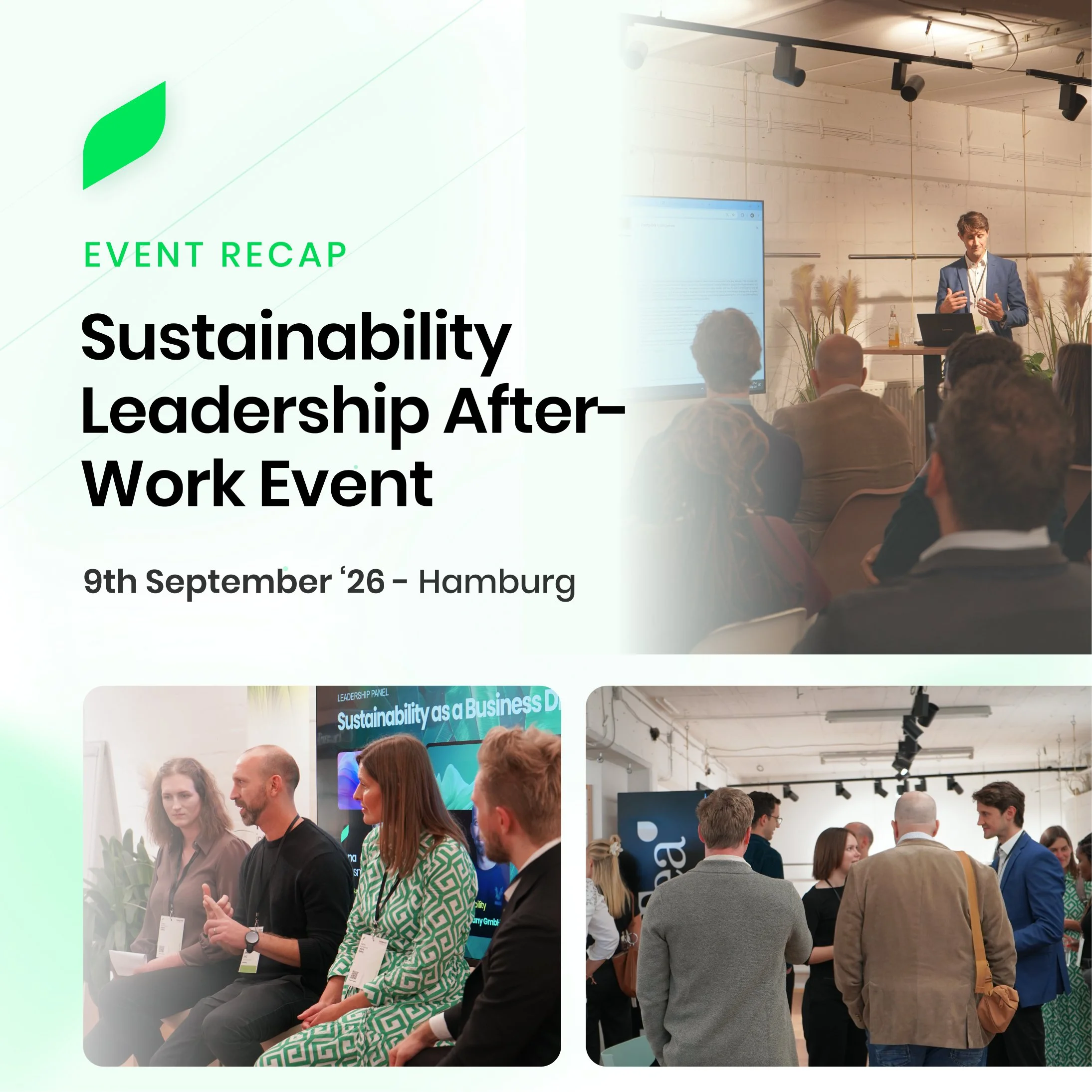
These are the first findings from an ongoing research program, which continues at our upcoming events in Düsseldorf, Hamburg, Vienna, Frankfurt, Berlin and other cities over the coming months. Both formats so far included interactive sessions that offered insights into how sustainability is managed across very different companies. This article sets out seven findings, and what they reveal about integrating sustainability into business strategy, strengthening reporting processes and maintaining high-quality data.
Research Findings
We started by looking at where sustainability currently sits inside the organization, and where the people doing the work believe it belongs.
33% of respondents reported that their organization has a dedicated sustainability team. In the remaining organizations, sustainability is integrated into an existing function, such as finance, legal and compliance or corporate strategy, rather than operating as a standalone team. Both models can work, but they create different levels of access to the discussions in which budgets and priorities are set.
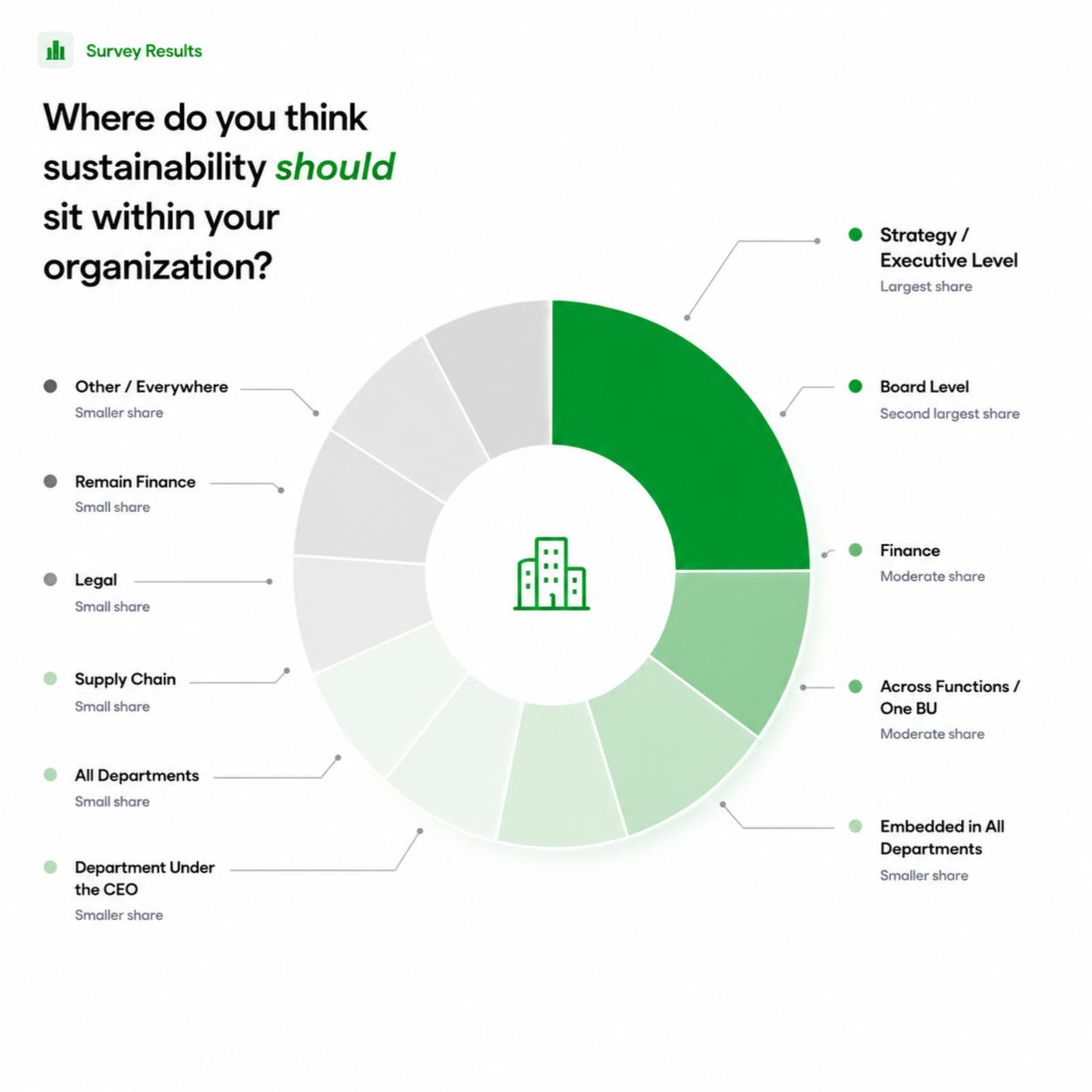
When asked where sustainability should sit within the organization, 27% placed it in the strategy layer rather than in operations, compliance or communications. This points to the importance of having sustainability close to strategic decision-making.
Participants also revealed which sustainability activities they would like to devote more time and attention to. Innovation and impact ranked first, followed by stakeholder engagement, with data quality third. Reporting and compliance ranked last. The tension is clear: teams want to focus on higher-impact work, but their time is still absorbed by the tasks required to prepare the necessary data.
A similar pattern appeared when participants were asked how well sustainability is currently connected to business decision-making in their organization. On a scale running from "not connected at all" to "fully integrated", the average was approximately 2.7 out of 5. Sustainability is recognized and increasingly measured, but it is not yet consistently part of the decisions that shape budgets, products and business priorities.
Bridging the Gap
The most consistent theme across the workshops was dissatisfaction with the relationship between sustainability and business planning. Participants felt that the two were often treated separately, even though bringing them closer together could improve how priorities are set and decisions are made.
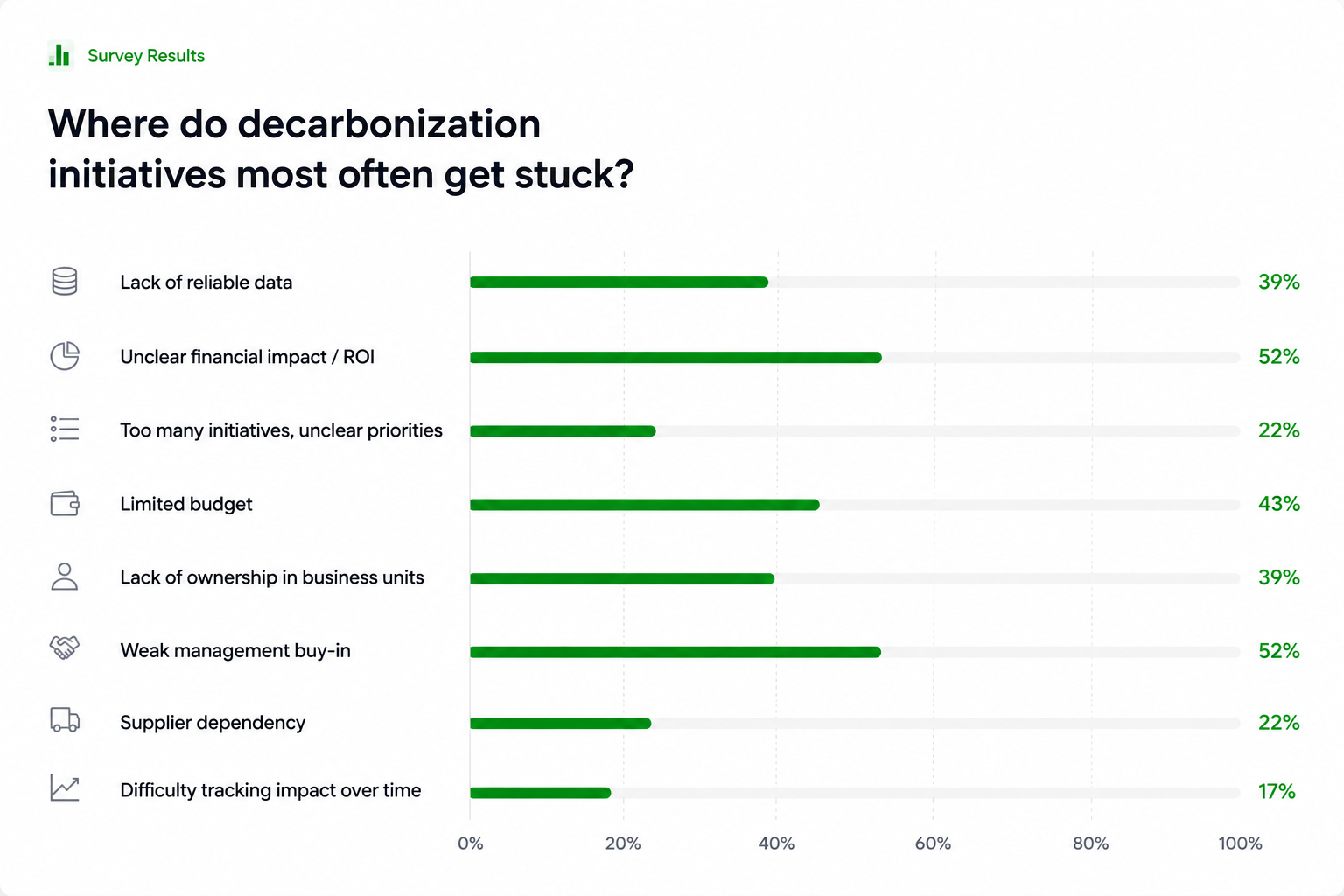
When asked where decarbonization initiatives tend to get stuck, two answers ranked highest, each selected by 52% of respondents: unclear financial impact or ROI, and weak management buy-in. Limited budgets followed with 43%, while lack of reliable data and lack of ownership within business units were each selected by 39%.
An open question about the biggest barrier to turning sustainability targets into real business transformation pointed to the same conclusion. Participants highlighted budget constraints, limited data and the difficulty of securing management support, alongside broader challenges around ownership and established ways of working.
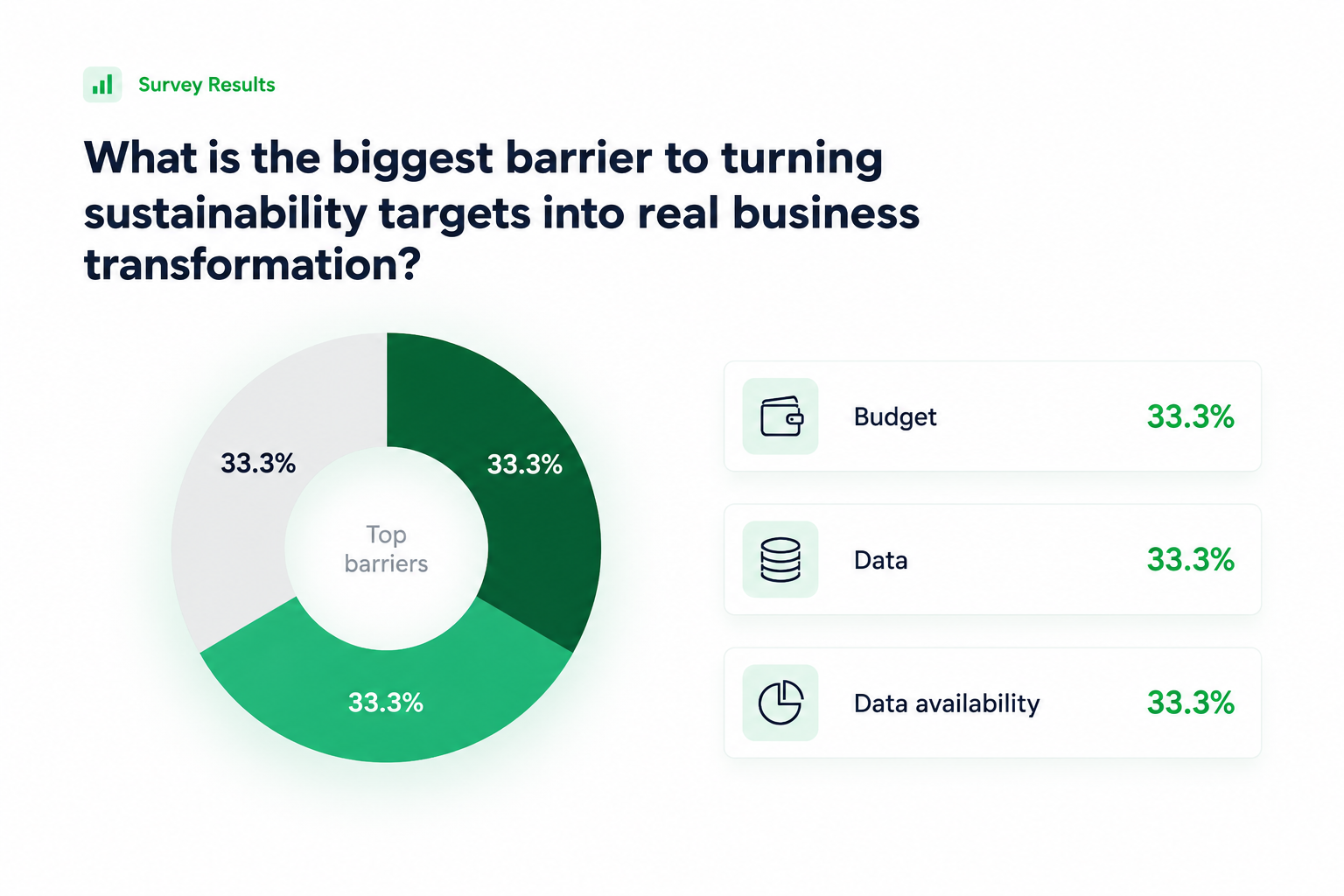
These results are closely connected. Support from management is harder to secure when the financial implications of an initiative are unclear. Budgets are harder to justify without evidence of expected savings and risks. And responsibility tends to remain with sustainability teams when other business units do not see how a climate target relates to their own priorities. Yet the link between sustainability and business value is often more direct than it first appears. Three areas in particular show where that connection already exists.
Sustainable decisions are often the more cost-effective ones. Reducing energy demand, using fewer materials, extending product life cycles and avoiding waste can lower operating costs while limiting exposure to future energy and carbon prices. Framed only as emissions reduction, these measures compete for sustainability funding. Framed as cost and risk management, they can compete for capital alongside other business priorities.
Regulation affects more than the sustainability team. New requirements can influence how companies source materials, design products, work with suppliers and report financial information. This means regulatory changes need to be understood across the organization rather than addressed by the sustainability team alone. When the teams responsible for implementing these changes are involved from the start, they have more time to adapt their processes and prepare for what is required.
Data quality is a shared responsibility. Sustainability data now supports assurance, customer questionnaires, supplier requests, tender responses and product claims. If a figure cannot be explained, the impact extends beyond the sustainability team. Although data quality is often solely treated as a reporting issue, it also shapes stakeholder engagement and customer trust across the organization.
Together, these examples show that sustainability is connected to the wider organization in multiple ways. Finance, regulation and data quality all extend beyond the sustainability function and require collaboration across teams. The challenge is not simply to give sustainability a stronger position, but to build processes that move the right information and responsibilities through the organization.
Building a System That Can Keep Up
The barriers described so far, including unclear financial impact, weak buy-in, unreliable data and unclear ownership, are often treated as separate problems. Yet the workshop results suggest that these challenges are closely connected.
When asked where their teams spend the most time, 40% of participants said cleaning, validating and consolidating data. Another 30% pointed to collecting supplier and Scope 3 data, while 20% selected internal data collection. Because this information comes from different departments, suppliers and systems, teams often spend significant time reconciling inconsistent formats, reporting periods and organizational boundaries. That effort leaves less capacity for analysing results, building stronger business cases and supporting implementation.
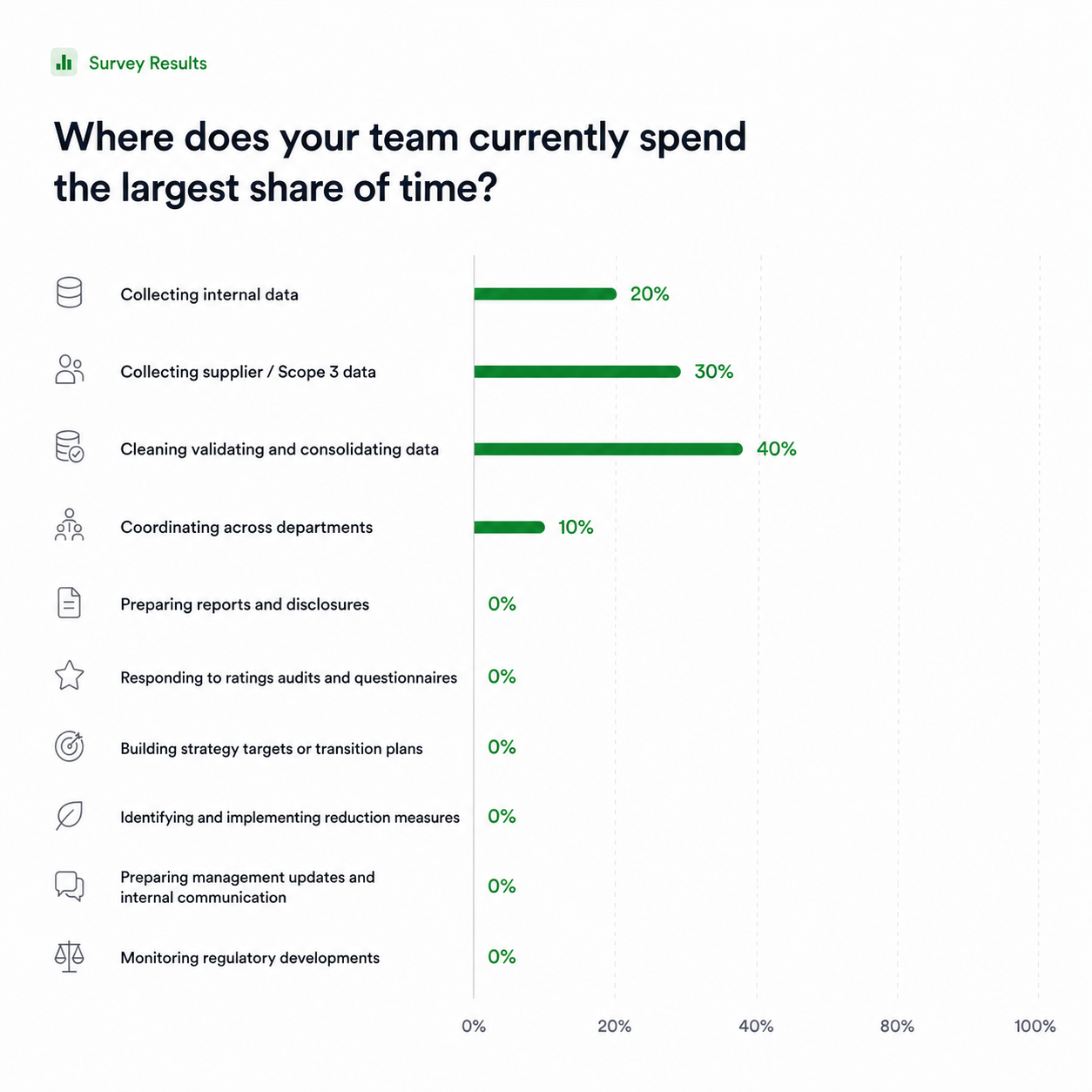
At the same time, reporting cycles are getting shorter and requirements continue to grow. Therefore, teams must streamline compliance processes while simultaneously improving data quality, which remains challenging.
Collecting more data is not the answer either. When asked what would make carbon data more useful for decision-making, participants mentioned:
Transparency
Higher reliability
Methodological alignment and consistent standards
Supplier-specific data for raw materials
Primary data for Scope 1 and Scope 2
Evidence of impact and progress against targets
Relevant information tailored to stakeholder needs
The priority here is usability rather than volume. Data quality cannot simply be treated as a final review step before reporting. It needs to be built into the process through clear responsibilities, common definitions and transparent methodologies.
The findings around AI build on this by showing what makes automated results credible. While 35% of respondents saw manual reporting as the area where AI could help most today, trust depended less on automation itself and more on the evidence behind the result. Transparent calculation logic was selected by 86% of participants, source references by 81% and auditor or legal acceptance by 57%. By contrast, only 24% selected confidence scores, suggesting that a percentage alone offers limited reassurance unless the underlying method and source can also be checked.
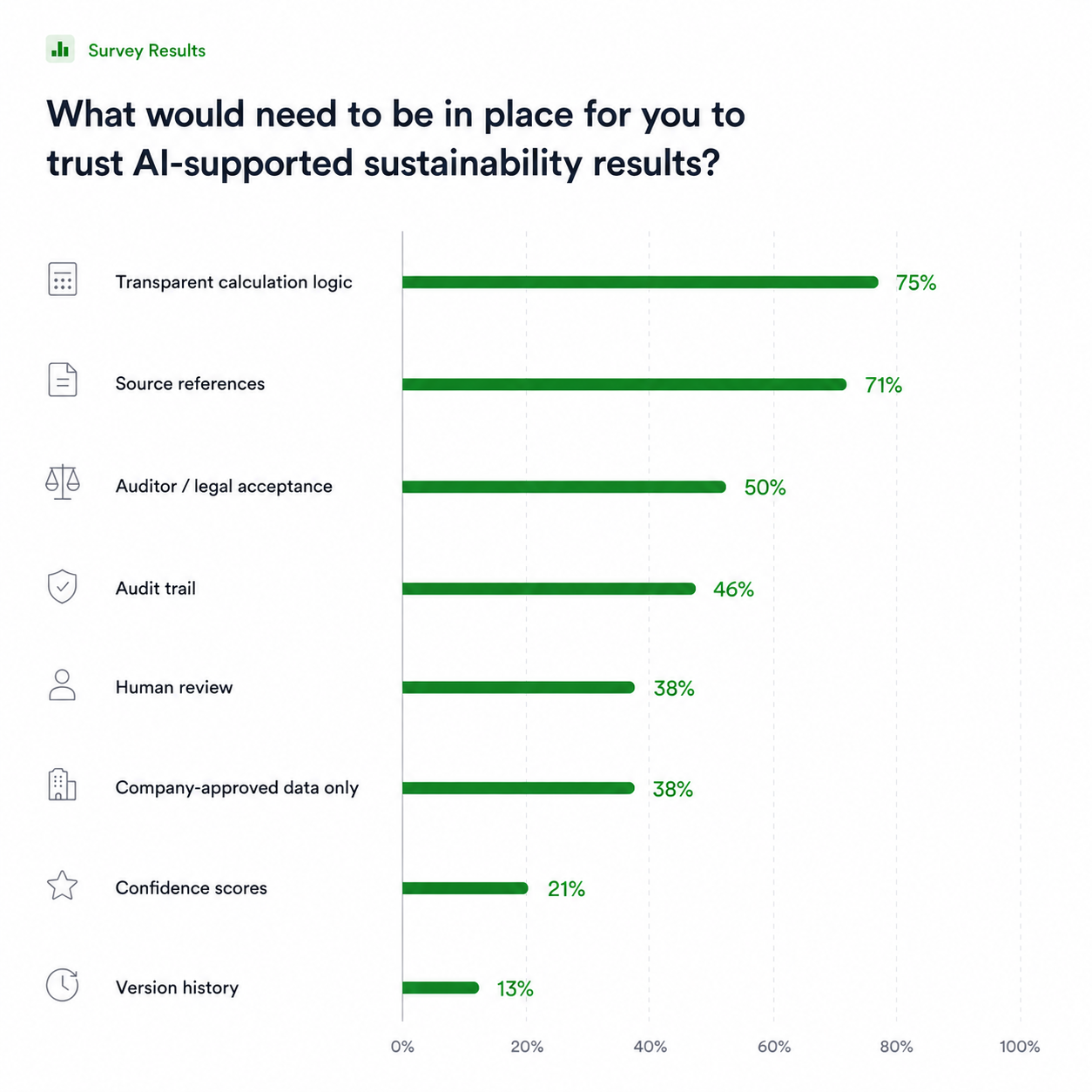
These findings reinforce the need for a more integrated approach. Compliance, data quality and auditability all depend on process design, not reporting alone. Without stronger foundations, teams remain tied to manual work, and information may arrive too late to shape decisions.
One way to do this is to rethink how sustainability data is collected and managed. Rather than assembling information once a year, data can be collected on a continuous basis while retaining the calculation logic behind each figure. That is the principle behind intelligent reporting in the Footprint Intelligence platform: data is collected at the source, classified as it arrives, and each result carries its methodology and references with it.
When the manual work of preparing data is reduced, sustainability teams have the capacity to build the business cases that management buy-in depends on. As each figure is linked to its methodology and sources, the underlying evidence can be traced for an audit, tender response or board discussion without having to reconstruct it first. By providing information continuously rather than on an annual basis, this approach can inform decisions on sourcing, product specifications and capital allocation while those decisions can still be influenced. In this way, sustainability data is no longer simply a record of past performance but an input into future decisions.
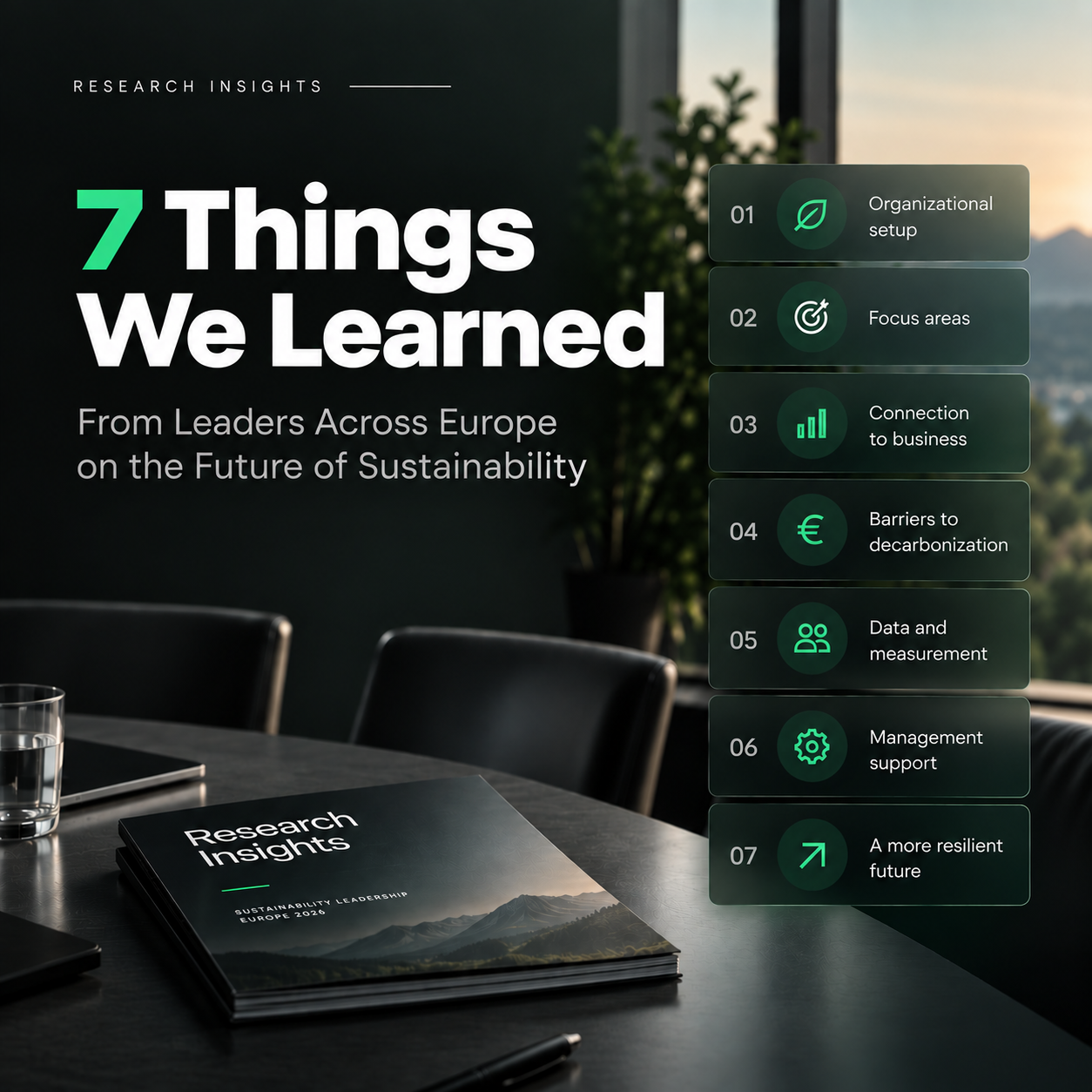
Seven Things We Learned
A dedicated sustainability team is not the default. 33% of respondents have one, while in other organizations, sustainability sits within functions such as finance, legal and compliance or corporate strategy.
Sustainability professionals believe the function belongs closer to strategy. 27% placed it in the strategy layer rather than in operations, compliance or communications.
Sustainability is not yet embedded in decision-making. Participants rated the current connection at approximately 2.7 out of 5.
The work teams want to do is not the work filling their time. Innovation and impact ranked first among the activities people want to spend more time on and reporting and compliance last, while 90% of respondents said the largest share of their time goes to collecting, cleaning and consolidating data.
Decarbonization stalls on financial clarity and management support, not on ambition. Unclear financial impact and weak management buy-in were each named by 57% of respondents, ahead of limited budgets at 48%. Asked openly, participants named the same barriers alongside ownership and established ways of working.
Usability matters more than volume. What would make carbon data more useful is transparency, reliability, methodological alignment and evidence of progress against targets, not more data.
Trust in AI depends on traceability rather than automation. Manual reporting is where 35% see the clearest use for AI today, but 86% require transparent calculation logic and 81% source references, while only 24% are reassured by confidence scores.
From Reporting Capacity to Decision-Making Capacity
Across the workshops at both events, one theme was consistent: sustainability is becoming less about producing reports and more about improving business decisions.
The barriers are closely related. Without a clear business case, budgets and management support are harder to secure. Fragmented information makes that case harder to quantify, while manual data work leaves less time for analysis and implementation.
Going beyond reporting means more than improving the reporting process itself. Sustainability information must be reliable enough to support decisions, accessible to the people making them and available early enough to shape the outcome. Stronger data foundations, clearer ownership and effective use of technology can help create the conditions for this shift.
In doing so, sustainability can move from ambition to execution and from a reporting responsibility to a strategic management function.