AI for Sustainable Operations: From ESG Complexity to Resilience & ROI
How AI is turning sustainability from a reporting exercise into a business capability — and what industry leaders shared in Düsseldorf
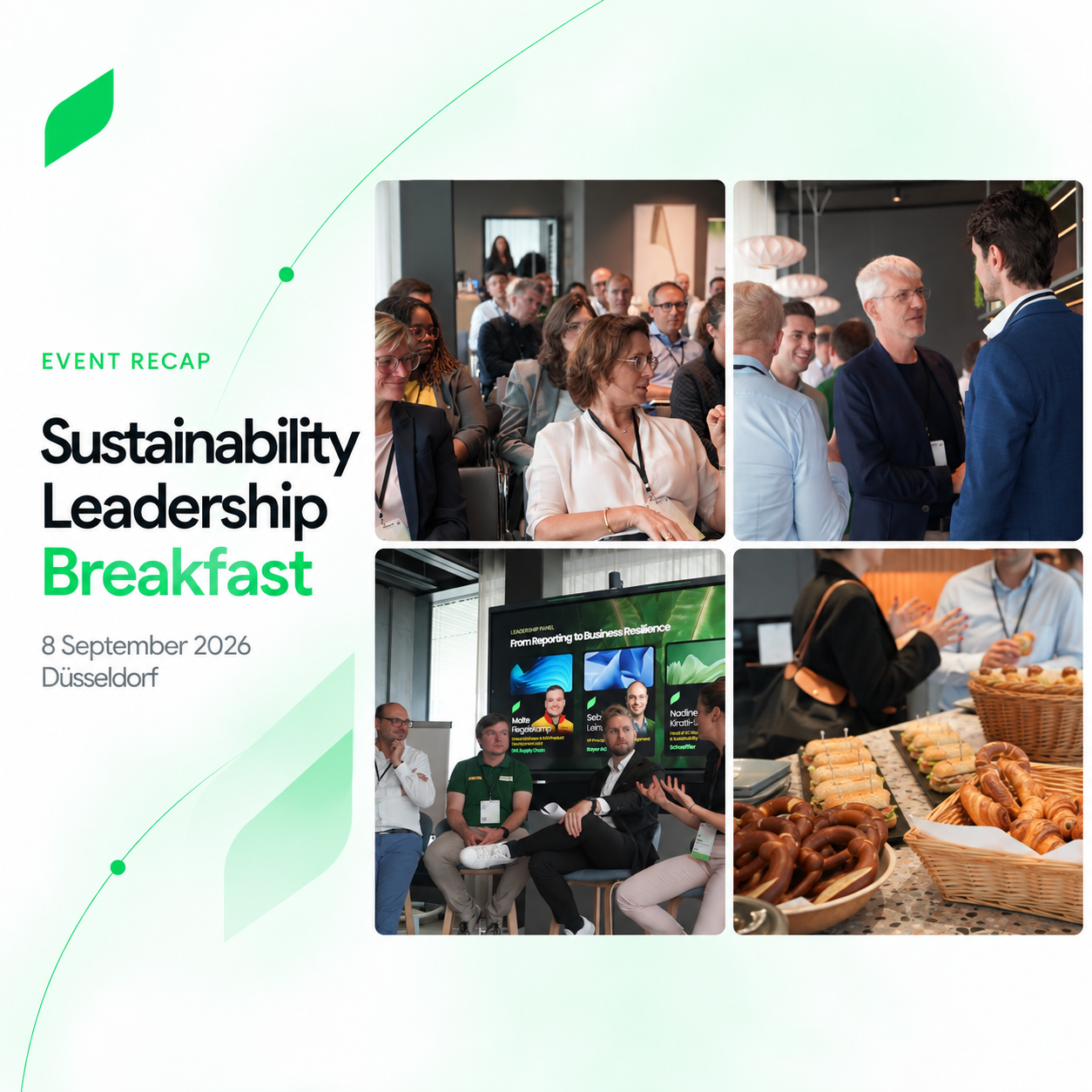
Insights from the Düsseldorf Leadership Breakfast hosted by EY × Footprint Intelligence, 8 September 2026
Where AI meets the shift from reporting to resilience
For most of the past decade, corporate sustainability has largely revolved around a single verb: report. Measure the footprint, collect the data, answer the questionnaire, publish the disclosure. That work was necessary, and it built a discipline where none existed before. But on the morning of 8 September 2026, at the EY-Parthenon office in Düsseldorf, senior practitioners from logistics, pharma, energy, finance and technology gathered for a conversation that started from a different premise: what if reporting is not the destination, but the foundation for something more valuable — and what if AI is the lever that finally makes the shift possible?
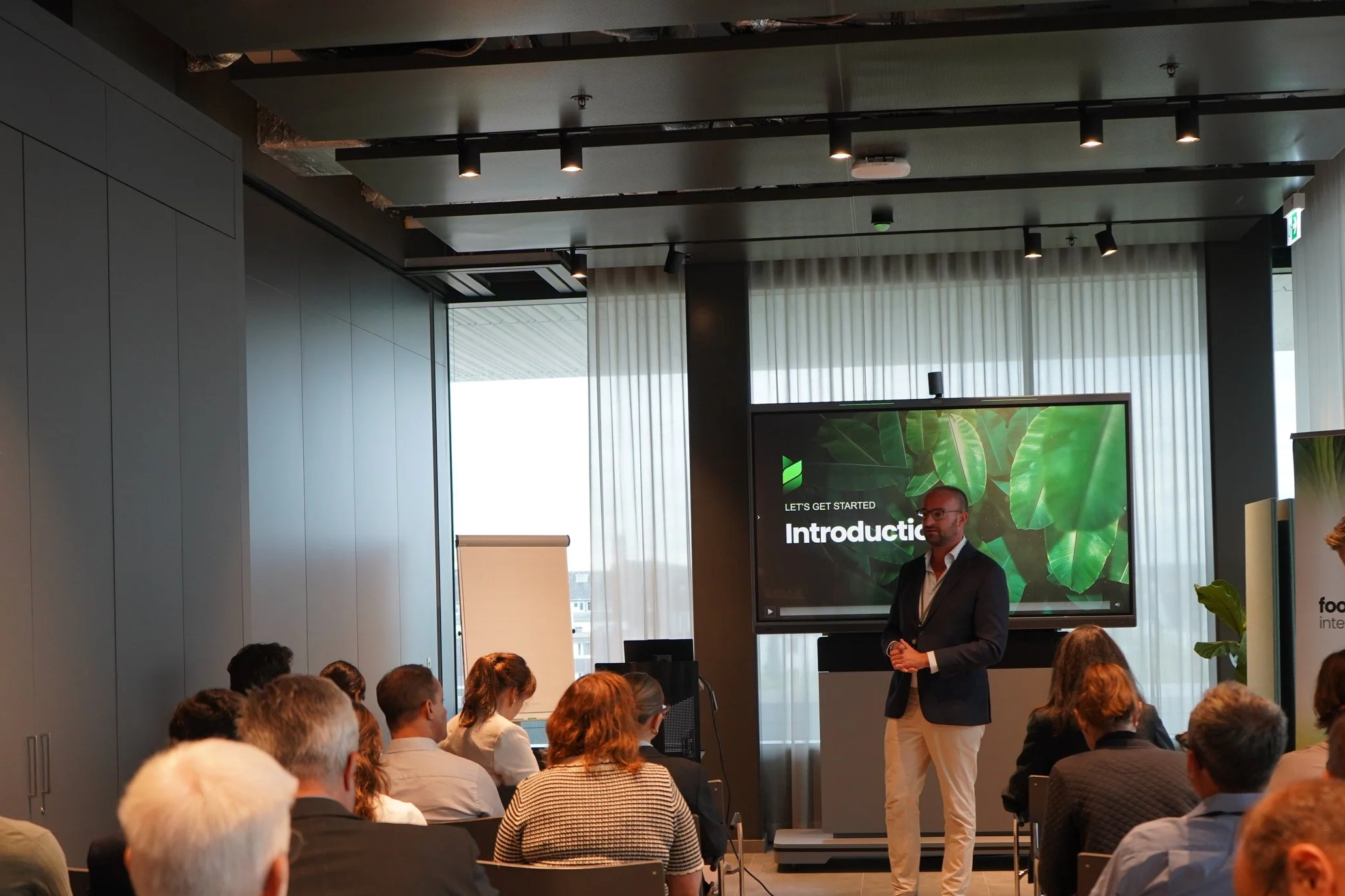
Under the title AI for Sustainable Operations — From ESG Complexity to Resilience & ROI, the Leadership Breakfast co-hosted by EY and Footprint Intelligence set out to answer two connected questions. First, how can sustainability evolve from a compliance exercise into a strategic capability — one that informs risk management, shapes supply-chain decisions and earns its place in the business case? Second, where can AI realistically help: by cutting the data and reporting burden that consumes most sustainability teams today, by monitoring compliance and screening risk, and by quantifying the business value of measures so that better decisions get made faster. The morning combined a live pulse survey of the room, framing presentations from EY on organizational readiness and from Footprint Intelligence on AI-supported decision-making and a leadership panel with practitioners from Bayer, DHL Supply Chain and Schaeffler.
What emerged was not a tidy consensus but something more useful: a shared vocabulary for a transition that many organizations are living through simultaneously — and a clear-eyed view of what AI can and cannot do within it. This article captures that vocabulary — the data, the arguments, the examples and the tensions.
Who was in the room — and why that mattered
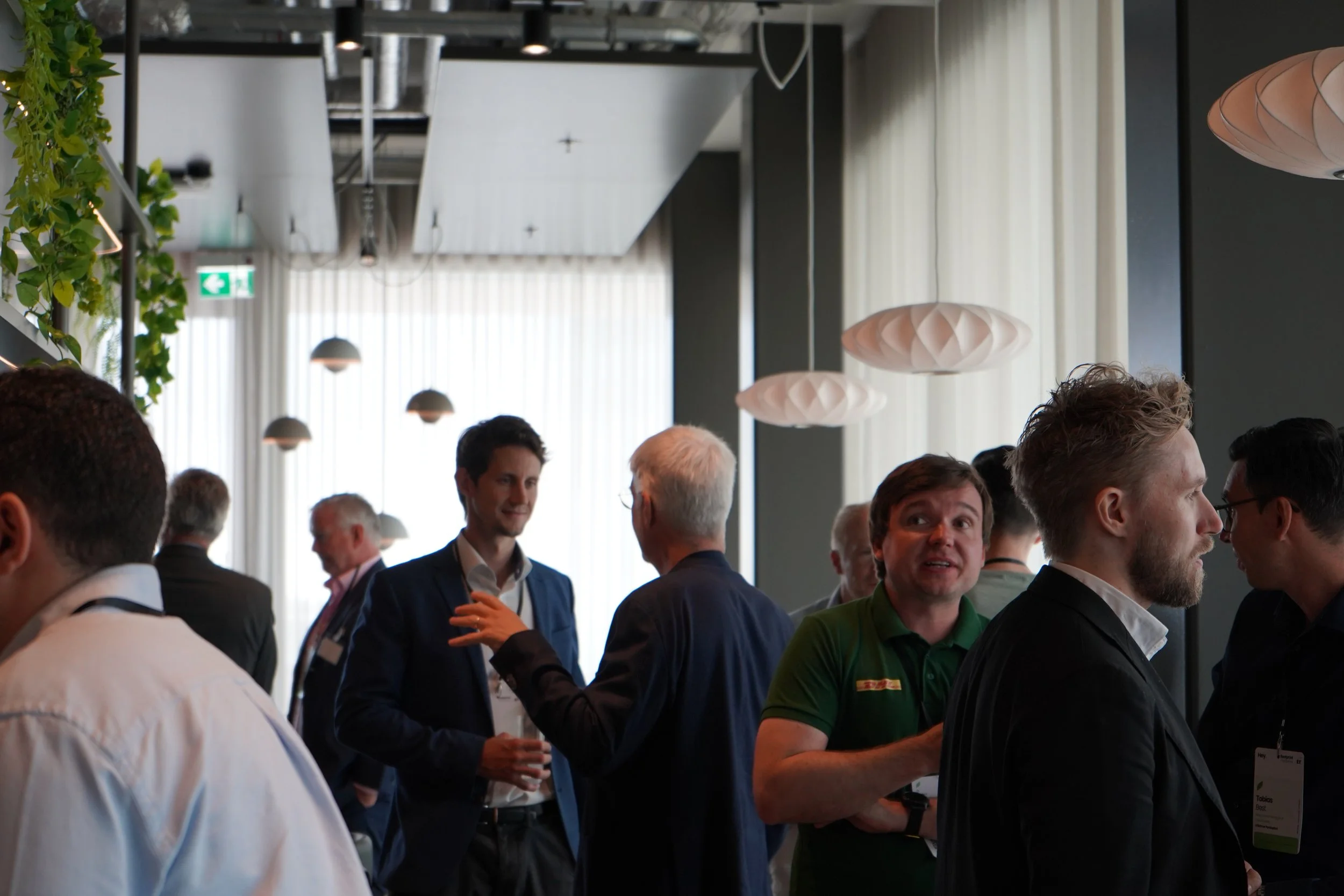
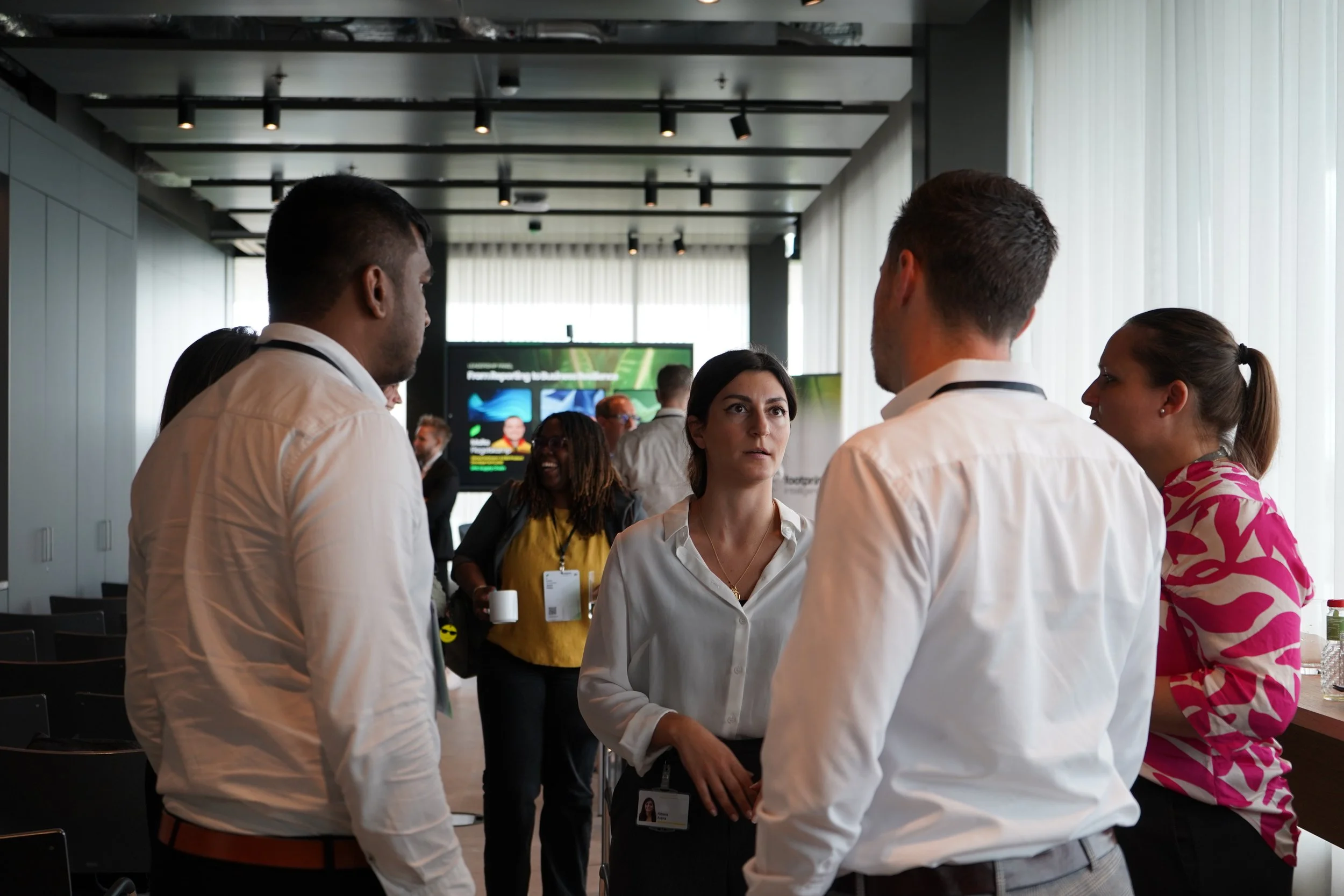
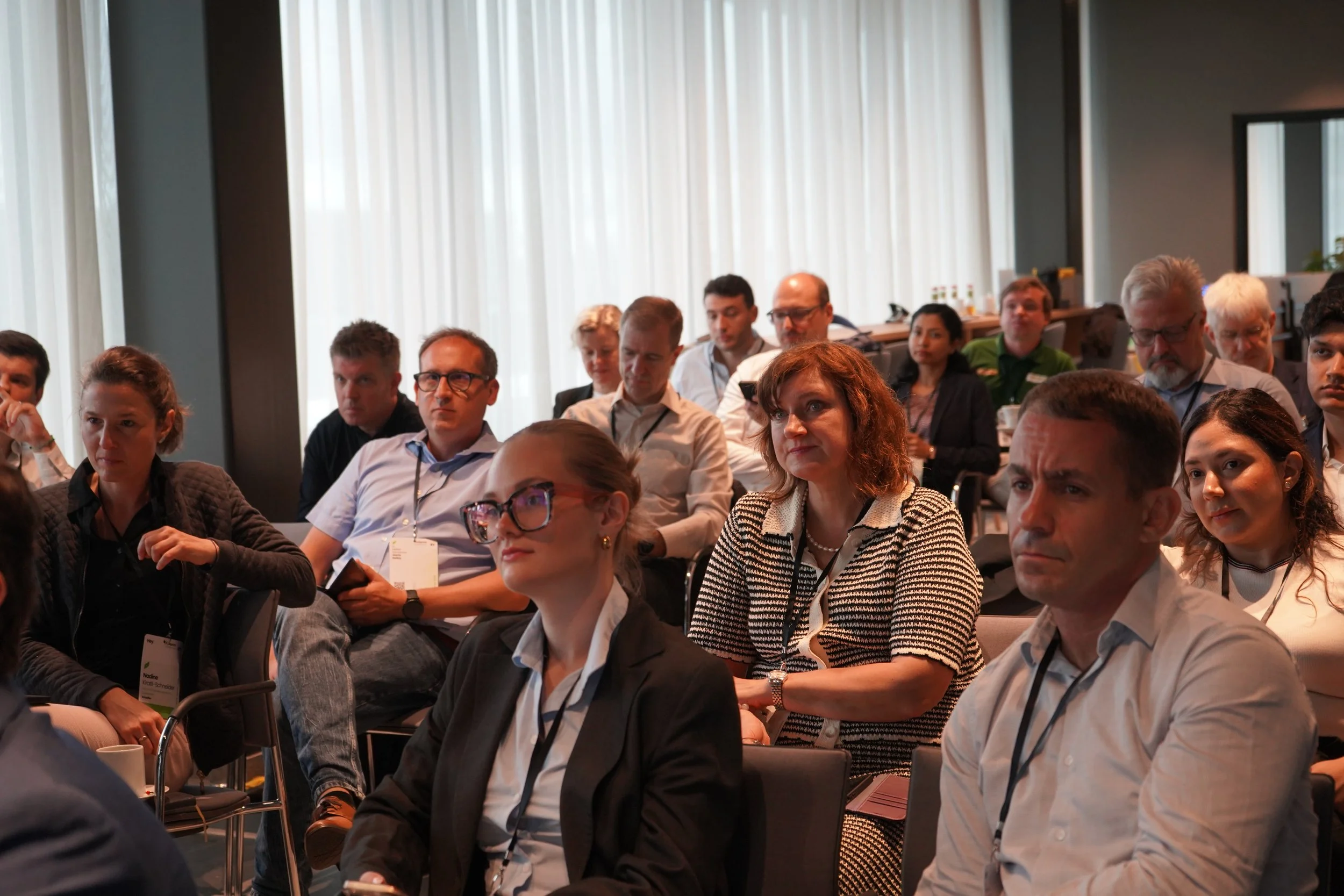
The guest list was deliberately cross-functional. Sustainability leads were present, but so were heads of procurement, supply-chain directors, EHS managers, packaging engineers and corporate strategy developers.
Industries represented spanned construction, steel and industrial services, automotive supply, industrial gases, consumer goods and personal care, specialty chemicals and hygiene solutions, packaging, energy, pharma and life sciences, parcel and contract logistics, elder care, travel, banking, electronics, and IT services.
This composition was itself a finding. Several participants noted during the introduction round that the challenges they face are no longer purely "sustainability topics". They sit at the intersection of sustainability, procurement, supply chain, risk, finance and corporate strategy — and increasingly require all of those functions in the same room.
The introduction round surfaced a familiar cluster of pain points: data ownership scattered across functions and systems; Scope 3 as a persistent resource drain; the growing weight of ESG ratings such as CDP and EcoVadis; a regulatory stack that now includes CSDDD, CBAM, EUDR and ESG disclosure requirements; and the sobering reality that much of the underlying work remains manual. One participant described a data landscape in which no central sustainability data layer exists at all, making every coordination step between Sustainability, Procurement, Operations and Finance a negotiation.
The pulse check: What our research programme revealed
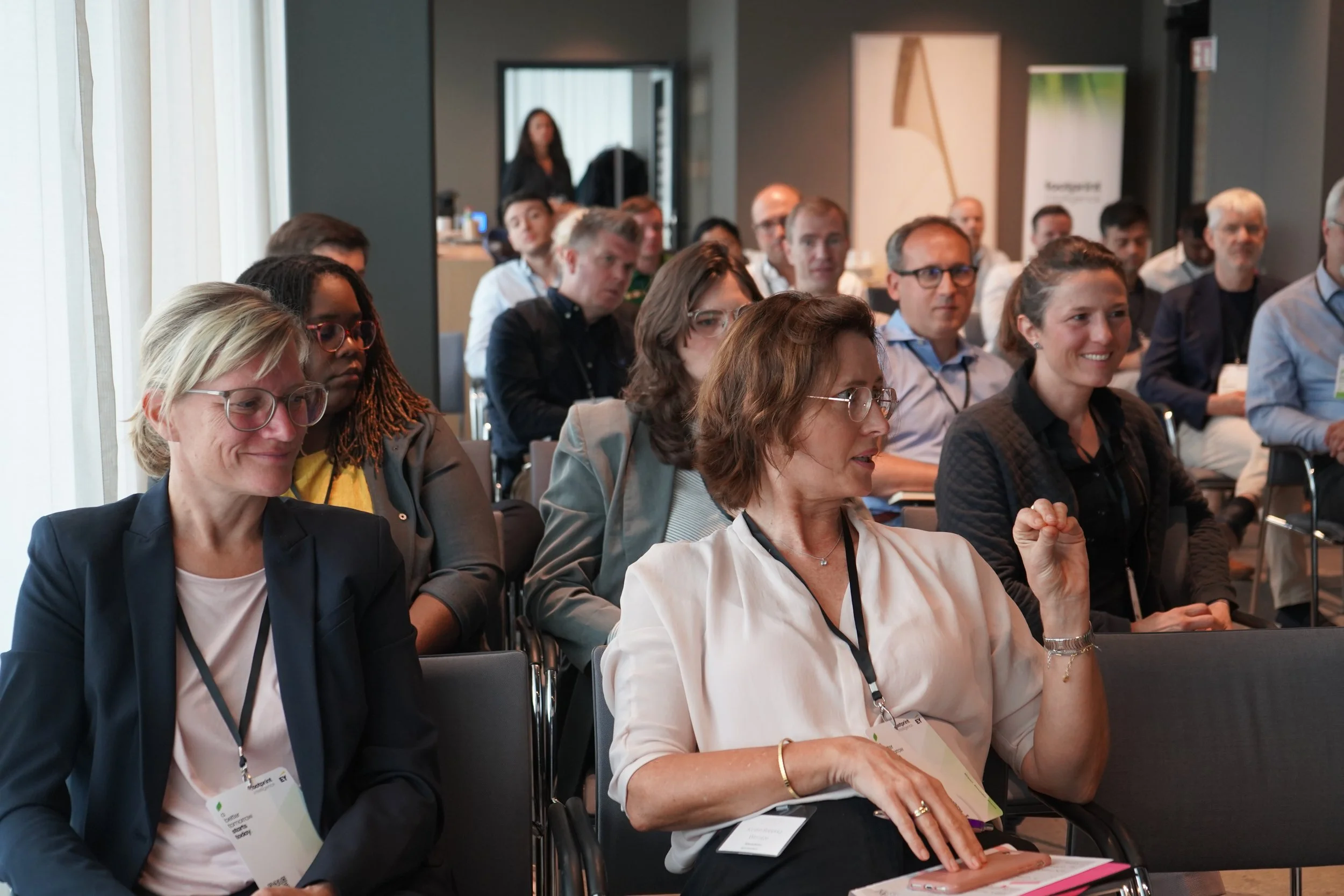
As part of Footprint Intelligence's ongoing research programme on the state of sustainability management, the morning was opened with a live survey.
1. Compliance still tops the agenda, but strategy is climbing
Asked which sustainability topics are currently highest on their organization's agenda, participants placed regulatory compliance first (41%) and Scope 3 and data quality second (37%). Behind those two, strategy and business impact (26%) already ranked third — ahead of carbon accounting, sustainability reporting and product sustainability, each at 22%.
The bottom of the list is as revealing as the top. Decarbonization (15%), suppliers and resilience (11%) and climate risk and resilience (4%) trail far behind.
What it reveals: Agendas are still set by external obligation, not by internal risk. Climate risk and resilience, the very topic the panel would later identify as the strongest bridge between sustainability and business strategy, is barely on the radar. The gap between where the agenda sits and where the value sits was the unspoken theme of the whole morning.
2. Strategy and procurement own the levers
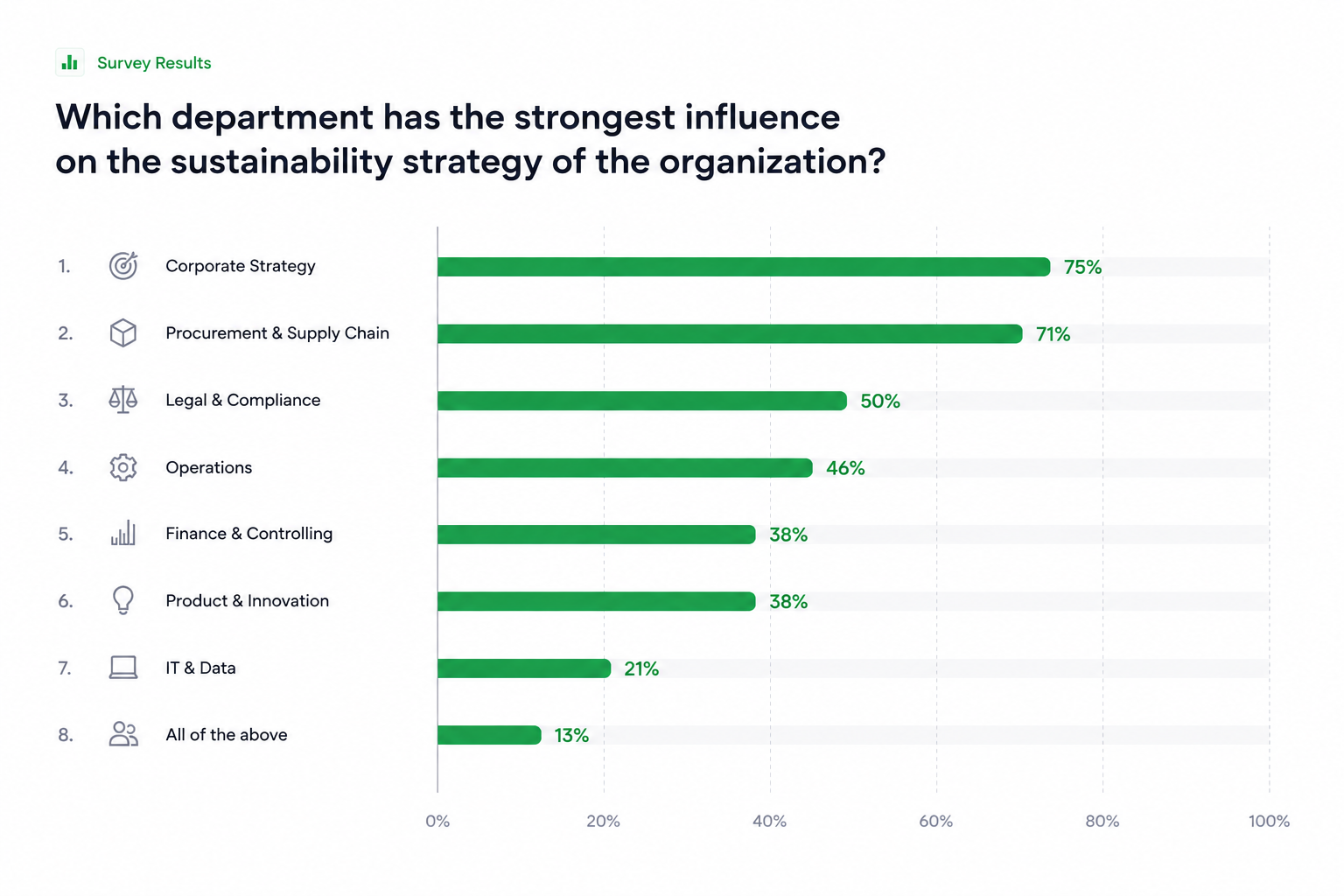
When asked which department has the strongest influence on the sustainability strategy of the organization, the room's collective ranking placed Corporate Strategy first, followed by Procurement and Supply Chain, Legal and Compliance, Operations, Finance and Controlling, Product and Innovation and — last among the named functions — IT and Data.
What it reveals: Two things stand out. First, procurement and supply chain outrank finance, operations and product — a signal that in the current phase, sustainability is being shaped more by who buys and who moves goods than by who designs or who pays. Second, IT and Data rank last, even though data was named as the single greatest bottleneck by almost everyone. This points to a notable disconnect: the function most closely associated with solving the data challenge has the least influence on sustainability strategy. That gap may help explain why data remains such a persistent bottleneck.
3. Sustainability teams are still data teams
The question of where sustainability teams currently spend the most time and resources produced the clearest result of the morning. Data validation and data quality (37%) came first, followed by internal data collection (33%) and cross-functional coordination (33%). Reporting (30%) and strategy and transition planning (30%) tied for the next place. Implementing and tracking measures — the activity that actually reduces emissions — was named by only 22%. Scope 3 as a discrete task and audits and questionnaires each drew 7%.
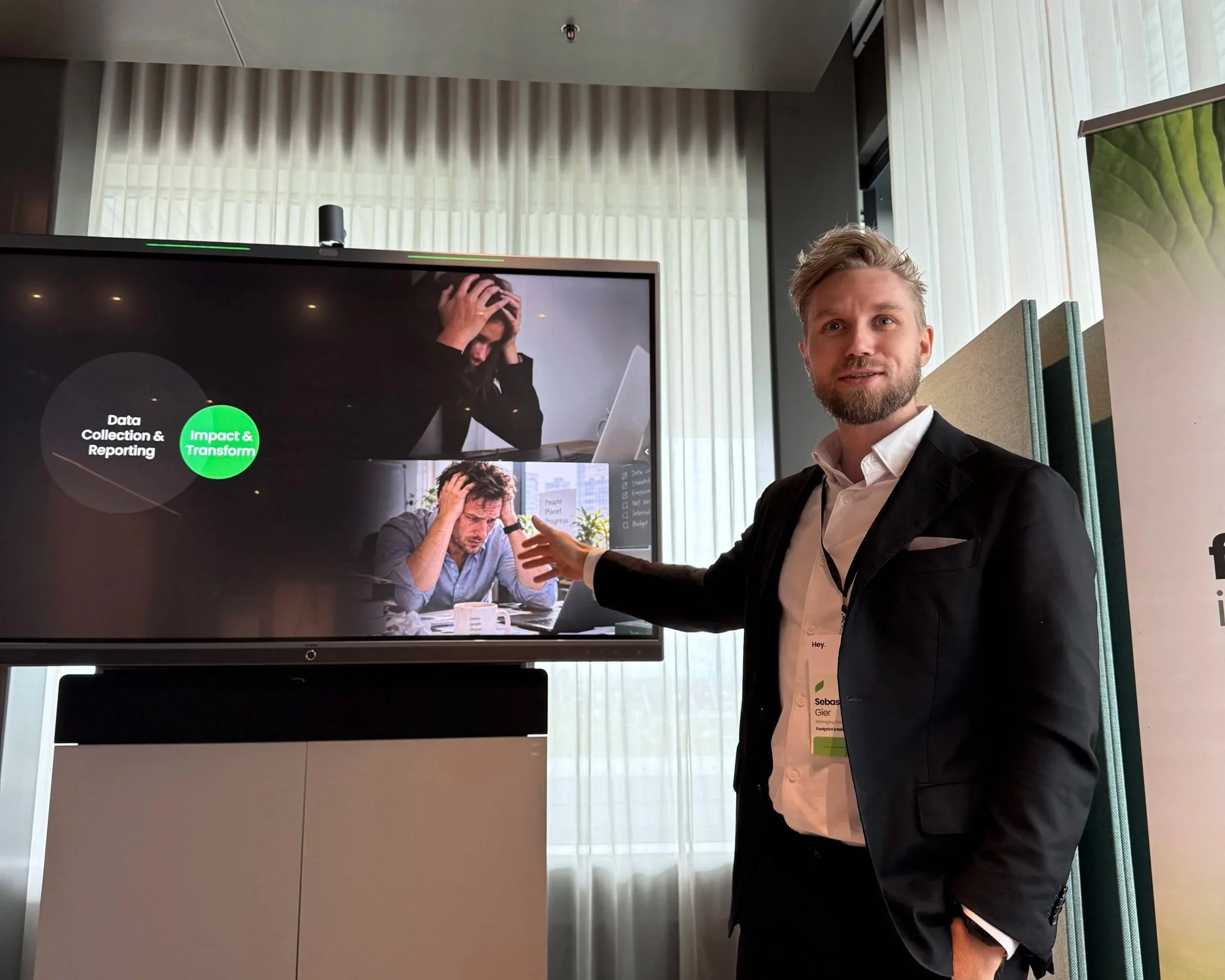
What it reveals: Three of the top four time sinks are forms of the same problem: getting data that exists somewhere in the organization into a form that can be trusted. Strategy and implementation together receive a minority of the team's attention. The picture is one of highly qualified professionals spending the majority of their capacity upstream of any decision. This is precisely the shift that Footprint Intelligence would later frame as moving resources from "Data Collection & Reporting" toward "Impact & Transform".
4. AI is expected to fix the paperwork
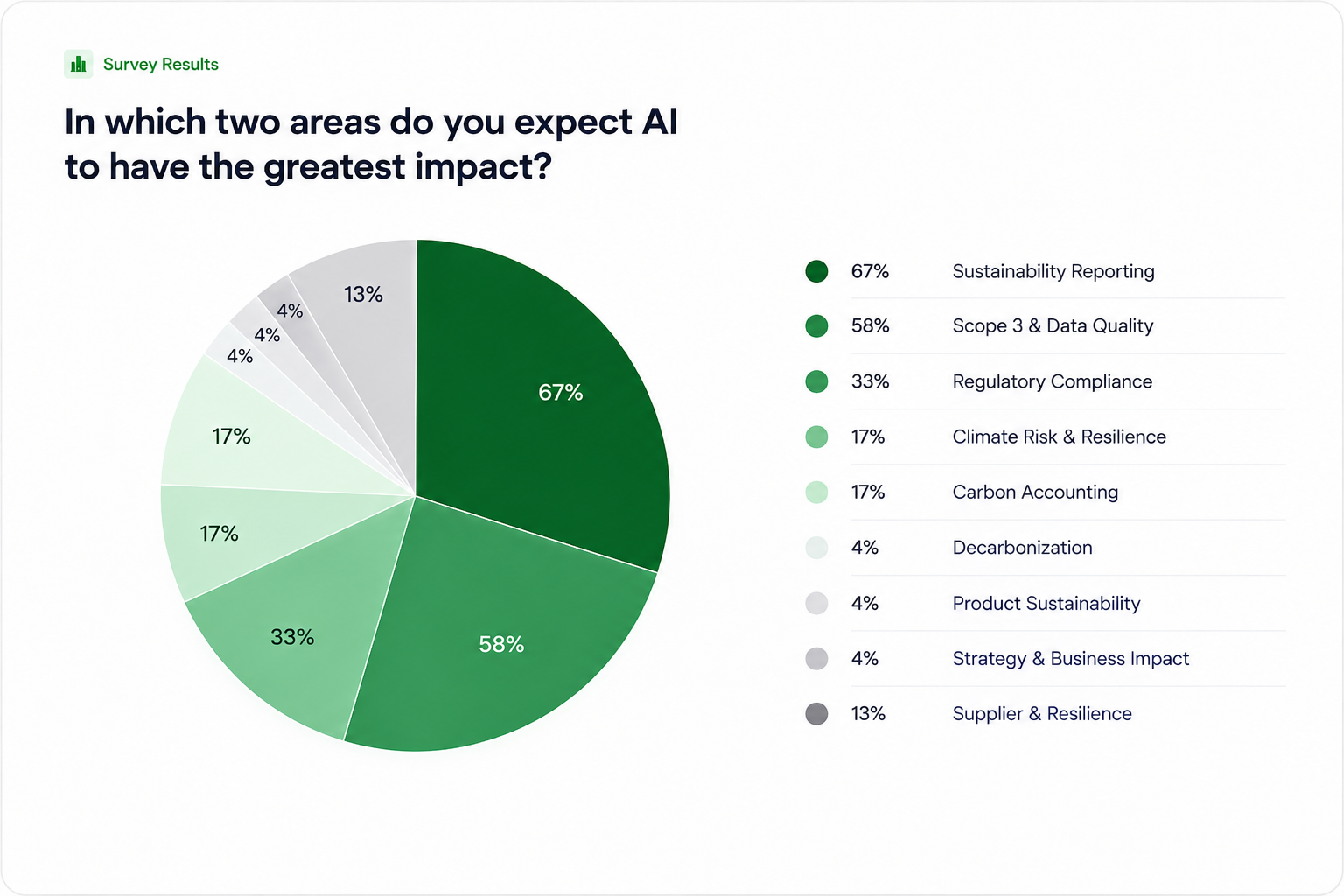
Participants were asked to choose the two areas in which they expect AI to have the greatest impact. Sustainability reporting (59%) and Scope 3 and data quality (52%) dominated. Regulatory compliance (30%) and carbon accounting (19%) followed. Then the curve drops sharply: climate risk and resilience (15%), supplier and resilience (11%), and — at 4% each — decarbonization, product sustainability, and strategy and business impact.
What it reveals: Practitioners currently see AI as a way to relieve the burden they feel most acutely: reporting and data. That is rational — it is where the hours go. But it also means the room expects AI to make the reporting phase more efficient rather than to change what sustainability is for. Almost nobody yet expects AI to help decide which measures to prioritize, how to quantify a business case, or how to anticipate physical and transition risk. The implication is that the market is at the beginning of an adoption curve: first automate the burden, then discover that the freed-up capacity can be spent on decisions. The organizations that reach the second stage first will have a meaningful head start.
Taken as a set, the four questions tell a single story. Compliance sets the agenda; data consumes the team; strategy and procurement hold the decision rights; and AI is expected to relieve the administrative load. What is missing from the picture is resilience — as an agenda item, as a use case for AI, and as a shared language between sustainability and the business. The rest of the morning was, in effect, an argument for closing that gap.
Organizational readiness: Is your company set up to turn ambition into outcomes?
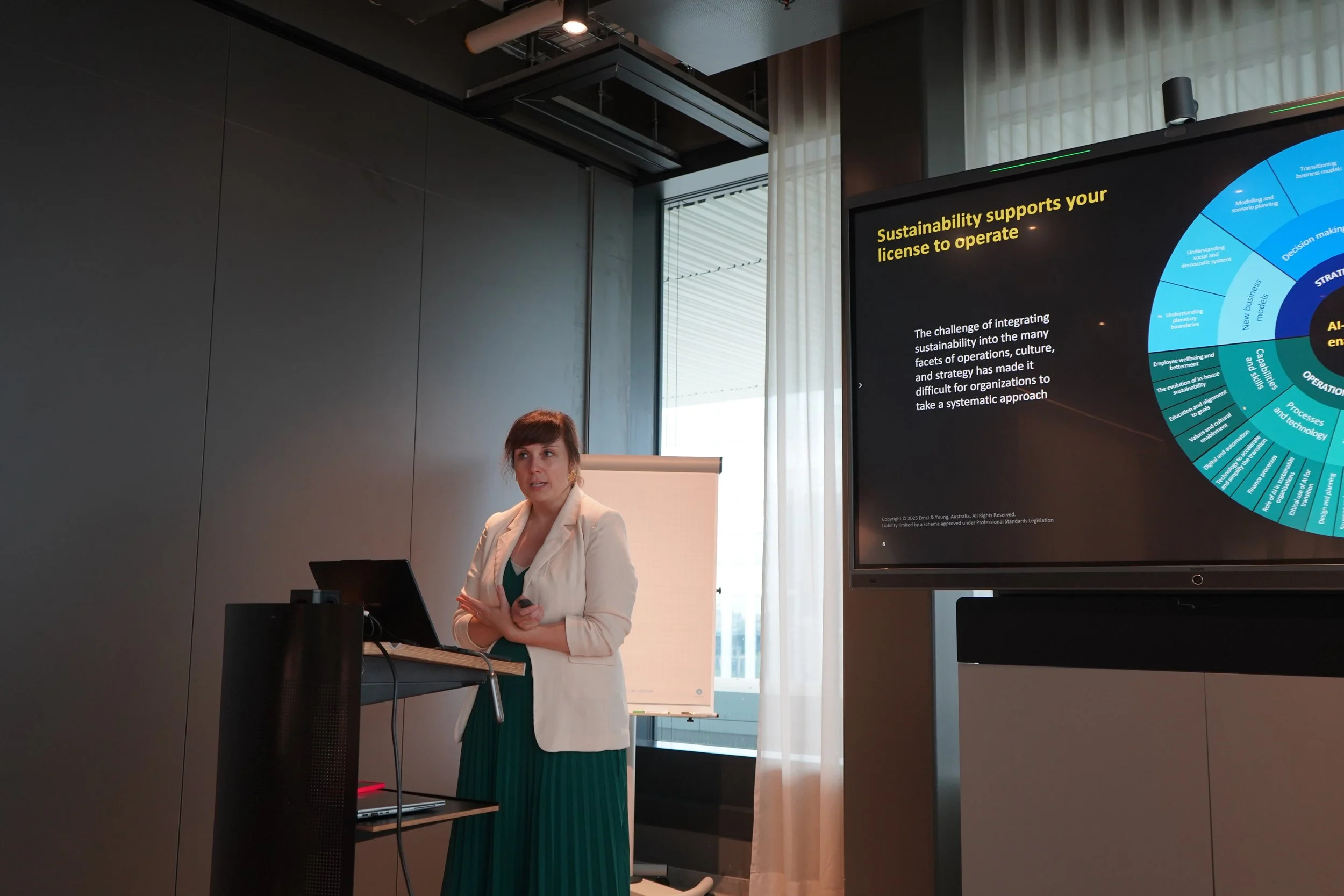
EY opened its presentation with a question rather than a framework: Are you prepared for this? The "this" was a summer of climate impacts that EY presented as increasingly routine rather than exceptional — record heat, low water levels on the Rhine that raised transport costs, reduced crop yields, flooding that damaged infrastructure and interrupted business, rising insurance premiums, and falling labor productivity.
EY's argument was that sustainability supports a company's license to operate, and that most organizations already have the visible artefacts of a sustainability strategy — targets, KPIs, a report — but lack the connection between those artefacts and daily operational decisions. Their Sustainable Operating Blueprint frames the challenge along two dimensions:
Strategic clarity — the capacity to navigate volatility and build resilience into the organization's long-term direction.
Operational embeddedness — the mechanisms that ensure aspirations are pursued and achieved through everyday business practice.
Organizations are assessed on a maturity scale from Constrained through Emerging, Transitioning and Sustainable to Regenerative, and the assessment is supported by an AI-enabled process: feed existing documentation into an analysis agent, form hypotheses about entry points and stakeholders, validate those hypotheses with the business, and synthesize them into "Do Now, Do Next, Do Later" recommendations.
The most instructive part of EY's session was a worked example from product design and planning. Picture a manufacturer that has already lightweighted a priority product, completed a life-cycle assessment, identified recycled packaging material, and involved its sustainability team. Real progress — and yet the organization is still only "Transitioning". Why? Because the outcome depends on the team, the product and the strength of an individual sponsor. Repeat the exercise with the next product, in a different business unit, under a tighter launch timeline, and the LCA may not be repeated; the recycled content may vanish under cost pressure; repairability may remain voluntary.
EY's conclusion: value remains trapped in pilots until an organization changes the default — mandatory design gates, minimum performance thresholds, portfolio-wide targets, product and cost data that are connected, and explicit decision rights for when environmental and commercial objectives pull in different directions. The ROI levers are real (lower material cost, reduced warranty exposure, aftermarket revenue, reduced exposure to volatile virgin inputs, better access to sustainability-led tenders), but they only materialize when the system, not the individual, makes the sustainable outcome repeatable.
Three discussion themes followed. Sustainable packaging was raised as an area where sustainability must be embedded in product and operational decisions rather than managed as a separate initiative. Customer expectations were described by several participants as becoming as important as regulation in driving change. And a recurring question — how do we leverage sustainability rather than merely comply with it? — made clear that many organizations are still early on that journey.
From data collection to impact: Where AI actually helps
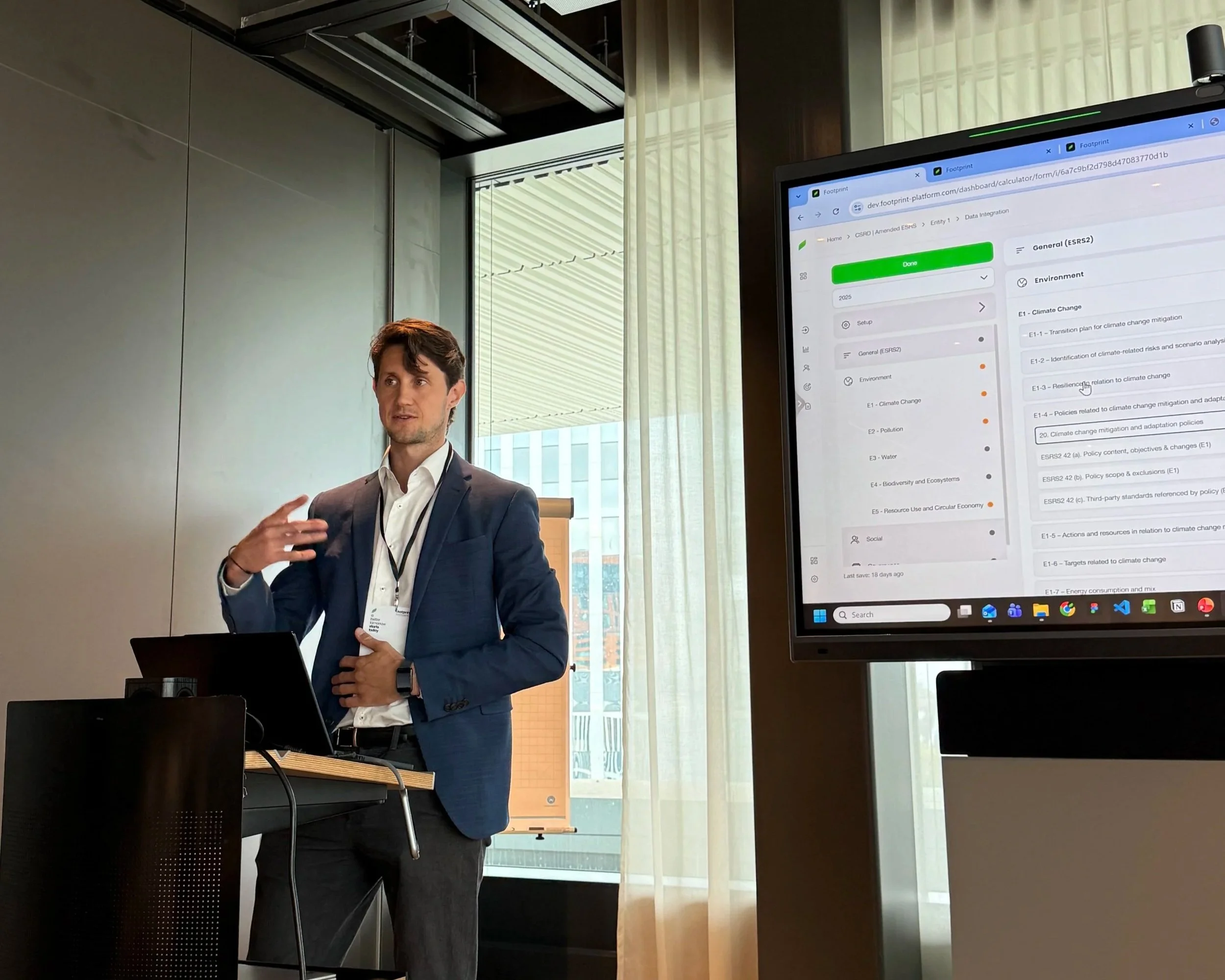
Footprint Intelligence's session picked up exactly where the survey left off. The core framing was a shift in where sustainability teams spend their capacity: away from Data Collection & Reporting and toward Impact & Transform. The presentation's premise was that the reporting burden is not going to disappear — but that it can be compressed, and that the capacity this frees up is the most valuable resource a sustainability team has.
Five use cases anchored the discussion:
ESG data integration. The recurring absence of a sustainability data layer means data arrives from multiple internal systems (ERP, procurement, logistics, facilities) and external sources (suppliers, emission-factor databases, ratings). AI can structure, match and reconcile fragmented inputs into a usable foundation — the prerequisite for everything downstream.
Ratings and questionnaires. AI can prepare and structure the information required for EcoVadis, CDP and customer assessments. The room was emphatic on one condition: outputs must be validated by humans before they enter any disclosure or assessment. Speed without verification simply moves the risk.
Compliance via AI agents. Agents that monitor regulatory requirements and reduce manual compliance work were discussed as a realistic near-term application, particularly for the growing stack of LkSG, CBAM, EUDR and disclosure obligations.
Sustainability claims. The EU's Empowering Consumers Directive came up as a concrete example of how sustainability data now connects directly to Marketing, Legal, Product and Risk Management. A claim that cannot be substantiated with data is no longer a communication issue; it is a liability.
The ROI of sustainability. The session argued that measures should be evaluated across several value dimensions simultaneously — cost reduction, risk mitigation, revenue opportunity, customer value and resilience — and that quantifying these alongside emission impact is what earns a measure a place in the investment plan.
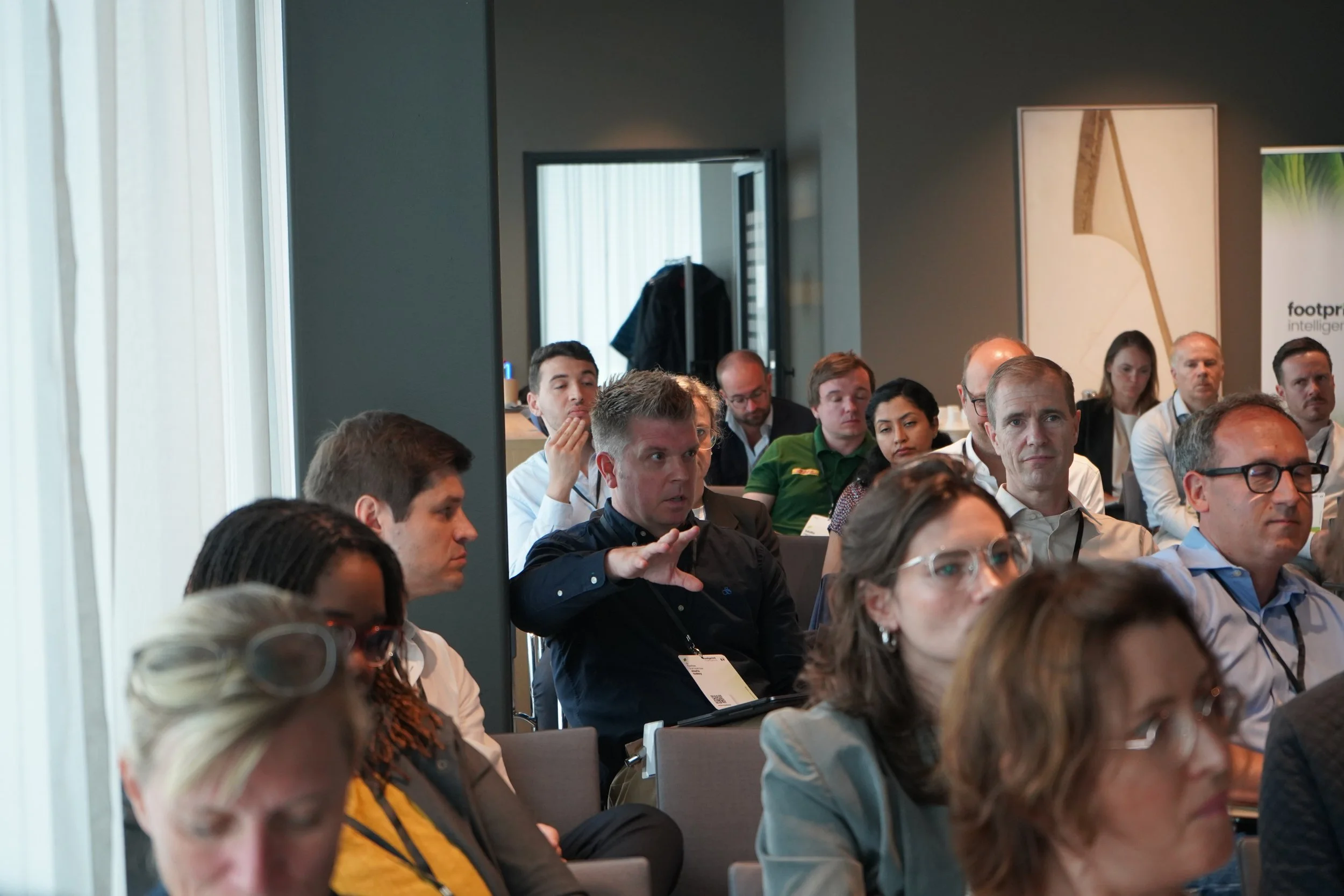
The most important intervention came from the room rather than the stage. AI should not replace critical thinking. The advice was unambiguous: do not start with the technology; start with the problem or the business challenge, then assess where AI can help. Human judgement remains irreplaceable when setting strategy, interpreting risk, communicating with management, deciding which stakeholder to involve first, and validating what an AI system produces. That framing — problem first, technology second, human judgement throughout — was echoed by every panelist that followed.
The leadership panel: From sustainability to business resilience
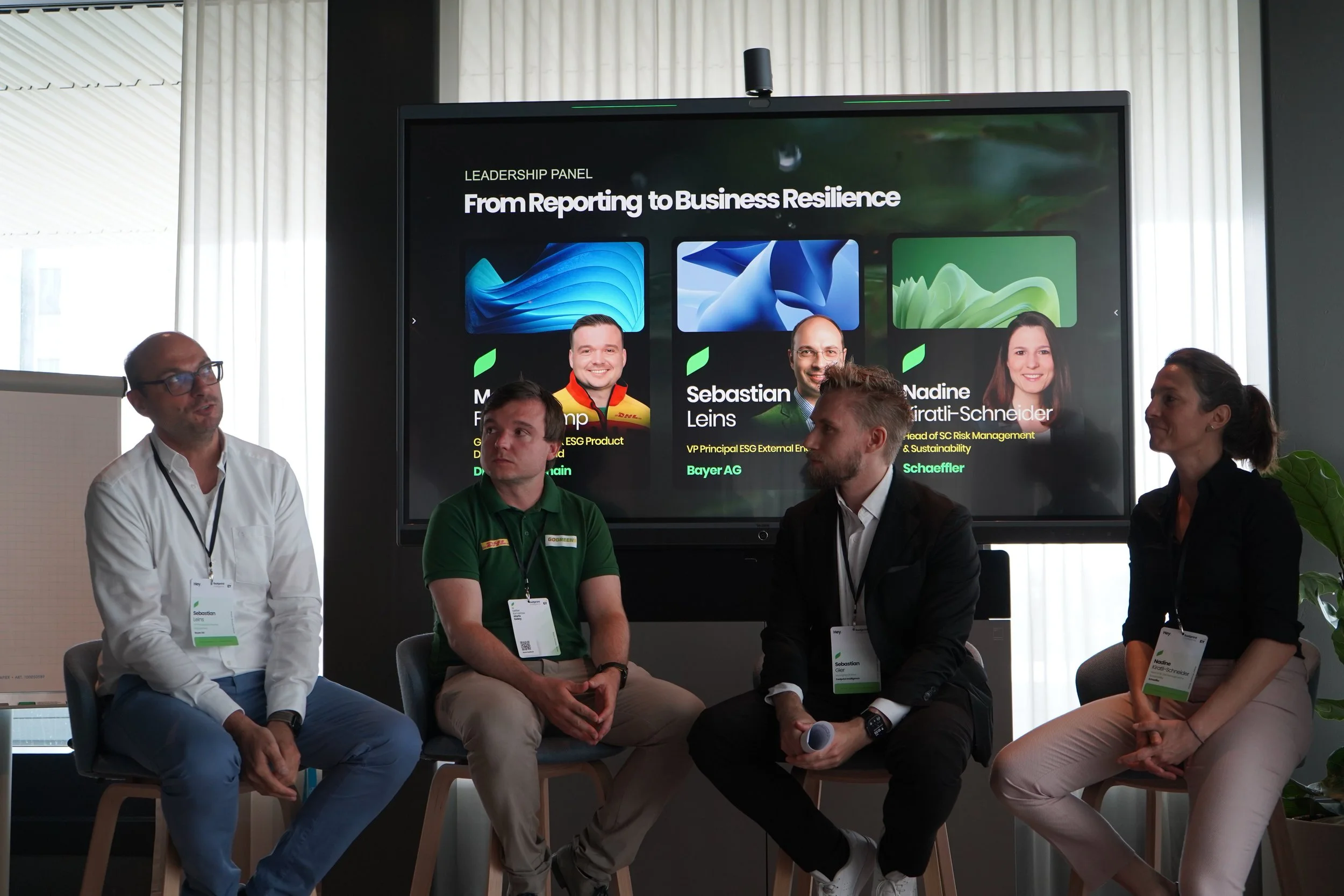
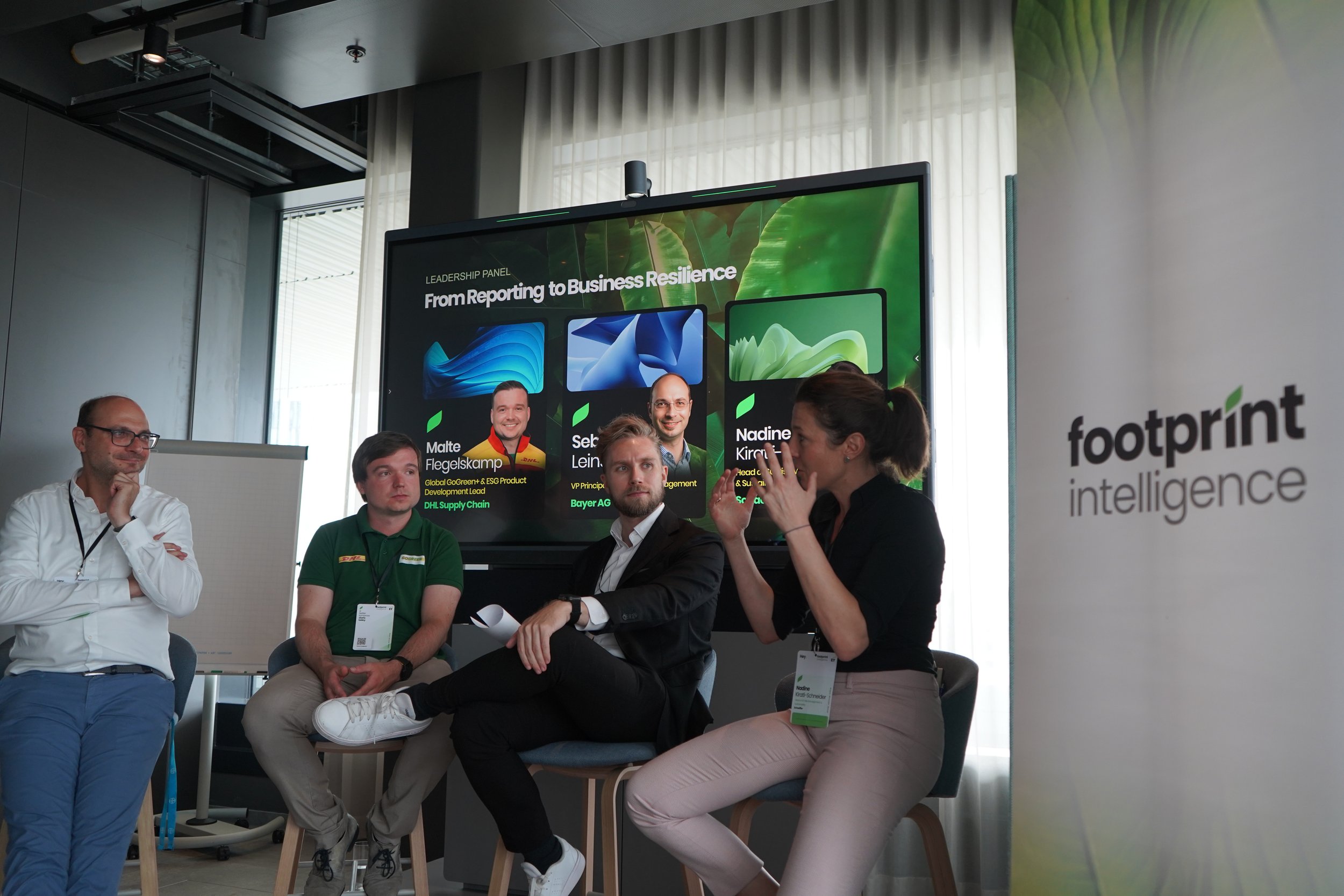
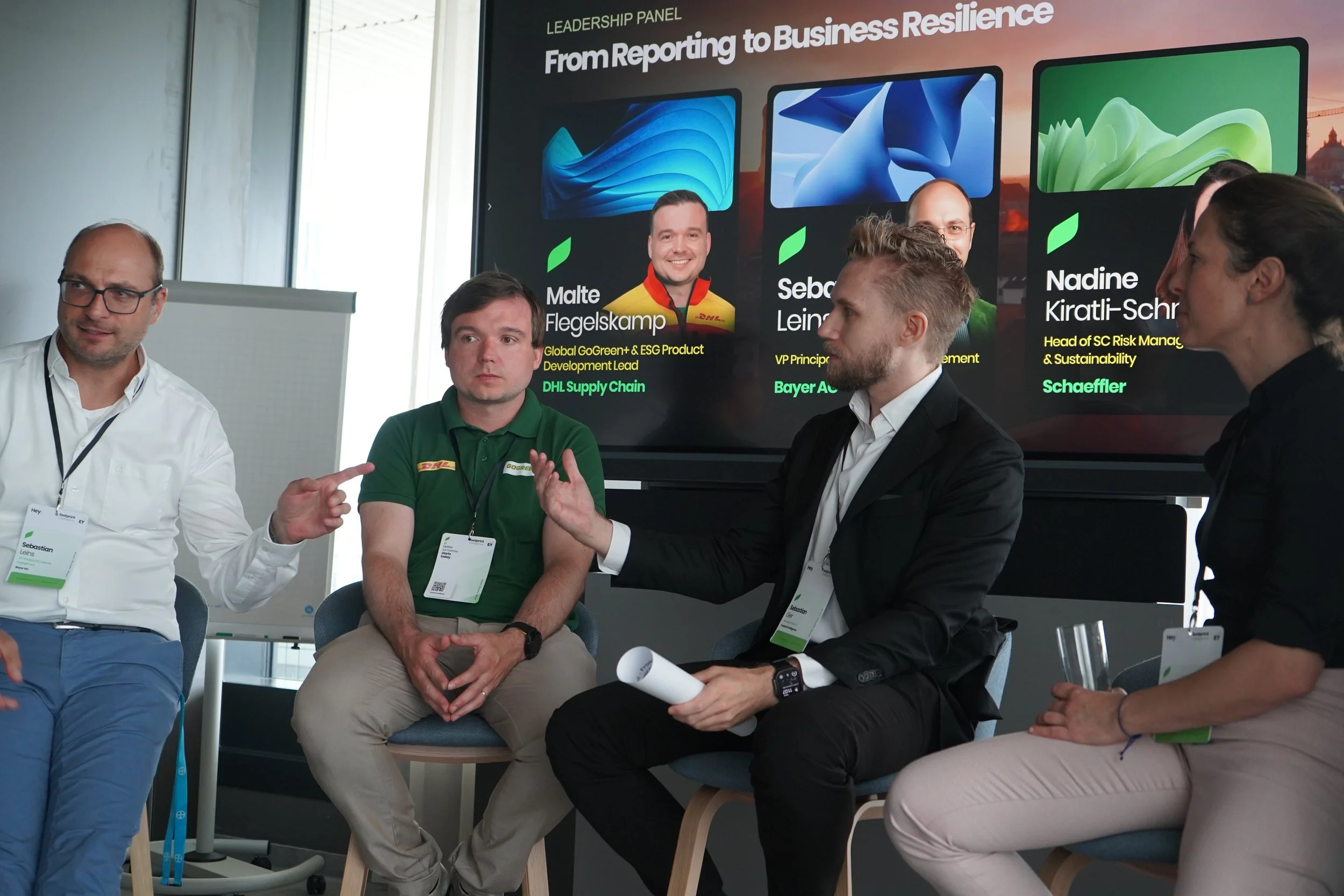
The panel brought together three complementary perspectives on this transition::
Sebastian Leins, VP Principal ESG External Engagement at Bayer — responsible for sustainability reporting including CSRD, ESG ratings and investor-relevant disclosures, with a strategic focus on enterprise risk, regulation, human rights, supply chains and EU-level policy.
Malte Flegelskamp, Global GoGreen+ & ESG Product Development Lead at DHL Supply Chain — working at the interface of product development, strategy, sales, compliance and data processes to build decarbonization strategies and compliant sustainable logistics products with large B2B customers, primarily in warehousing and road freight.
Nadine Kiratli-Schneider, Head of Supply Chain Risk Management & Sustainability at Schaeffler — leading a team that combines transport risk management with emissions reduction, target setting, measure planning and execution, and contributing to the group's climate risk assessment.
Risk and sustainability are converging
Nadine Kiratli-Schneider opened with an observation that framed much of the discussion: risk management and sustainability are becoming the same conversation. Her team's mandate is to screen global risks across the locations — identify them, assess their relevance, understand the impact on transportation and supply chains, and develop mitigation measures. Supply-chain resilience, in the end, means keeping cargo and materials moving.
The catch is that almost every transportation decision has an emissions consequence. When a geopolitical disruption threatens a freight lane, the first priority is continuity of supply — but the reflexive solution, switching to air freight, carries significant cost and emission penalties. The team's job is therefore not to optimize a single KPI but to find alternatives that hold continuity, cost and emissions in balance. Sustainability, transportation and risk teams increasingly need to work as one.
She described her role as sitting between the commercial pressures of the operating business and the demands of governance. A recurring challenge is finding the budget for decarbonization — and keeping it on the agenda when other functions are focused on more immediate priorities.
Speaking the language of the stakeholder
The strongest single theme of the panel was linguistic. Sustainability arguments alone, Nadine Kiratli-Schneider noted, do not always create enough internal momentum. Her team increasingly frames issues in terms of financial resilience, operational risk, cost exposure, security of supply and customer requirements. Before trying to convince anyone, the questions are: Who am I speaking to? What are their KPIs? What are they accountable for? Who owns the budget? What language makes this relevant to them?
Sebastian Leins described the same shift. Sustainability needs to be connected to enterprise risk management, commercial exposure, legal risk, reputation and resilience. The sustainability argument does not disappear — it is translated into the language of the person who has to make the decision.
Sustainability as enterprise risk
Sebastian Leins was direct about what many years in the field had taught him: sustainability has to be understood as part of enterprise risk management, not alongside it. He offered three illustrations.
The first was physical: dependence on the River Rhine. Low water levels disrupt transportation and raise logistics costs. When management sees climate impact as a tangible business risk rather than an abstract sustainability concern, the conversation changes.
The second was the supplier base. A company with a very large number of suppliers carries exposure to human-rights, climate, environmental and regulatory risks across that base, and the objective is to identify and mitigate them before they materialize.
The third was regulatory: environmental claims. Under emerging rules, breaches may expose companies to financial penalties linked to annual revenue. That transforms a marketing question into a board-level risk.
His takeaway was that quantifying sustainability-related risk is the lever. Once management understands the possible financial exposure, integrating the issue into core business decisions becomes far easier. He also cautioned against maximalism: there is no one-size-fits-all strategy, and an incremental five percent improvement delivered consistently can matter more than a hundred-percent ambition that never lands. Oncology treatments that must be air-freighted worldwide cannot be decarbonized the way consumer goods can — the strategy must follow the business model.
"Burn less and burn clean"
Malte Flegelskamp brought the operational logistics view. Depending on the market, DHL Supply Chain operates its own fleet or outsources transport, which means the same emissions can fall into different scopes in different countries — a reminder that reporting architecture is itself an operational choice. The company is moving toward shipment-level carbon data so that customers and internal teams can make decisions at the level where decisions are actually taken.
His decarbonization framing was memorably simple. Burn less: route and network optimization, better capacity utilization, shared transportation networks, more efficient planning. Burn clean: alternative fuels, lower-carbon transport options, fleet technology transition.
The distinction matters for the business case. Network optimization is a rare win-win — lower emissions and lower operating cost reinforce each other. Solar PV on a warehouse roof is straightforward to justify. Alternative fuels, by contrast, deliver no direct saving; the value is strategic, and someone has to pay the premium. Warehousing, roughly half the business, already offers a good deal of "default" sustainability — green electricity, LED, sustainable buildings — that is not separately priced. Road freight, the other half, is where decarbonization is expensive and where the willingness to pay is tested. High-margin customers in sectors such as luxury or pharma tend to be far more willing than others.
Sustainability targets meet commercial reality
Malte Flegelskamp also surfaced a structural tension specific to contract logistics. Providers work from one tender cycle to the next and may not know whether they will still operate a given customer contract in a few years' time. Customers, meanwhile, expect ambitious long-term decarbonization commitments that require investment today.
The example he gave was a customer asking a logistics provider to sign a general decarbonization commitment. Legal is reluctant to sign broad or generic pledges. Account management wants to meet customer expectations and stay competitive in the tender. Sustainability wants credible commitments. Operations needs solutions that are technically and financially feasible. This was perhaps the morning's clearest illustration of sustainability as a cross-functional business decision rather than a sustainability-team decision.
He also noted that small pilots are legitimate — two or three electric trucks in one country can be valuable and need not scale immediately — while very small volumes of alternative fuel are hard to make work. And he welcomed the tightening of green-claims rules: not everything can simply be called carbon neutral, and that discipline improves the market.
Never waste a crisis
One of the most memorable exchanges concerned the European energy crisis. When energy security became an operational emergency, measures that had previously been discussed primarily as decarbonization suddenly acquired a second rationale: energy security, price stability, operational resilience. Measures with a weak short-term return under normal conditions became commercially attractive once energy prices rose, supply became uncertain and geopolitical exposure increased.
The lesson the panel drew was not to wait for crises but to use them. "Never waste a crisis" — whether an energy shock, a geopolitical disruption, a transport bottleneck or a physical climate event — because moments of disruption create a window for resilience investments that are otherwise hard to justify.
KPI conflicts, trade-offs and the business-case question
Nadine Kiratli-Schneider framed many sustainability challenges as, at their core, KPI conflicts: cost versus emissions, continuity versus emissions, speed versus sustainability, customer expectations versus operational feasibility, short-term financial targets versus long-term resilience.
Asked directly whether every sustainability measure needs a clear business case, her answer was nuanced. Not every measure does. Where a company has committed to a target, delivering the measure is an obligation regardless of the payback calculation; the business-case question then shifts from whether to how cost-efficiently. But that only works when the trade-offs are transparent. The goal is not to eliminate them — that is impossible — but to make them visible so that better-informed decisions can be taken.
AI in risk management
The panel closed on AI. Nadine Kiratli-Schneider's starting point was consistent with the earlier discussion: begin with the problem, not with an "AI target". The pressure her team faces is more risks, more data, fewer resources and higher management expectations. With the underlying risk-management process now more mature, automation becomes the logical next step. Agentic approaches could enable continuous risk screening, identify changes early, prioritize emerging issues and help prepare mitigation options — supported by internal data-science capabilities.
What AI does not replace, she was clear, is strategic judgement, stakeholder management, prioritization, management communication and knowing whom to involve first. Everything that is manual today is a candidate for automation; the leap to strategy still requires human creativity.
Summary: Ten conclusions from Düsseldorf
1. Sustainability is a cross-functional management topic. Sustainability teams alone cannot deliver the transformation. Procurement, Supply Chain, Risk, Finance, Operations, Strategy, Legal and Commercial all hold pieces of it — and the survey shows Strategy and Procurement hold the largest.
2. Resilience is the strongest bridge to the business. Climate, resource, supplier and geopolitical risks make sustainability directly relevant to operational continuity. Yet only a small minority of participants have it on their agenda. That gap is an opportunity.
3. The language is changing. "Financial resilience", "risk", "cost", "security of supply" and "customer value" create more internal traction than sustainability terminology alone. The argument does not disappear; it is translated.
4. Data remains the bottleneck. Validation, collection and coordination consume the majority of team capacity, while implementation receives a fraction. The function best placed to fix this — IT and Data — currently has the least strategic influence.
5. AI should solve a defined problem, not become an objective. The most credible applications are data integration, compliance monitoring, ratings preparation, risk screening, supplier assessment and more granular carbon reporting.
6. Human judgement is not optional. AI can automate analysis; strategy, trade-offs and stakeholder management remain human responsibilities — and every AI output that enters a disclosure needs a human check.
7. The best business cases combine several value dimensions. Emissions, cost, risk, customer value, regulatory protection and resilience together make a case that any single dimension cannot.
8. Trade-offs are unavoidable. The goal is to make them transparent, not to pretend they can be eliminated.
9. Management buy-in depends on relevance. Understand the decision-maker's KPIs, budget and risks; then build the case around them. And when a crisis arrives, use it.
10. Moving from pilots to scale is the real test. Individual projects prove capability; repeatable decision rules, connected data and portfolio-wide defaults prove maturity.
What this means for your organization
If the Düsseldorf survey resembles your own team, three moves follow.
Reallocate before you automate. Map where your team's hours go. If the majority sits in data collection and validation, that is the first target for integration and AI support — not because reporting stops mattering, but because every hour recovered is an hour available for decisions.
Bring resilience onto the agenda deliberately. Climate risk and resilience are where sustainability and the business already overlap most. If it is not yet a formal agenda item, start with one concrete exposure — a river, a port, a supplier region, an energy contract — and quantify it.
Learn the language of the stakeholder who owns the budget. Procurement, supply chain and strategy currently shape sustainability outcomes more than any other functions. Understand their KPIs, and frame the next measure in those terms.
The direction of travel is clear: sustainability is moving toward risk management, operational performance and business resilience. AI's role is to lower the cost of getting there — by reducing the administrative burden and providing the information needed to make better decisions faster. The organizations that make that shift first will not only report better. They will decide better.
Footprint Intelligence would like to thank EY, the panelists and all participants for an open and candid discussion. The pulse survey referenced in this article is part of Footprint Intelligence's ongoing research programme on the state of sustainability management; results reflect responses from senior practitioners attending the Düsseldorf Leadership Breakfast on 8 September 2026 and are indicative rather than statistically representative.