The State of Corporate Decarbonization in Europe: What 20 Companies’ Data Tells us
“Decarbonization” is a term most if not all corporate professionals will be familiar with. Over the past fifteen years, it has grown into an ESG buzzword of sorts and now dominates sustainability target write-ups. With the regulatory landscape growing more complex and deadlines tightening, companies across Europe are being heavily encouraged to decarbonize and show real commitment to the 2050 net-zero goal.
This is no small task, and as the timeline slowly shrinks, pressure to cut emissions decisively is only increasing. Sustainability regulations and standards reflect this. Companies are being asked to supply more granular data and set up measurable, time-bound targets that concretely evidence dedication to decarbonization. Action is the primary focus now, even if that action is progress rather than immediate achievement.
So, how are companies in Europe coping?
One of our recent articles analyzed a set of reports from ten of the top digital media companies in Europe to find out what the triumphs and roadblocks are in their respective sustainability sectors. From this analysis, Scope 3 exposed itself as the biggest decarbonization challenge, with companies generally finding it easier to cut down on Scope 1 and 2. This article will take this data and look at it on a larger scale. In addition to the initial ten reports, we have investigated ten more from some of the biggest corporations in Europe to provide a broader sense of how corporate Europe is dealing with decarbonization pressures. Here, the following questions will be tackled:
Are there gaps between commitments and results?
Which ESG sectors and categories are moving the fastest?
What is the hardest number to move?
What are the roadblocks to corporate decarbonization?
In order to tackle ESG problems, we first have to understand where the obstacles are coming from. This article will take inventory of the various successes and challenges that are linked with corporate decarbonization today and point towards what needs to change to realize the looming net-zero target.
Our Sample
As mentioned above, the ten reports that were used in our recent article about Scope 3 in the digital media industry will reappear alongside ten among the largest corporate companies in Europe (measured by market capitalization). This setup allows us to look at decarbonization data that spans a wide range of industries and could potentially illuminate shared pain points.
Here are the contenders (click on the names to be taken to the reports):
Our Insights
There is a story behind every set of data, and our sample highlights this. Each report unveils a complex narrative of progress, obstacles, and achievements, expressing that the path to net-zero is not always a linear one.
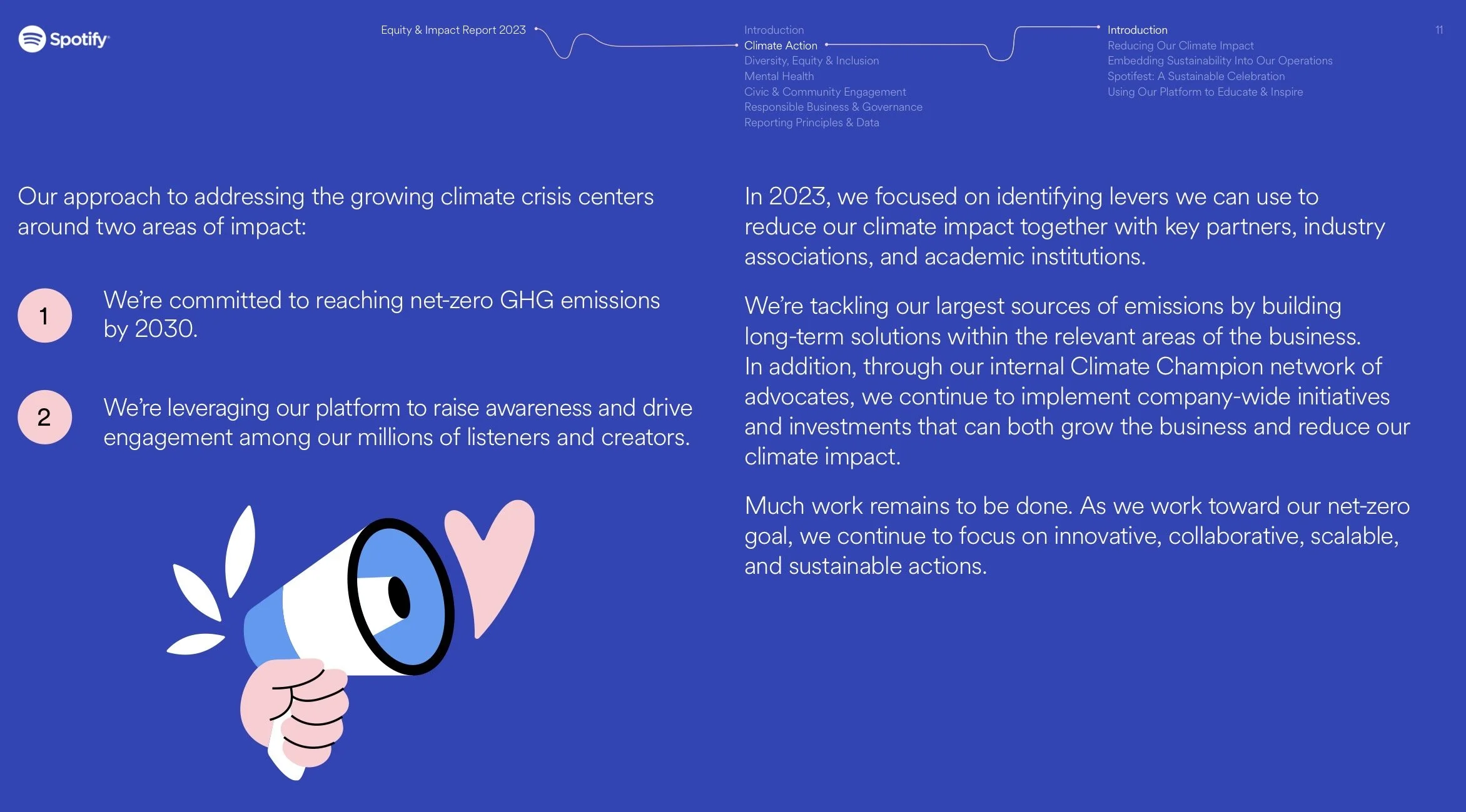
Spotify have moved forward their net-zero achievement date to 2030
Target-setting
Targets are central to decarbonization efforts, and there is an increased pressure on businesses to set focused, time-bound targets that reflect the reality of the obstacles they face. The goal is to avoid over-promising and failing to deliver. This is what our sample has committed to:
Most companies have committed to net-zero by 2050, showing an alignment with the SBTi goal.
Others have moved the date forward to 2040 or even earlier in some instances. This shows proactivity; however, the question remains of whether they will be able to back it up through action.
A proportion of companies have chosen to set targets for all three Scopes as a collective rather than highlighting the isolated figures. This approach will likely be phased out in the next two years as the new SBTi standard mandates Scope-specific targets.
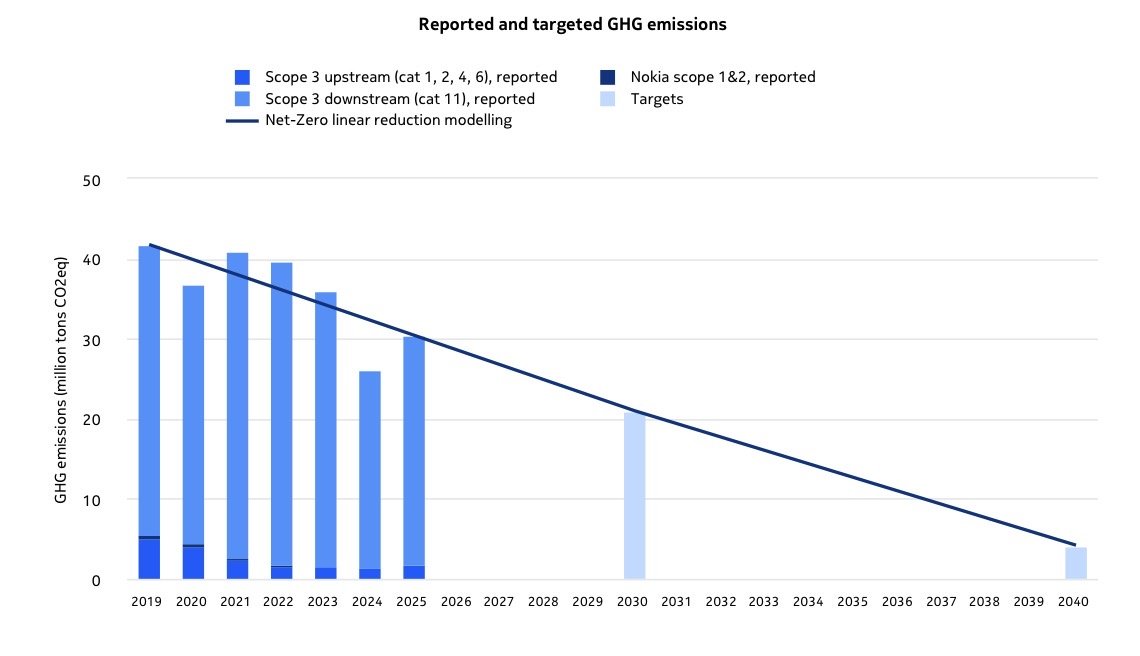
Scope 3 occupies a large proportion of Nokia’s emissions
Problem categories
As covered in our previous reports article, Scope 3 remains the hardest number to move because of how large it is. These emissions are also becoming increasingly remote in with the rapid growth of data centers and cloud infrastructure, making it an even more difficult category to decarbonize.
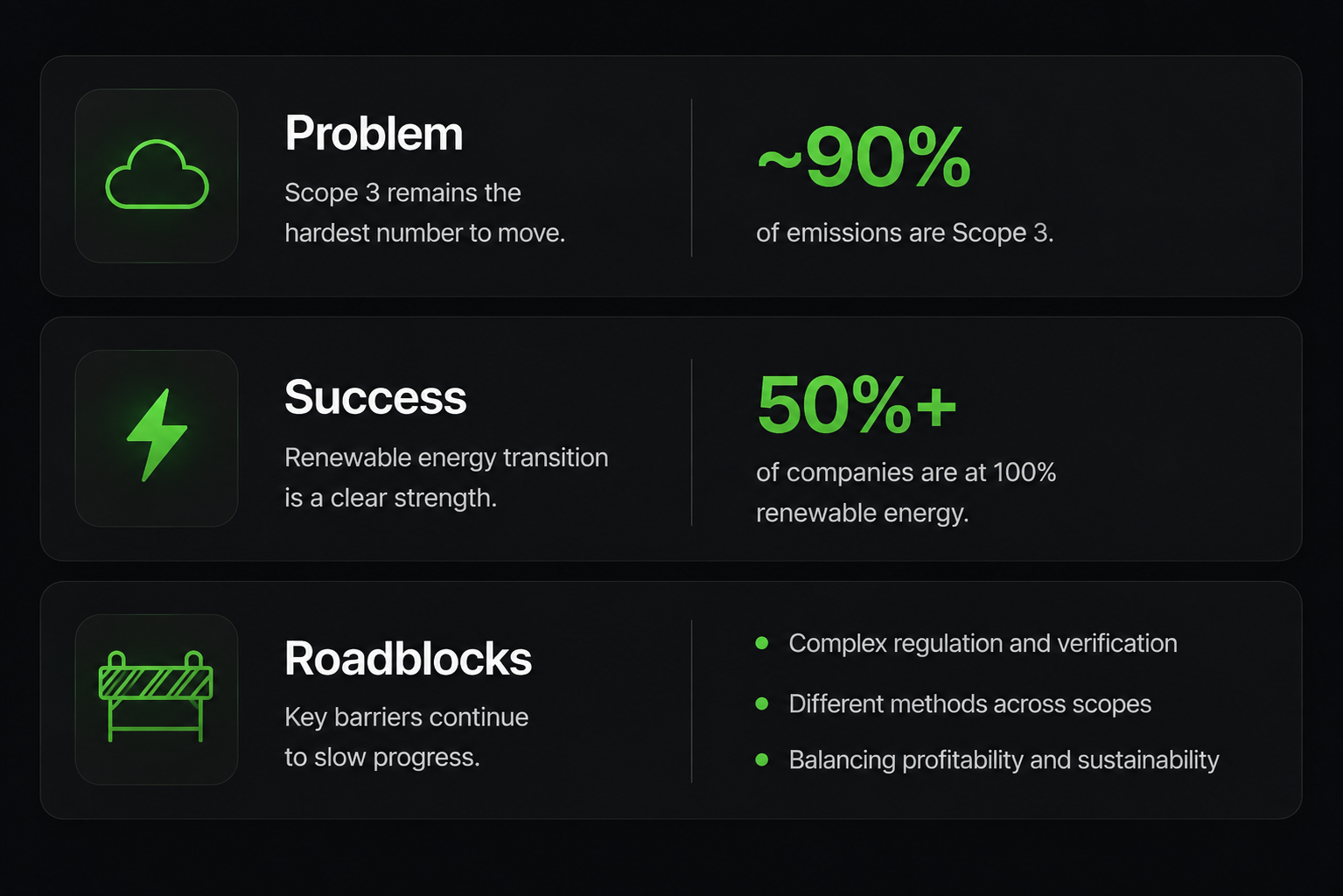
Scope 3 emissions make up roughly 90% of overall company emissions across the sample.
New cloud technology and third party digital infrastructure makes this figure even more difficult to reduce. However, some companies have committed to focusing clean energy efforts to this area in the near-term to combat its rising contribution to emissions.
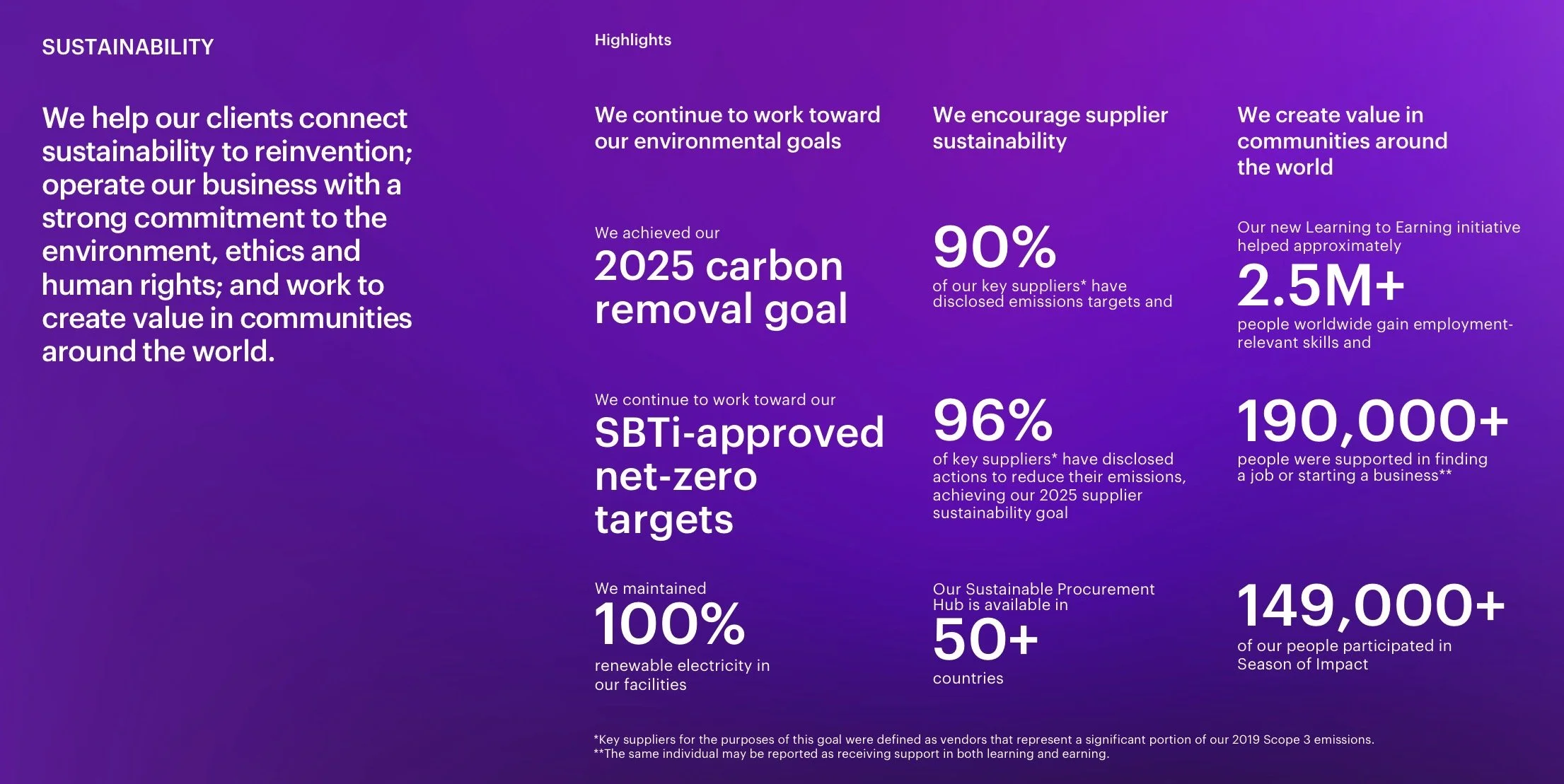
Accenture have reached 100% renewable energy across their facilities
Success
Another callback to our digital media reports piece, the renewable energy transition figures tell a story of success. Over 50% of the examined companies are at 100% renewable energy, with the others not far behind.
Renewable energy transitions are a strength. Companies are between 70-100% renewable energy and are now setting their sights on extending this to data centers.
Many companies are already at 100% renewable energy. If they aren’t, they have near-term targets to achieve this goal or have already managed it in focus areas such as office buildings and facilities.
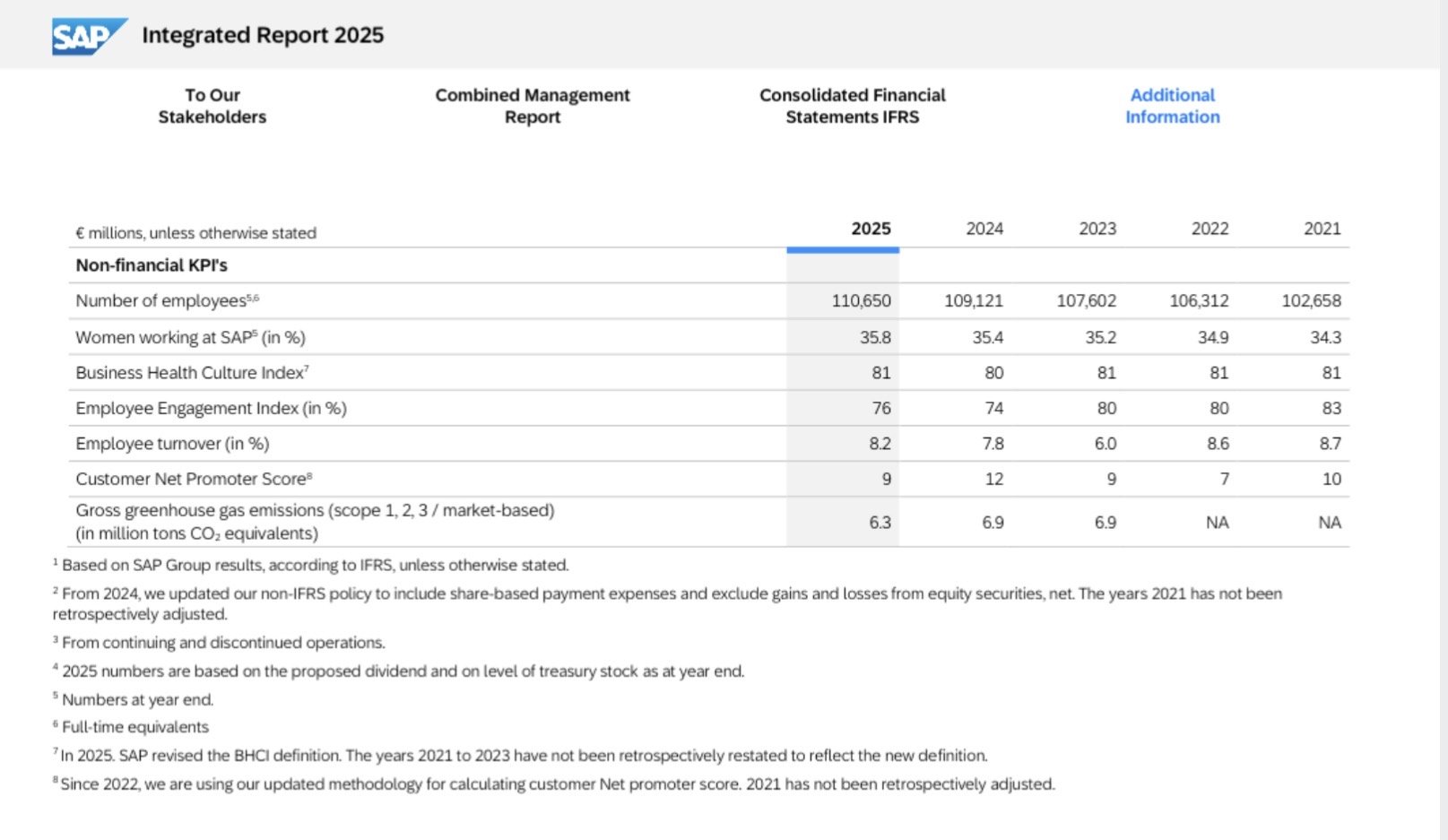
The SAP report highlights the financial weight greenhouse gas emissions carry
Roadblocks
The regulatory landscape is complex and expansive and the pressure to report accurately is now being applied with force. These are the factors that are preventing companies from making ambitious emissions cuts at speed.
Comparable target verification: Each company has different ratings they use and a different board system that they have implemented to regulate sustainable development goals.
Different reduction methods: applying the same strategy to all three scopes vs tackling each individually.
Balancing profitability with sustainability: decarbonizing Scope 3 in particular can take up a significant amount of time which can then eat into a company’s financial capacity.
Decarbonization at a glance
What Needs To Change?
The governing target now is to reach net-zero by 2050. While there has been progress across corporate Europe, efforts to decarbonize will need to accelerate in order to meet this goal on time. The challenges reflected across the reports sample indicate where the problem areas lie, illuminating opportunities for change. Through looking at these areas in more detail, it becomes easier to understand what needs to shift for decarbonization missions to proceed successfully.
Isolated Scope Categories
As mentioned in the previous section, some companies have chosen to combine all three Scope targets under a singular figure. While this can be helpful in providing an overall overview of their collective emissions, it struggles to accommodate the different contexts and challenges that accompany each category.
The new SBTi Standard V.2.0 will obligate companies to report on all three Scopes as isolated categories rather than grouping the targets together. Additionally, it encourages companies to first focus on completely decarbonizing Scope 1 emissions and then follow with renewable energy across Scope 2 and incremental progress with Scope 3. This reflects an understanding that each category targets a different area and that these areas are often on different timelines.
Ongoing Reporting
As regulatory requirements increase, accurate reporting has become even more important. The shift that needs to occur is in how companies approach the task. It should be treated as an ongoing responsibility rather than an annual activity. Data must be regularly audited and communication with suppliers needs to be constant in order to prevent an end-of-year data scramble that may risk missing a deadline.
The difference between data that holds up under close scrutiny and data that doesn’t is often the difference between two types of reporting system. The first is manual reporting. Data is stored in spreadsheets and local files or spread out across email chains with suppliers. With this format, ongoing reporting becomes difficult, as the task of auditing data is compounded by the task of locating it. The second type is intelligent reporting. These are streamlined systems that store all your data in one singular platform, allowing for direct supplier collaboration and easy audit. Companies that choose the second system will find ongoing reporting to be much less of a challenge than ones who choose the first.
Transparency
Naturally, transparency has always been obligated when it comes to reporting. However, the shift that is occurring now is that companies have to be more transparent when it comes to setting goals as well as evidencing them. Businesses are encouraged to set realistic targets that reflect their operational realities rather than over-promising and under-delivering. Action is now the priority, and progress still counts as action.
The goal of net-zero by 2050 is a collective effort, and each participating company needs to be honest about what they can contribute.
Closing The Gap
In order to set realistic goals, maintain transparency, and make measurable progress, companies need to have easy access to all of their data. As reporting standards tighten and data requirements becomes more demanding, companies will need to have a system in place that can cut out a portion of the audit task rather than add onto it.
An efficient reporting system will help close the gap here, Footprint Intelligence among them.
These are the factors that will likely slow decarbonization down:
Inaccessible data stored in obscure places.
Difficulty collaborating with suppliers across the value chain when it comes to reporting.
Manual collection and retrieval that takes up extensive amounts of time.
The action itself is not always the central issue. Documenting the action can often be more taxing, requiring a highly streamlined reporting workflow which can be tricker to set up when data is so expansive and varied. It is also worth noting that any positive climate action is essentially negated if it is not evidenced properly.
However, a positive thing about these challenges is that they can be tackled.
This is what is going to make decarbonization more achievable:
A centralized, intelligent reporting system that can respond to requests.
A system that allows suppliers to directly contribute their own figures.
A platform that not only allows insight to be interpreted, but provides that insight itself.
Footprint Intelligence is a platform that has been designed to make decarbonization a realizable goal. With the increased pressure on verifiable climate action, an intelligent reporting system can take control of part of this verification process. This will leave sustainability teams with more time to achieve the targets they have set and decarbonize efficiently.
For corporate Europe to be in a good place moving towards the net-zero 2050 deadline, decarbonization efforts need to accelerate and this acceleration needs to be properly evidenced. The companies that lead will be the ones who report proactively and intelligently, answering decarbonization questions before they are formally asked.