Understanding ESG Ratings: EcoVadis, MSCI, Sustainalytics, CDP
Sustainability ratings, sometimes referred to as ESG ratings, are a tool for companies to measure the success of their ESG strategy and demonstrate their performance to investors, customers, and procurement teams. Many of the most popular ratings were developed by independent companies, yet are now widely recognized as a reputable stamp of approval.
They have also been more recently recognized by the European Commission as a valuable tool for investors and companies. To ensure transparent methodologies, the EU Regulation on the transparency and integrity of ESG rating activities (Regulation 2024/3005) comes into application on 2 July 2026, requiring rating providers operating in the EU to be authorised by ESMA and to disclose their methodologies and data sources. This tells us that ESG ratings aren't going anywhere. And as they become more interwoven with European law, it is likely that their influence will only grow.
Broken down, a rating is a question (or series of questions) about your business. Different ratings will have different focus areas, but generally they tend to target ESG strategy and commitments to emissions reductions. But with so many on the market, where are you supposed to start? This article will aim to tackle some of the common questions businesses have about ESG ratings, such as:
What is a sustainability rating?
Who benefits from a sustainability rating?
Which rating is best suited to my company?
How can I receive a positive rating?
We focus on four of the most popular providers: EcoVadis, MSCI, CDP and Sustainalytics. But even if these four aren't on your list, the advice will still transfer to other ratings on the market.
ESG Ratings: What Are They?
ESG ratings are essentially a metric against which companies can measure how sustainable they are. They tend to involve a questionnaire as a starting point, where a company provides sets of data and information that show how committed they are to operating sustainably.
For some providers, this is the only step. After submitting the relevant information, the company receives a rating which will usually be made public as well. Other providers attach additional steps to help companies improve their initial result. This might be a consultation with sustainability experts, or specialized data insights showing where emissions can be reduced.
It is worth noting that these ratings are rarely free. Often the payment is made by investors who want to use the rating to learn more about companies they have invested in, or intend to invest in. If a company sets up its own rating, it pays itself.
This definition works as a foundation for understanding ESG ratings, but it is still broad and in some ways too generic. To get at the detail, it helps to look at specific services and what they can offer your business.
EcoVadis
EcoVadis is the largest sustainability ratings provider in the world, with around 150,000 rated companies to date. Recently, it has been presenting itself more as a tool that is particularly valuable for tackling the supply chain. Where most ratings are built to inform investors, EcoVadis seems to be geared towards helping the companies themselves assess the environmental, social and ethical performance of their suppliers, broadly covering all three ESG focus areas.
It is also unique in that it assesses these three elements in a single evaluation. The methodology spans four themes: Environment, Labor & Human Rights, Ethics and Sustainable Procurement, with 21 specific criterion aligned to the GRI, UN Global Compact, and ISO 26000 standards.
The process is relatively straightforward: a company completes an evidence-based assessment and receives a score out of 100. Strong performers are awarded a medal (Bronze, Silver, Gold or Platinum) and early reporters can receive a badge. This assessment result constitutes the rating itself, but that is not where the relationship ends. EcoVadis aims to facilitate supplier collaboration, offering scorecards and benchmarks designed to move performance forward rather than simply record it. This means that if a company’s initial rating is lower, they can work directly with EcoVadis to raise it.
Best for: companies under pressure from customers or procurement teams to prove supplier sustainability, and businesses that want one comprehensive rating covering the full breadth of ESG.
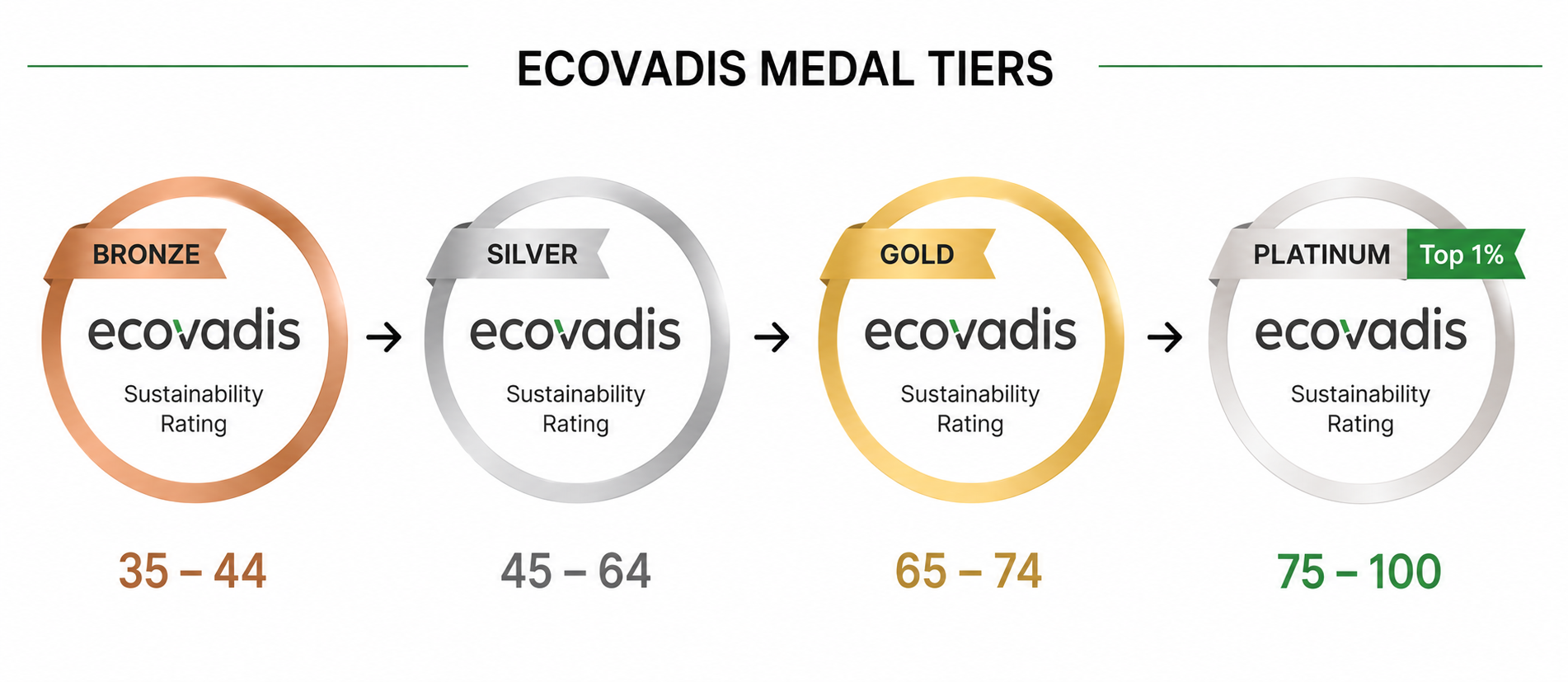
EcoVadis Medal Tier List
MSCI
MSCI ESG Ratings ask a different question: how resilient is a company to the ESG risks that could affect its financial performance? The rating was conceived for investors first, with the rating serving to help them make informed decisions and identify industry leaders to add to their portfolio.
MSCI assesses companies against around 35 key ESG issues, selected and weighted according to their financial relevance within a given industry. Companies are then placed on a AAA to CCC scale and classified as a Leader, Average performer or Laggard relative to their peers.
The emphasis on financial materiality is the defining feature here. MSCI is less interested in a company's full sustainability footprint than in the ESG factors most likely to move its valuation or risk profile and effect investment. ESG issues are assessed in relation to material resilience rather than being tackled on a purely strategic level.
Best for: listed companies or businesses raising capital where investor scrutiny (rather than supply-chain pressure) is the central concern.
Sustainalytics
Sustainalytics also serves an investor audience, with the rating focusing on risk above all else. Its ESG Risk Ratings assess how exposed a company is to material ESG issues, and how well it is managing that exposure.
The model breaks down risk into different categories: total exposure, the portion that is manageable versus unmanageable, the risk a company has actually managed, the management gap, and the unmanaged risk that remains. The output the company will receive goes beyond a singular rating figure. They will instead receive an overall rating and risk level, a detailed company analysis, their material ESG issues, insights on relevant company events, and a full ESG risk decomposition.
This structure makes Sustainalytics useful well beyond a headline score. The same data supports strategy development, investment selection, regulatory reporting and portfolio management.
Best for: companies that want to understand and reduce specific ESG risk exposures, and those whose investors or reporting obligations demand a granular, risk-based view.
CDP
CDP acts as a disclosure platform as well as a conventional rating. Companies use it to measure and report their environmental impact and publicly show their commitment to slowing climate change.
The process runs on a questionnaire spanning a set of environmental themes. For 2026, CDP's questionnaire covers climate change, water security, forests, biodiversity, plastics and oceans. Responses are scored from D up to A, and each year CDP publishes an "A List" recognising its top-scoring companies.
CDP's strength is the depth it goes into on the environmental side. It does not attempt the full ESG breadth of EcoVadis or the financial-materiality lens of MSCI, but the detail it goes into on the “E” cannot be competed with.
Best for: companies whose primary exposure is environmental, and those that want a recognised, public benchmark of climate and environmental disclosure.
Put side by side, the four are not really competitors so much as different instruments. EcoVadis reads supply-chain sustainability across all of ESG, offering a more comprehensive rating. MSCI and Sustainalytics both speak to investors, but MSCI ranks companies on financially material issues while Sustainalytics assesses unmanaged risk. CDP goes deeper than the other three on environmental disclosure and climate-focused assessment. The right one depends less on which is objectively "best" and more on what your company wants (or needs) to evaluate.
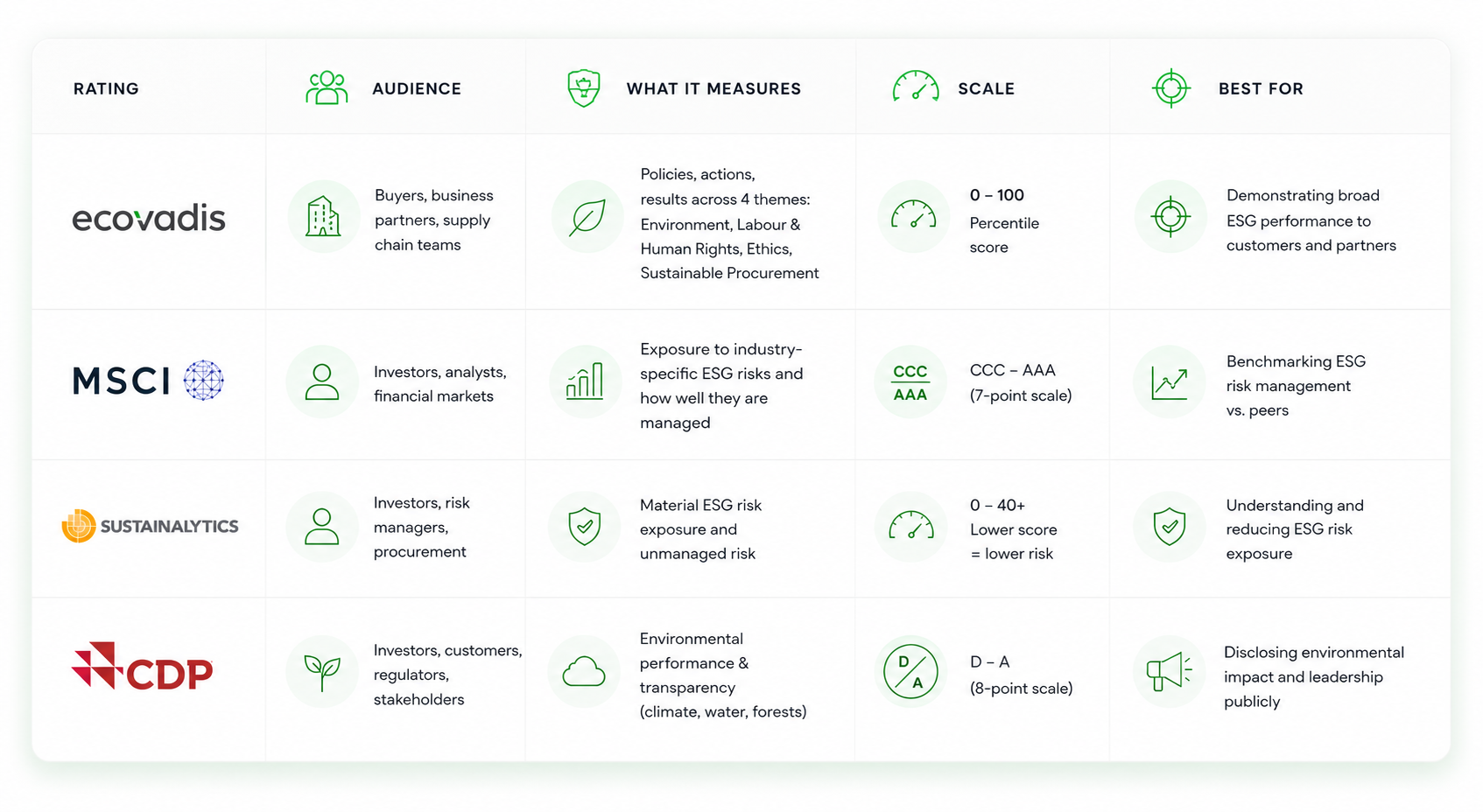
What Each Rating Is Offering
What Can a Rating Actually Offer Your Business?
Ratings have become a sign of strong market position and investment opportunity, which makes them attractive. However, not all ratings will be necessary for one company and the pros and cons of each come down to priorities.
EcoVadis gives you breadth and a widely recognised and well-respected credential. The trade-off is that the assessment is documentation-heavy and the medal expires after 12 months. Currently, it works on a tacit renewal model, so it will take an additional payment from the purchasing company following the rating’s expiration and reevaluate the rating with this payment. When the subscription is cancelled, the rating expires. This means that the rating is better suited to companies who are looking for a long-term investment in their market position rather than a one-off assessment.
MSCI gives investors a clean, comparable signal regarding a company’s exposure and material vulnerability. The trade-off is control: MSCI can rate you using public data regardless of whether you engage, and the financial-materiality lens overlooks impacts that don't affect your valuation. It operates on an investor-pays basis, meaning the companies being rated tend to have little control in where there data goes following the assessment. It is of limited use to a private SME with no investor audience.
Sustainalytics gives you a precise map of where your unmanaged risk sits. The trade-off is that the risk framing can feel abstract to operational teams and, like MSCI, it is built for an investor lens first. The cost of a rating is customized depending on the size of the company and it also operates on a subscription model, making it a longer term investment similar to EcoVadis. For companies looking to make decisive operational emissions cuts, EcoVadis or even CDP may be a more sensible choice.
CDP gives you a public, credible environmental benchmark and the visibility of the A List. The trade-off is that it is narrow by design. While it is a competitive signifier of climate-consciousness, a strong CDP score says little about labour, ethics or governance. CDP operates on admin fees, which companies must pay in order to disclose their data and receive a rating. These fees can range from $1,170 to $7,650 depending on the plan and region, and will need to be paid yearly for the rating to be kept beyond the annual expiration.
A useful shortcut is to start by examining where the rating pressure is coming from:
Customers or procurement asking for proof → EcoVadis.
Investors or capital markets scrutinising you → MSCI or Sustainalytics.
A need for a material story that is mainly environmental → CDP.
A need for full ESG coverage in one place → EcoVadis, supplemented by CDP for environmental depth.
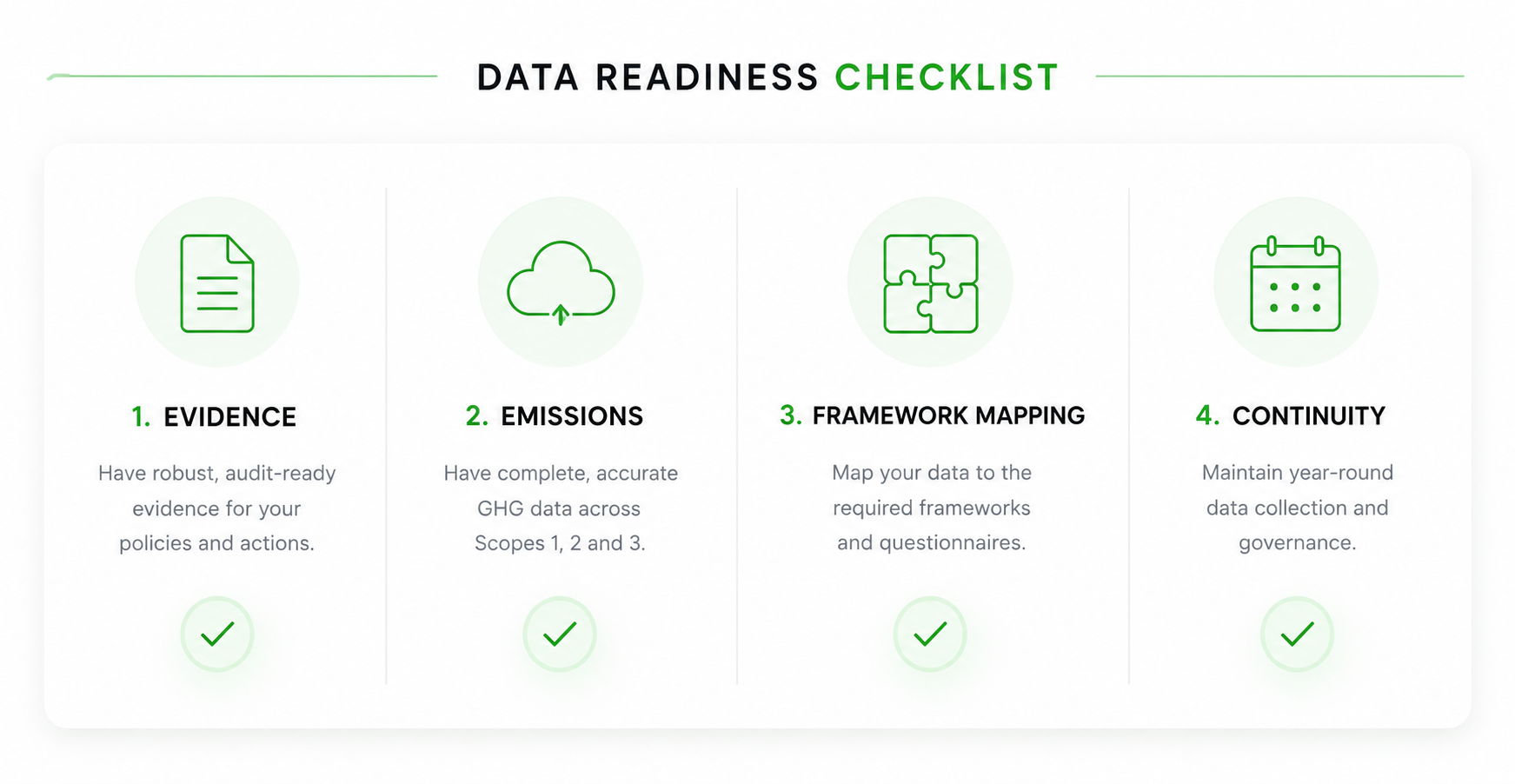
How to Prepare for a Strong Rating
Whichever provider you choose, the score you get is largely decided by the quality of the data and evidence you can produce.
Start with documented evidence. Ratings like EcoVadis are evidence-based: a policy statement counts for little without the certificate, procedure or record that backs it. Companies that struggle here usually have the right intentions but can't locate the proof.
Get your emissions data in order. Expect questions on Scope 1, 2 and increasingly Scope 3 emissions, your targets, and your progress against them. CDP's climate questionnaire in particular goes deep on this.
Map the questions to the framework. Each provider asks about different things - supplier practices (EcoVadis), financially material issues (MSCI), risk exposure and management (Sustainalytics), environmental disclosure (CDP). Knowing the lens tells you what evidence to gather first.
Treat it as continuous, not annual. All of these ratings are subscription-based, so tend to expire and reevaluate annually. The companies that score well consistently treat the rating as an ongoing standard for data quality rather than a one-off assessment.
This is where a centralized reporting system earns its place. When sustainability data lives in scattered spreadsheets, every assessment becomes a task of manual reconstruction. Platforms built to structure and manage ESG data - Footprint Intelligence to name one - are better positioned to produce the evidence on demand than tools designed only to store it. For the two most data-intensive ratings, EcoVadis and MSCI, Footprint Intelligence offers dedicated preparation support.
Automating Preparation
While the new regulation on ratings will make it compulsory for rating providers to publish their methodologies, the specific questions may be more hidden. This means that the best way to prepare for a rating is to conduct a comprehensive audit that covers the ESG focuses areas the providers are interested in. Sourcing data across all three Scopes and different ESG categories is no small task, especially when high data quality is also a necessity. Here, automation could prove to be a valuable tool.
An ESG-Ratings Agent could help with many things, including but not limited to:
Retrieving relevant data for you.
Helping structure responses in line with questionnaire requirements.
Evaluating how your data performs against published methodologies.
Helping to identify gaps that could lower your rating score.
These tools can substantially reduce the time required to locate and organize supporting evidence. Additionally, these agents can be used alongside the assessment itself to help make any last minute retrievals or explain complex questions. Check out our EcoVadis and MSCI Agent pages to find out more.
Choosing Where to Start
There is no single best ESG rating and it’s unlikely that one company will need all four discussed here. As the EU's transparency regime takes effect and methodologies become public, the ratings themselves will become more central to how customers, investors and regulators read your business.
The companies that tend to perform well are not necessarily those with the most data, but those that know where it is, trust its quality and can retrieve it efficiently when needed.