


Every sustainability measure, as a business case.
Investment, savings, payback, KPI or CO₂ impact – calculated live, for every action you're considering or already running.

Actions Databaase
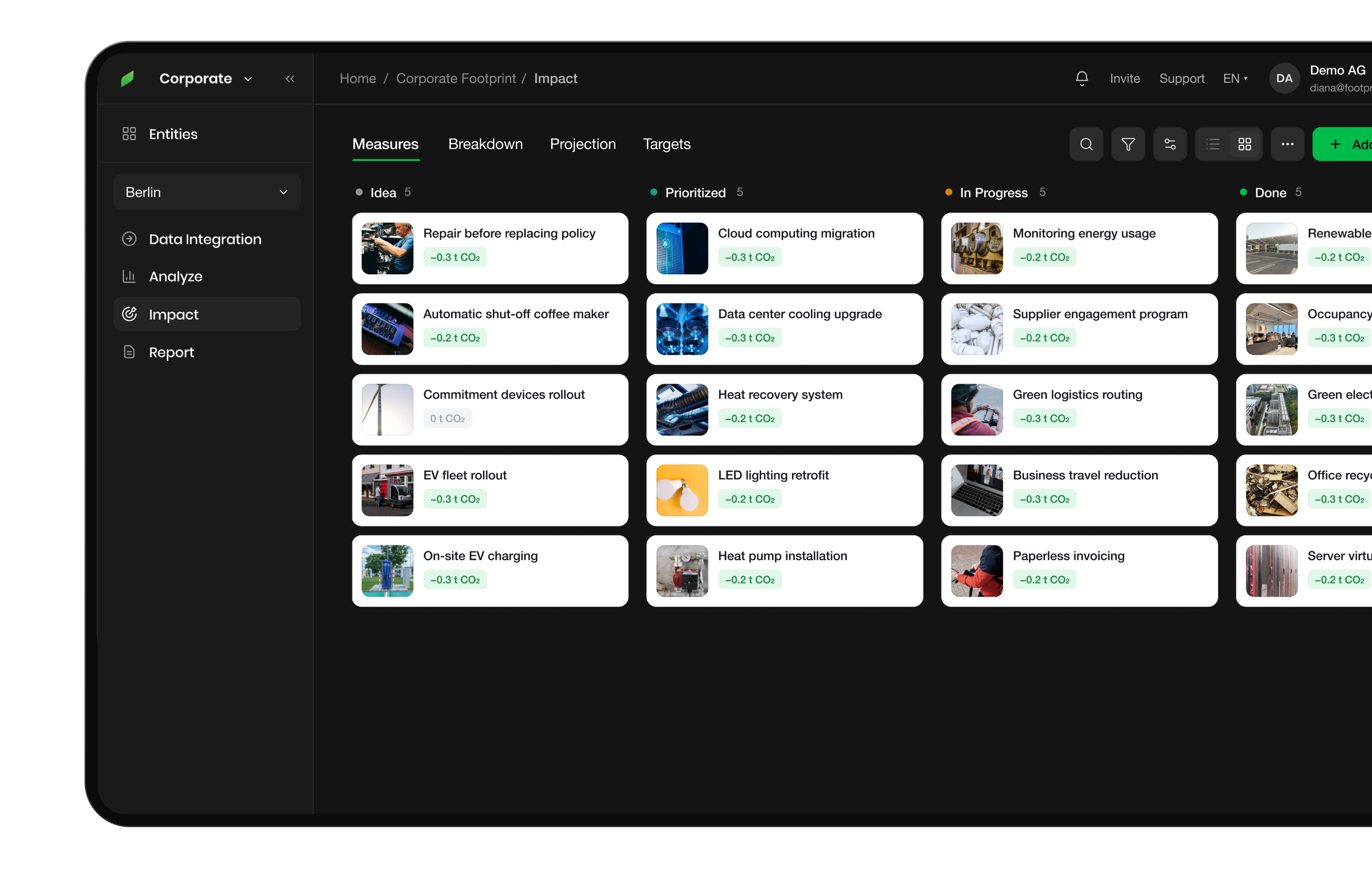
Track measures. Quantify their impact.
Give every action a status, owner, reduction estimate and financial case. Move it from idea to done, add data and the numbers move with it.

Built for business impact
Sustainability work, made visible.
Assign a measure to colleagues, track its status, and see who's accountable for what. Sustainability work stops living in someone's inbox and starts living in one shared view the whole team can see.
✔ Clear ownership
Assign every measure to the right person.
✔ Shared progress
See what is planned, active and completed.
✔ One decision record
Keep financial and emissions assumptions together.


Business Case
Track the business value, not just the footprint.
Connect emissions reductions to investment, operational savings and payback so sustainability decisions can speak the same language as finance.
Targets & Strategy
Set targets aligned with SBTi.
Define near-term and long-term reduction pathways aligned with the Science Based Targets initiative, or build a fully custom target – tracked automatically as your data comes in.
Forecasting
Predict where measures are leading to.
See your emissions trajectory with and without planned measures – and how it tracks against your near- and long-term targets.

One View
Everything about the measure, in one place.
Cost, savings, payback and impact live together against a single measure, recalculating live as new numbers come in.

Flexible by design
Start with the data you have. Refine as you learn.
Model impact with simple ratings, precise formulas, financial values and ESG KPIs — without forcing every measure into the same level of detail.

Turn sustainability action into business decisions
Frequently Asked Questions
-
A business case for a sustainability measure is a structured view of what an action costs, what it saves, and what it delivers — financially and environmentally — over time. It typically includes the investment required, ongoing savings or costs, the revenue or risk effect, and the payback period, so the action can be evaluated the same way any other business investment would be.
-
ROI on a sustainability initiative is calculated by comparing the total value it generates — savings, revenue growth and risk reduction — against the investment required, over a defined time horizon. Footprint Intelligence's Business Impact module calculates this automatically for every measure, including payback period and annual value, and recalculates live as figures are entered or the time horizon changes.
-
Payback period is the amount of time it takes for a measure's savings and returns to cover its initial investment. It matters because it gives finance and leadership teams a fast, familiar way to judge a sustainability action alongside any other capital decision, without needing a separate framework.
-
Yes — a single measure can carry both its CO2 impact and its financial business case at the same time. This means a solar installation, a fleet upgrade, or a supplier programme shows its emissions reduction and its payback period side by side, rather than living in two separate reports.
-
It works for both. Carbon measures quantify CO2 reduced; ESG measures link to the specific ESRS datapoints they move — for example gender pay gap or training hours — with the same financial structure applied to each.
-
A measure doesn't need finished data to get started. It can be entered as a rough rating, a single total, a year-by-year table, or a formula, and switched between those methods later as better data becomes available — without losing anything already entered. -
A spreadsheet model is built once and goes out of date the moment an assumption changes. Business Impact keeps every measure's business case live, recalculates it automatically, and rolls individual measures up into a single portfolio view — so the numbers stay current without anyone maintaining a parallel file. -
Yes. Measures linked to ESRS datapoints feed directly into CSRD-aligned reporting, and every figure carries a traceable source and method — which matters both for internal sign-off and for external audit.
-
The system tracks how much of each KPI or emissions figure is already claimed by other measures and flags it before a new measure can claim the same improvement again. This keeps the portfolio-level totals accurate rather than inflated by overlapping claims.