Sustainability reporting rests on two kinds of work: data work that repeats every period, and decisions that need expert judgment. Software carries the first, and consulting adds value on the second. How much consulting a company needs on top of its software depends less on its size than on how complex its reporting process is, how often it repeats and where judgment is needed.
Software provides the foundation: recurring data collection, carbon calculations and ESG reporting. Consulting adds a layer on top where judgment is needed, such as setting methodologies, interpreting requirements and reviewing complex decisions. Some platforms integrate that layer directly, while others work alongside external advisors.
This distinction matters even as reporting requirements change. On 3 July 2026, the European Commission adopted the revised European Sustainability Reporting Standards (ESRS), which apply mandatorily from financial year 2027, together with a voluntary reporting standard based on VSME. Yet fewer mandatory disclosures do not mean fewer data requests. Customers, banks and investors keep asking, and each request still has to be coordinated across subsidiaries, systems and people.
The real question is not whether to choose software or consulting, but how much expert support to add to the system that holds your data. This guide shows where each layer adds value, illustrates the difference through a practical example and provides a framework for deciding how much consulting your setup needs.
How Consulting Builds on a Software Foundation
Every reporting process needs a place where data is collected, calculated and documented. Data requests, calculations, emission-factor mappings, review steps and KPI tracking have to be applied consistently across people, entities and reporting periods. Without that foundation, there is no data for anyone to work with, internal or external.
Consulting adds most value on top of that foundation, where the answer is not yet clear. Defining a Scope 3 boundary, choosing a calculation method, interpreting a new requirement or challenging an assumption all require judgment that cannot simply be built into a workflow. Once the decision is made, the platform applies it in every following period.
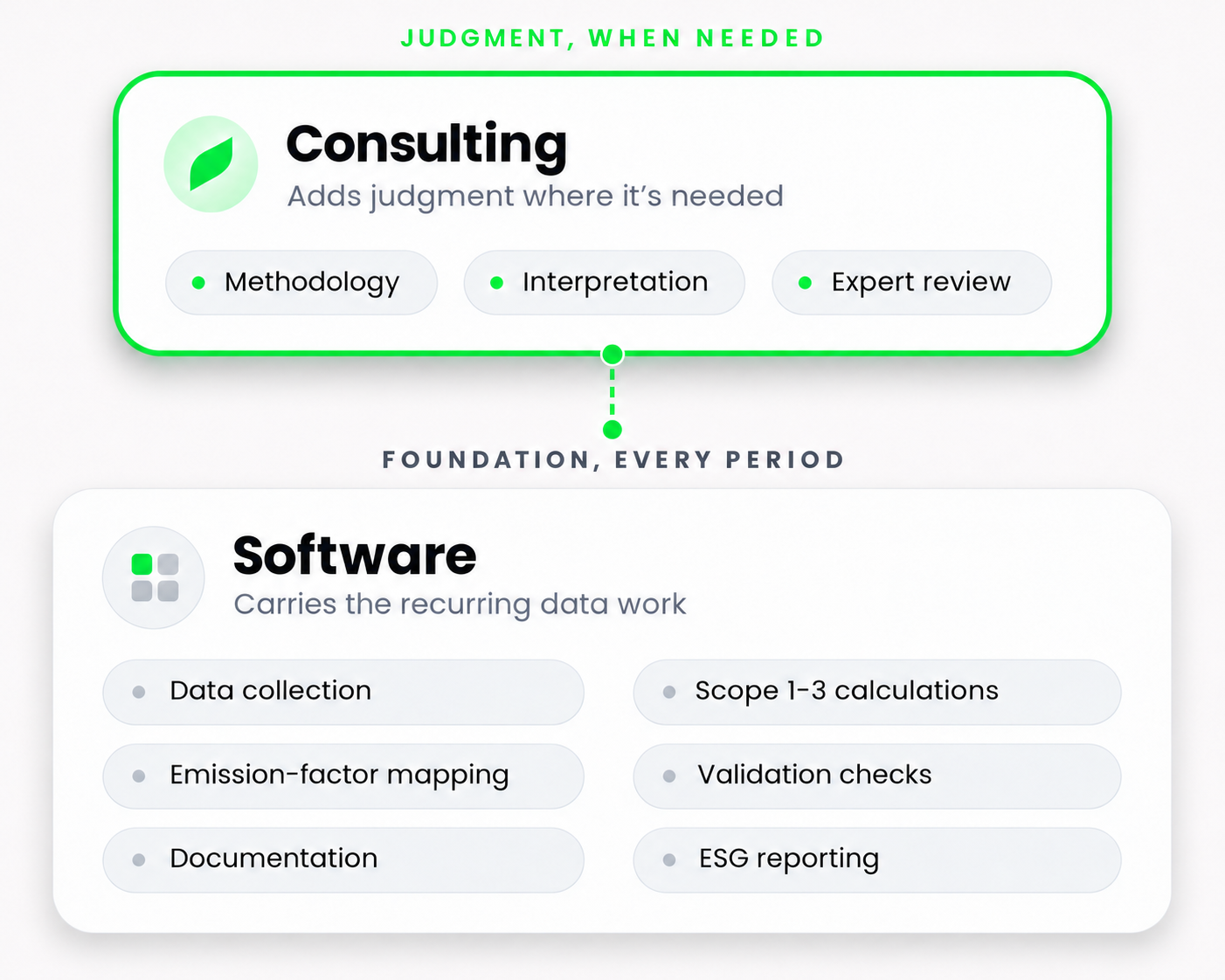
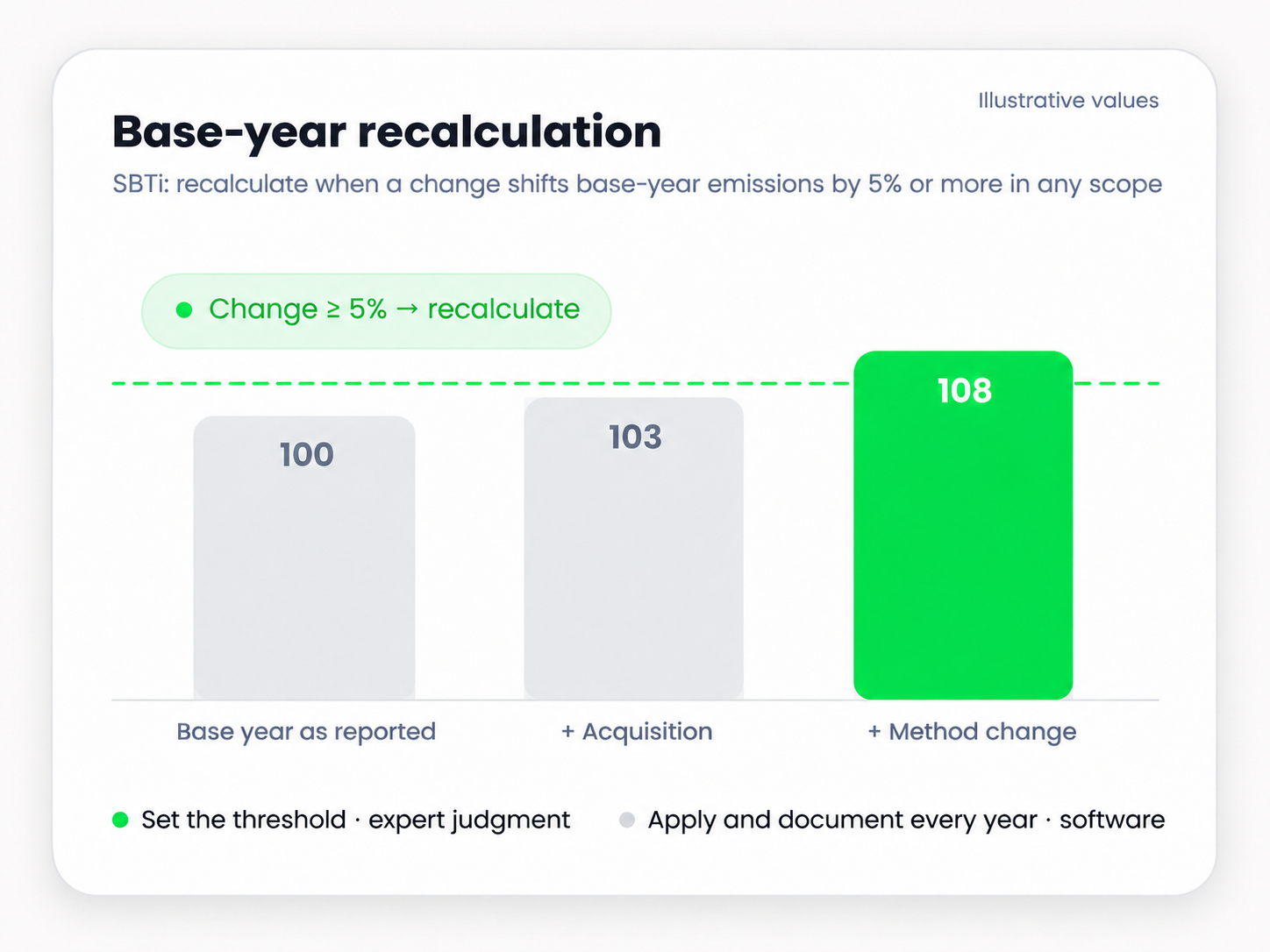
The Greenhouse Gas Protocol (GHG Protocol) shows how the two layers work together. Structural changes, methodology changes and errors can trigger a base-year recalculation. The standard leaves the significance threshold to the company. Companies with science-based targets have a fixed reference: the SBTi requires recalculation when changes shift base-year emissions in any scope by 5% or more. Setting that policy is a judgment call where expert input helps. Applying and documenting it every year is work the software carries.
The practical difference becomes clear when sustainability data has to be collected across multiple subsidiaries.
What Changes When 20 Subsidiaries Have to Report?
Consider a company preparing its annual corporate carbon footprint across 20 subsidiaries, each with its own data owners, systems, energy bills and purchasing records.
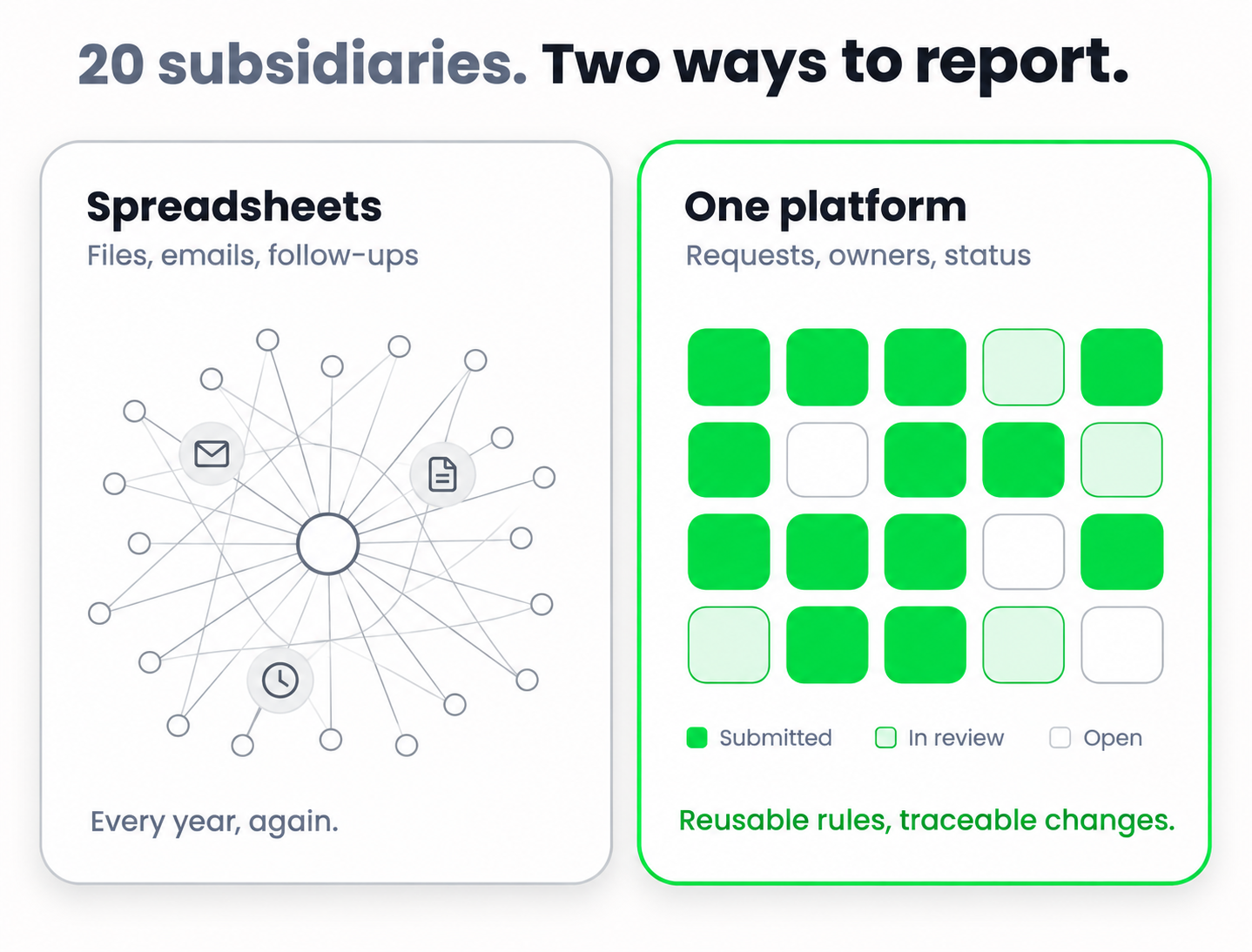
With spreadsheets, the central team becomes the coordination hub. It distributes templates, follows up on missing submissions, consolidates files in different formats and checks units, formulas and emission factors. It also has to maintain documentation and historical calculations. Much of this work returns the following year, often relying on files, emails and individual employees' knowledge.
With carbon accounting software, the process can be managed centrally. Data requests are assigned to responsible owners, progress and reminders are tracked in one place, and calculation rules, emission-factor mappings and validation checks can be reused. Documentation and changes remain traceable across reporting periods. The sustainability team can spend less time coordinating submissions and more time reviewing exceptions, improving data quality and addressing methodological questions.
Software still requires implementation, data preparation and human review. This is where consulting complements the platform: during onboarding, for complex methodological decisions and for independent review. How much of that support a company needs depends less on its size than on how much coordination, repetition and complexity its reporting process involves.
How Much Consulting Does Your Setup Need?
The right level of expert support depends on what a company needs and how it plans to manage sustainability reporting over time.
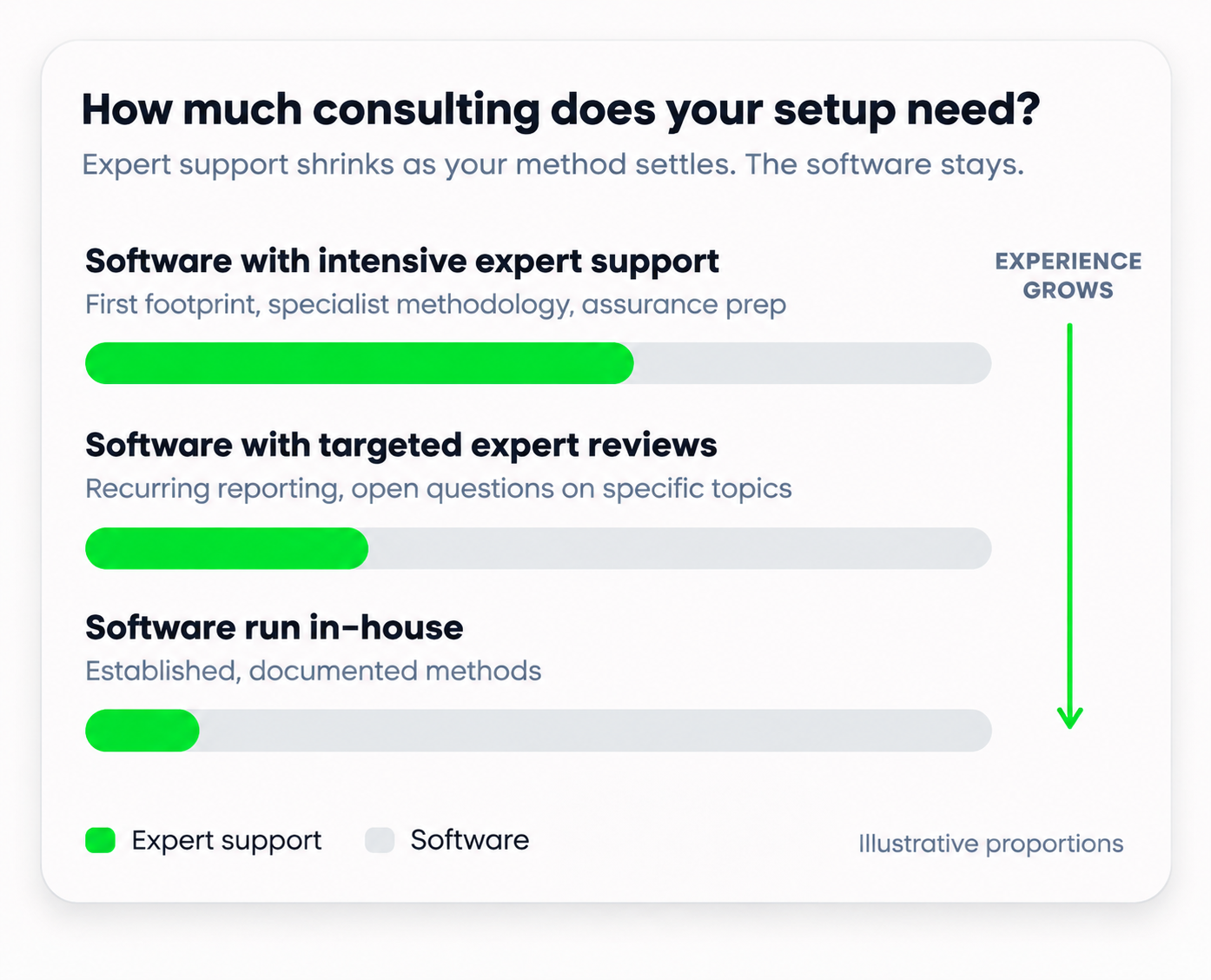
Software with intensive expert support: You are building your first carbon footprint, need specialist methodology or regulatory expertise, or are preparing for assurance. Experts help set the methodology while the platform captures the data from the start, so the work does not have to be rebuilt the following year.
Software with targeted expert reviews: You have recurring reporting requirements and multiple data contributors, but still face open questions on specific topics. Your team runs the process, and experts contribute where their knowledge adds the most value.
Software run in-house: Your calculation methods are established and documented. The platform carries data collection, calculations, quality checks and reporting, and expert support stays available for new requirements.
Each setup should be assessed against its full cost. A software licence involves implementation and internal resources, expert support involves external fees and coordination, and spreadsheets require employee time and maintenance. For companies with few data sources, the foundation can start small. What matters is that data, calculations and documentation sit in one place from the first reporting period.
When participants at our past events were asked about the biggest barrier to turning sustainability targets into real business transformation, they highlighted budget constraints, limited data and the difficulty of securing management support, alongside broader challenges around ownership and established ways of working. Limited data is the barrier a software foundation addresses directly, and the rest is where expert support adds the most value.
Where Footprint Intelligence Fits
Footprint Intelligence combines AI-powered sustainability software with optional expert consulting and methodological support. The platform helps companies manage recurring processes such as data collection, Scope 1, 2 and 3 calculations, emission-factor matching, validation and ESG reporting.
Companies can use the software independently or add onboarding, methodological support and expert reviews according to their requirements and internal resources. This flexibility allows organisations to start with more specialist assistance and gradually take over more of the reporting process themselves.
How To Decide For Your Own Setup
Before deciding how much consulting to add, assess your reporting process against these five questions.
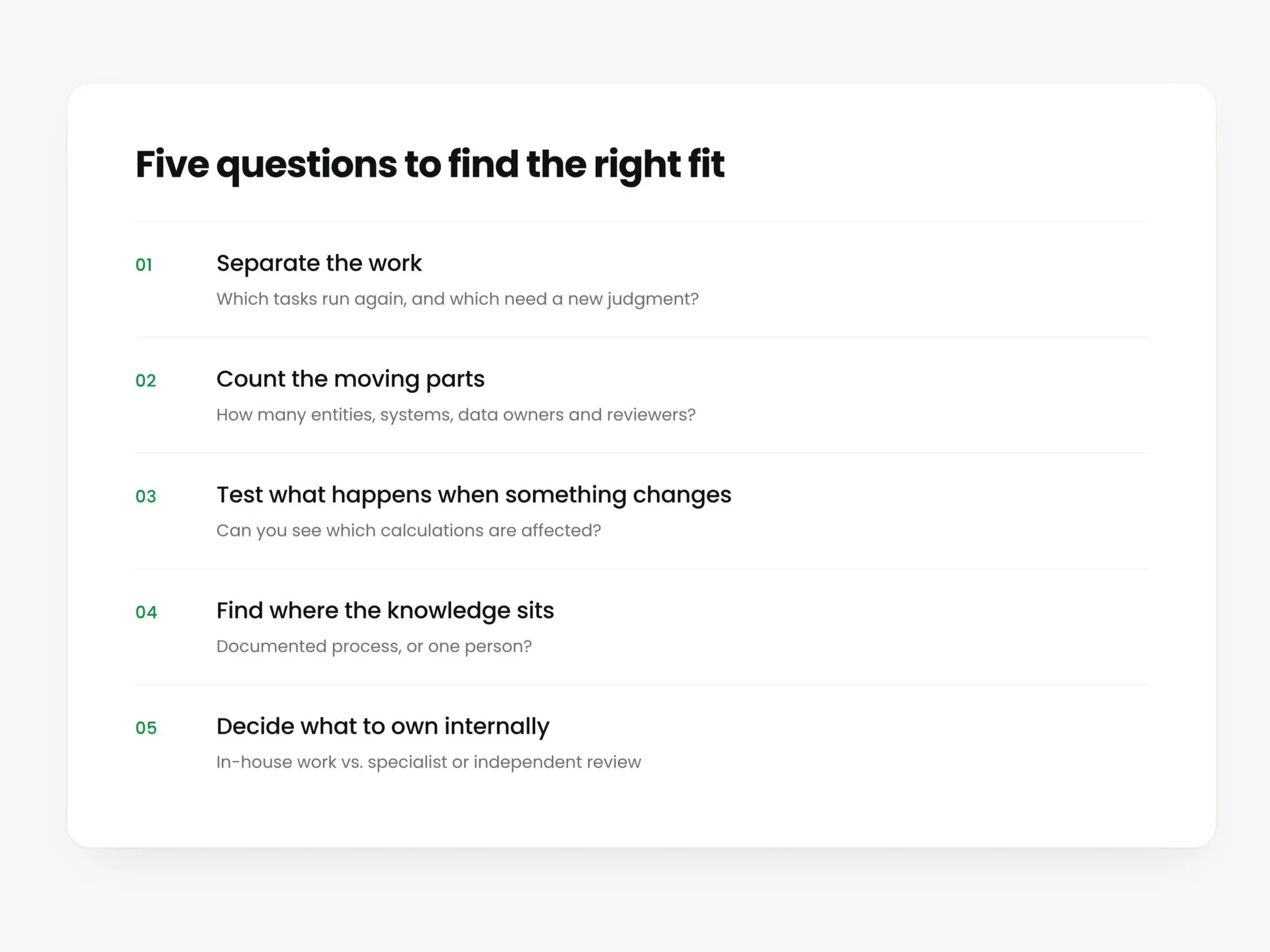
Separate recurring work from fresh decisions. Which tasks simply need to run again, and which still require a new methodological judgment?
Count the moving parts. How many entities, systems, data owners and reviewers contribute to the process?
Test what happens when something changes. Can you see which calculations are affected when a methodology, emission factor or source dataset changes?
Find where the knowledge sits. Is the process documented, or does it depend heavily on one employee or one external advisor?
Decide what you want to own internally. Recurring calculations and data management may make sense in-house, while specialist methodology or independent review may remain external.
Use the answers to identify where you need specialist expertise, which activities could benefit from automation and what your team can realistically manage internally.
As a rule of thumb: if most answers point to recurring work and many contributors, the software carries most of the process and consulting can stay targeted. If they point to open methodology questions, start with more expert support on the platform and reduce it as the approach settles.
Reporting requirements will keep changing, but the data work behind them repeats every period. The question for most teams is not whether to build that foundation, but how much expert support they need on top of it.
FAQs
Do we need a consultant if we use sustainability software? Software is the foundation: it holds the data, calculations and documentation that a consultant would otherwise have to rebuild each period. Consulting adds value on top, for a new methodology, a regulatory question or an independent review. Many companies use both, through one provider or by bringing in external advisors.
Can AI software replace sustainability consultants? Not fully. Software can automate data collection, calculations, emission-factor matching and validation. Consultants remain valuable for judgment, such as setting a Scope 3 boundary.
Which companies have to report under the CSRD? Only the largest. After the Omnibus changes, the CSRD applies to companies with more than 1,000 employees and more than €450 million in net turnover. Group structures, non-EU parents and national rules can change the answer, so confirm your position with a legal or audit adviser.
What is VSME? A voluntary reporting standard for companies outside the CSRD's scope, adopted by the Commission as a delegated act in July 2026. It helps companies answer requests from customers, banks and investors consistently. It also sets a ceiling: from financial year 2027, companies reporting under the CSRD may not demand more than VSME covers from value-chain partners with up to 1,000 employees.
Do we need external assurance? It depends on the law, your contracts and your own choice. CSRD reports are subject to limited assurance, and customers or lenders may ask for verification. A process that records source, owner and change history makes the audit trail easier to show.
How should we answer a customer's emissions request? First find out exactly what the customer needs. Some ask for Scope 1 and 2, others for Scope 3 data or product carbon footprints, and many use the VSME format. Agree the data and format, then collect only that. From financial year 2027, if you have up to 1,000 employees and the request is for the customer's CSRD report, you can decline anything that goes beyond VSME.
Can we outsource carbon accounting and still control our data? Yes, if the contract is clear about who owns the data, who can access and export it, and how calculations are documented.
Which providers offer both software and consulting? Some offer software only, some consulting only, and some both, directly or through partners. Ask who delivers the consulting, what it covers and whether you keep access to your data. Footprint Intelligence is one provider that offers both.