An Immersive Journey into 2055: What the EY Four Futures Experience in Munich Revealed About Climate Risk and Transition
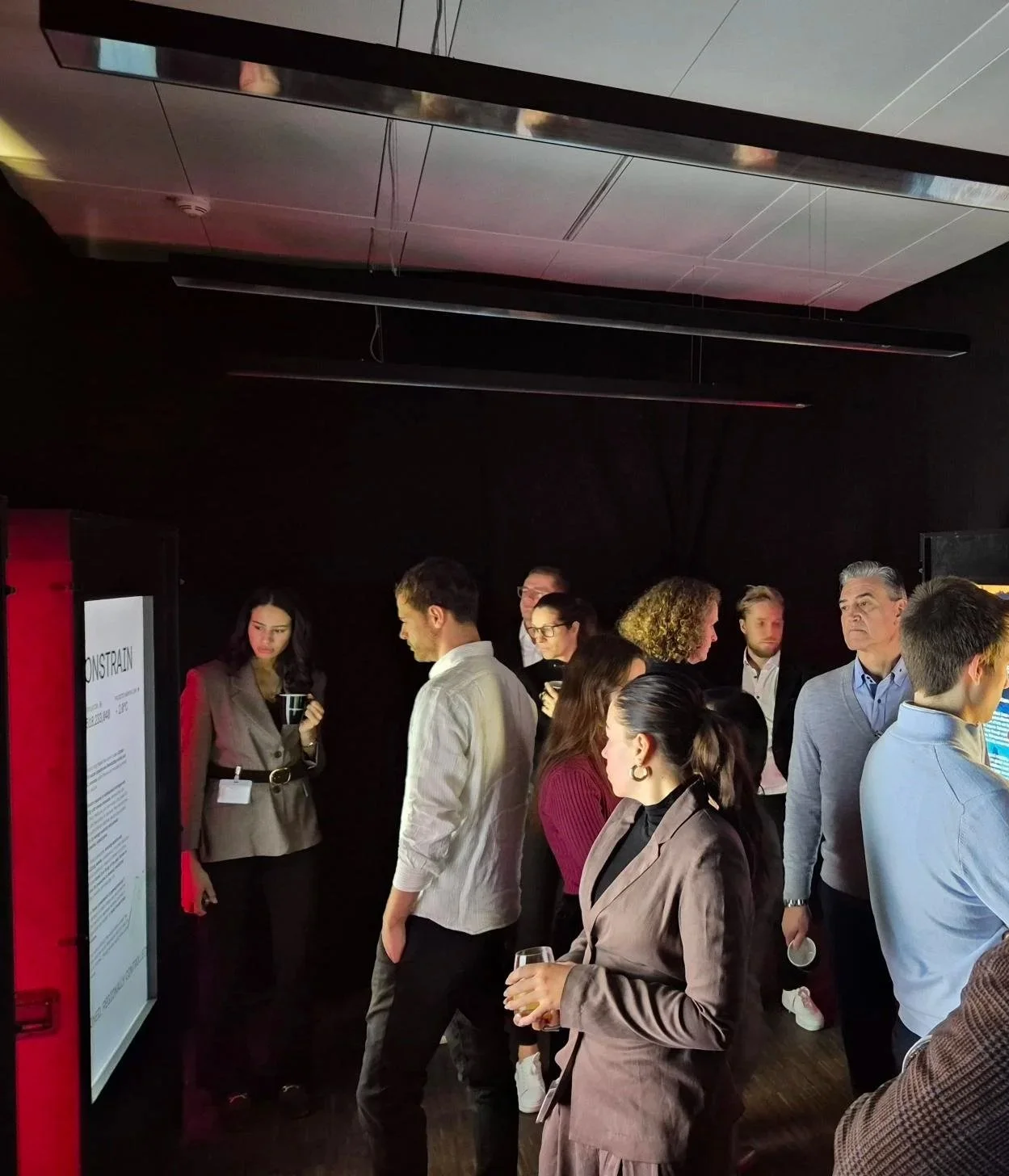
On the morning of March 27, 2026, the EY office in Munich did not feel like the setting for an ordinary business event. It felt like the threshold of a question many leadership teams are only beginning to ask with real seriousness: what kind of future are we preparing for and what kind of company will still matter in it?
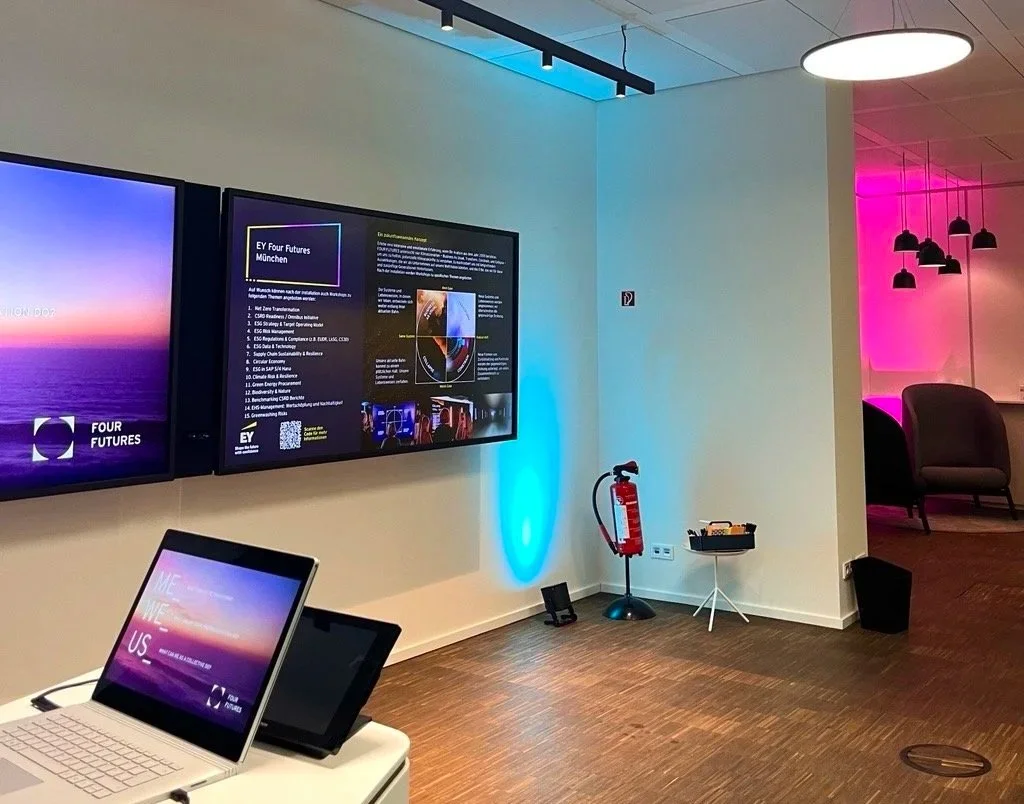
That was the power of the EY Four Futures experience, which Footprint Intelligence hosted together with EY. This format is an emotional journey into the year 2055: scientifically grounded, expert-led, and visualized through AI.
What makes Four Futures different is that it does not present climate and sustainability as a static set of charts, obligations, or disclosures. It turns future scenarios into something tangible. EY’s own framing is telling: the experience was first launched at COP28 and is designed to bridge the gap between climate data and real-world impact through storytelling and emotional engagement, so that participants do not merely understand possible outcomes intellectually, but can see, hear, and feel the consequences of today’s choices.
That shift in format mattered. And so did the mix of participants in the room.
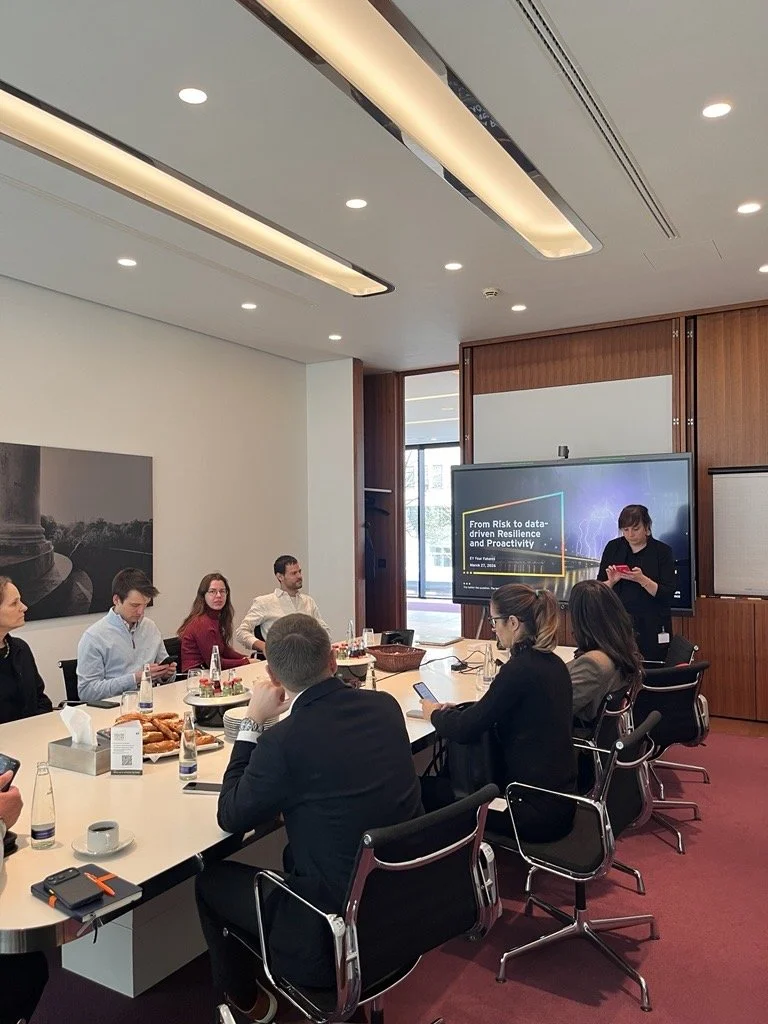
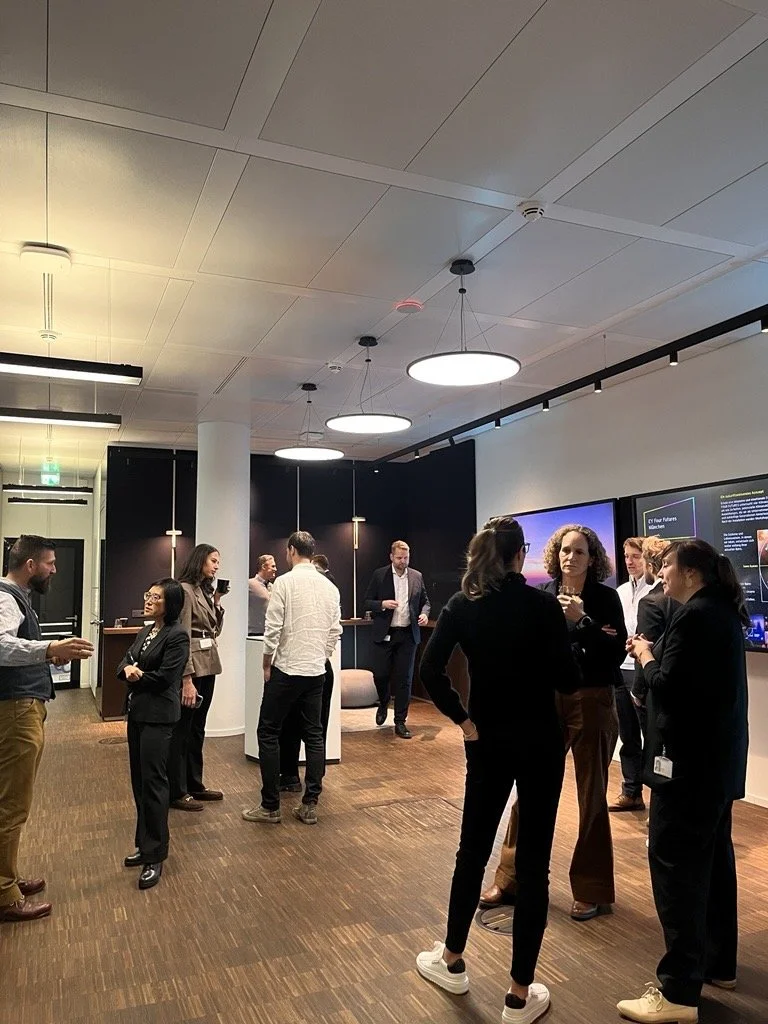
The group represented a striking cross-section of sectors: logistics and transport, international staffing and managed services, scheduling and workflow software, cybersecurity, banking, sustainable infrastructure, electrical safety, people-tech and AI-enabled performance intelligence, renewable energy, industrial electrification, and electric mobility. In other words, this was not a niche sustainability audience. It was a room that reflected how sustainability now cuts across operations, technology, finance, infrastructure, workforce strategy, and growth.
There was also a sense of continuity in the atmosphere. Most participants had already met at the Business Breakfast Footprint Intelligence hosted the Friday before. That meant the Munich event did not begin from zero. Instead of spending the morning establishing why sustainability matters, the room could move more quickly into the more difficult and more useful question: how do we turn sustainability into strategy, resilience, and measurable business value?
When the future stopped feeling distant
What stayed with many participants after the immersive experience was not one specific number, but a feeling: a sudden collapse of distance.
The futures shown in the installation did not feel abstract or remote. For many in the room, they felt uncomfortably close. Droughts, floods, water shortages, heat stress, disrupted systems and social tensions were not perceived as speculative scenes from a far-off century. They were recognized as extensions of developments already underway. That realization shaped the discussion that followed: parts of these futures are no longer hypothetical. They have already begun.
This was what gave the reflection its weight. The installation did not frame climate change merely as an environmental concern. It showed how deeply it will shape the conditions under which business, infrastructure, finance, institutions and everyday life operate. And it confronted participants with something even more unsettling: the children of today are the adults in these scenarios. The generations now growing up will not encounter 1.5, 2, 3 or 4 degrees of warming as a concept. They will encounter it as the world in which they have to live, work, and endure.
Once the future is seen not as a reporting horizon but as the lifetime of people already alive, the conversation changes. It becomes more immediate, more sober, and far more human.
What is already happening now
Part of what made the conversation so intense was the recognition that the underlying dynamics are already visible.
Water shortages, crop failures, floods, heatwaves and wider climate-related disruptions are no longer distant warnings. They are entering present-day operations, supply conditions and public life. The installation made these developments emotionally tangible, but the discussion afterward grounded them in current business reality.
This was especially visible in reflections on banking and insurance. In these sectors, climate risk and resilience are no longer treated as future-facing themes waiting politely at the edge of strategy. They already influence credit perspectives, asset assessments, pricing logic and insurability. In highly exposed regions, insurance availability is already tightening, and premiums are rising as both perceived and actual climate risk increase. That is a powerful signal. It shows that markets in some sectors are already reacting to physical climate exposure, even where other parts of the economy still behave as if there were more time.
That gave the broader discussion a sharper realism. Climate resilience is not only about what might happen later. It is increasingly about how companies respond to pressures already reshaping economic conditions.
The uncomfortable human instinct to normalize
Another thread in the conversation was more psychological than technical, but no less important.
Several participants reflected on the remarkable human capacity to block out negative realities in order to preserve a sense of normality. There is an understandable tendency, both individually and institutionally, to continue with business as usual even when warning signs are accumulating. The mind protects itself through distance, routine and selective attention.
But that instinct has limits. Climate disruption does not pause because organizations are slow to process it emotionally. It does not wait for planning cycles to become comfortable. One of the deeper effects of the installation was that it briefly broke this mechanism. It made it harder to file climate risk away as background noise. It turned it into something lived, visible and morally difficult to ignore.
That emotional honesty gave the later exchange its seriousness.
Resilience became the real subject in the room
But the full impact of the installation only became clear once the formal experience had ended.
As participants moved into the networking break and the subsequent inputs from EY and Footprint Intelligence, the emotional intensity of the exhibition gave way to a more grounded reflection. The scenarios did not remain images on a screen or impressions in the room; they carried directly into the conversation, shaping its tone, its questions, and its sense of urgency.
What followed was more than a discussion after an exhibition. It was a continuation of the experience through the lens of business reality: sector perspectives, management challenges, and the shared attempt to understand what resilience, climate risk, and strategic readiness mean in the present. EY sharpened the discussion around physical climate risk and resilience, while Footprint Intelligence focused on how these realities can be translated into business steering, decision-making, and measurable action.
Only then did the full depth of the morning begin to unfold.
That is why the conversation did not revolve around sustainability in generic terms. It centered on resilience.
The EY input gave this discussion a clear management lens. Resilience emerged not as a slogan, but as a concrete business capability: the ability of a company to anticipate climate-related shocks, absorb them, adapt under pressure, and continue operating. This shifted the conversation away from abstract concern toward a much more practical question: how can an organization remain functional as climate disruption becomes more frequent, more costly, and more systemic?
This is not a marginal issue. Companies that fail to adapt to climate risks could lose up to 7% of their profits each year by 2035. The implication is difficult to ignore. Heat, flooding, drought, and other physical hazards do not remain confined to sustainability teams. They affect sites, supply chains, operating continuity, workforce safety, asset exposure, insurability, cost structures, and long-term competitiveness.
In Munich, resilience therefore emerged not as a soft concept, but as a hard business capability.
Turning resilience into business decisions
This was where the Footprint Intelligence input added an important second layer to the discussion.
If resilience is the strategic necessity, organizations still need ways to act on it inside the business. The Footprint Intelligence perspective focused on how sustainability-related issues can be translated into business steering: not as vague aspiration, but as quantifiable effects across multiple KPIs. The central idea was simple and important. Climate-related measures become more useful when they can be linked to the terms in which companies actually make decisions: risk exposure, operational continuity, cost structures, investment logic, and commercial performance.
That perspective was reflected in the Footprint Intelligence material shared around the event. One slide framed the intersection of sustainability and business as a tangible win-win between risk reduction, cost efficiency and revenue growth. Another emphasized the need to quantify sustainability strategy across multiple business KPIs rather than keeping it in a narrow environmental silo. This matters because resilience decisions rarely sit in one function alone. They affect operations, procurement, finance, asset planning, leadership priorities and competitive positioning at the same time.
What emerged from this was not a simplistic claim that every sustainability measure automatically creates upside. The discussion was more mature than that. It was about making trade-offs visible. Which actions reduce exposure? Which ones avoid future losses? Which improve operational robustness? Which require investment now but protect long-term value? Which measures strengthen the business under more volatile climate conditions?
That is where quantification becomes essential.
Better data, better prioritization, better action
The discussion also made clear that resilience cannot be built on fragmented information.
Footprint Intelligence highlighted the importance of stronger ESG data and analytics maturity: not as an abstract maturity model, but as the practical foundation for better decisions. High-quality, structured data makes it easier to identify hotspots, understand where exposure is concentrated, target mitigation where it matters most, and assess the business effects of different interventions more credibly.
Once relevant climate risks are identified, companies need a disciplined way to evaluate them, estimate their financial relevance, and decide whether mitigation measures reduce the remaining net risk to an acceptable level. That may involve avoidance, reduction, transformation or, in limited cases, risk transfer. But none of these choices can be made well without a clearer informational base.
This is also where AI entered the conversation in a grounded way. Not as a futuristic promise, and not as a substitute for expertise, but as a tool for structuring complexity. AI can help connect environmental data with operational and financial logic, surface patterns across fragmented inputs, and support the quantification of measures across several business dimensions at once. In a field defined by uncertainty and interdependence, that kind of support can make resilience planning more actionable.
What remained after the discussion
What made the Munich exchange so meaningful was that it did not remain at the level of moral appeal. It stayed anchored in physical risk, financial consequence, business continuity, human behavior, and strategic response.
The most important insight was not simply that climate change is serious. Everyone in the room already knew that.
It was that resilience is becoming one of the defining management capabilities of our time.
And perhaps that is why the discussion after the installation felt so intense. The scenarios were set in the future, but the conversation was not really about the future at all. It was about what is already visible now and whether companies are willing to look at it clearly enough to respond.