Sustainability as a Business Case - Expert Insights
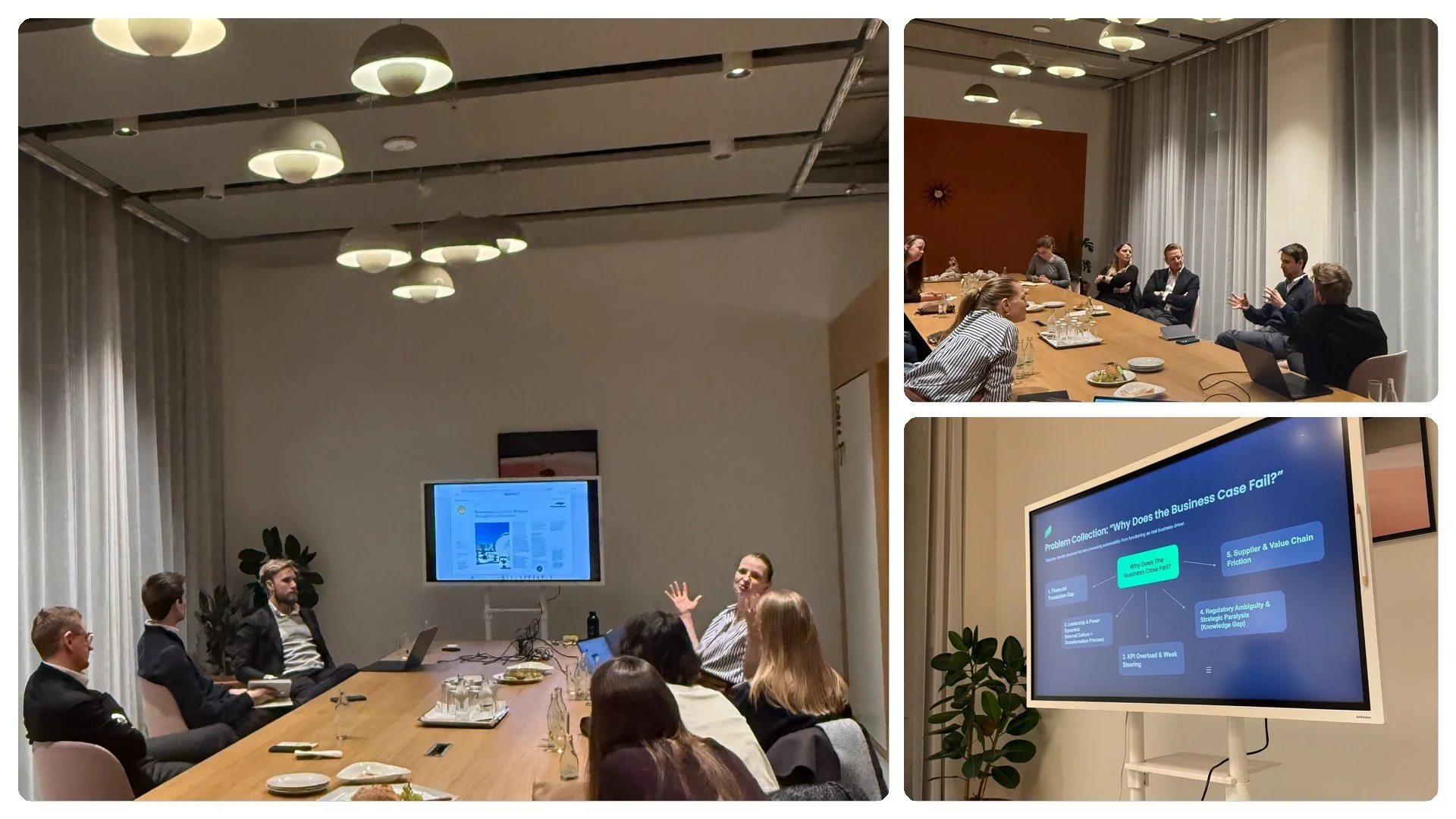
On 25 February 2026, sustainability professionals met in Munich for the monthly Sustainability Roundtable to discuss one central question:
How can sustainability governance, KPIs, and executive argumentation be structured to create measurable business impact?
The shared premise of the session was that sustainability is no longer just a reporting topic; it is simultaneously a regulatory requirement, a risk-management discipline, and a competitive factor that increasingly affects cost of capital, procurement conditions, and long-term enterprise value.
This article translates the key insights from the Munich Sustainability Roundtable into an evidence-based framework for executives, sustainability leaders, and finance teams.
1. Why the ESG-Business Case Debate Has Changed
The discussion started from a practical observation: many companies already have a sustainability strategy, but they struggle to turn it into decisions that survive CFO scrutiny and compete for budget against other investments.
This problem is becoming more urgent because the EU regulatory environment is not disappearing; it is becoming more selective in scope while remaining more demanding in data quality, traceability, and accountability.[1]
At the same time, recent academic evidence shows that markets and lenders already price climate-related information and risks, which means that even firms outside formal reporting scope may still face financial consequences for weak ESG governance, weak data quality, or delayed transition planning.[2]
A central implication from the discussion was that the ESG business case is no longer just about “doing the right thing”; it is about whether companies can translate sustainability topics into finance-relevant decision logic and governance routines.
2. EU Regulatory Context
Participants aligned on one core conclusion: while the EU is simplifying parts of the ESG framework through the Omnibus package, the strategic direction remains unchanged—toward audited ESG data, stronger due diligence, and greater legal and financial exposure.[3] The CSRD has already moved sustainability reporting into financial-grade disclosure (auditable, comparable, digitally tagged), with first reports for FY2024 published in 2025 and a narrowed scope after Omnibus (>1,000 employees and >€450m turnover).[4] In parallel, CSDDD shifts ESG further from reporting to enforceable value-chain due diligence, now focused on very large companies and pushed toward mid-2029, while the EU Forced Labour Regulation adds market-access risk by banning products linked to forced labour from December 2027.[5] The “Stop-the-Clock” directive created timing relief for parts of CSRD/CSDDD, but not strategic relief, because the underlying requirements remain and companies still need operational readiness.[6]
At the same time, multiple regulations are turning sustainability into a direct cost, traceability, and governance issue. CBAM (definitive regime from 1 January 2026, certificate surrender from 2027) and ETS2 (expected 2027/2028) make carbon a financial variable in procurement and cost structures.[7] EUDR (application from 30 December 2026), ESPR, and the Battery Regulation increase traceability and product-level data requirements, including geolocation proof and Digital Product Passport readiness.[8] PPWR and EmpCo tighten packaging compliance and anti-greenwashing obligations from 2026 onward.[9] In addition, the EU ESG Ratings Regulation (from 2 July 2026) and the EU AI Act (fully applicable from 2 August 2026, with further high-risk AI obligations by 2027) expand oversight into data credibility, methodologies, and AI-supported ESG processes.[10] In short, Omnibus may reduce who is formally in scope, but it does not reduce why ESG data remains critical for financing, procurement, claims, and market access.[11]
3. The “Business Case Failure Map”: Why ESG Initiatives Stall Internally
Participants clustered recurring internal barriers into five categories:
Financial Translation Gap (ESG metrics not linked to P&L, CapEx, or risk pricing)
Leadership and Power Dynamics (limited executive ownership, weak mandates, misaligned incentives)
KPI Overload and Weak Steering (too many reporting KPIs, too few decision-relevant KPIs)
Regulatory Ambiguity and Strategic Paralysis (wait-and-see posture under moving policy timelines)
Supplier and Value Chain Friction (Scope 3 uncertainty, procurement resistance, data gaps, margin trade-offs)
A central practical insight was that companies often “have a strategy,” but fail to build a trusted bridge from regulatory and sustainability content to a financial narrative that decision-makers can use.
Participants also highlighted that this is rarely only a sustainability-team problem. In practice, the business case fails when ESG topics are not translated into the language and decision logic of the functions that actually control budget, process change, contracts, and commercial execution.
4. Financial KPIs: The Bridge Finance Teams Actually Accept
The strongest pattern from the roundtable was simple: CO₂ figures alone rarely win budget decisions; successful internal cases connect sustainability initiatives to cash flow protection, cost of risk, margin impact, and capital allocation logic.
4.1 A practical “finance translation” KPI stack
Participants converged on a compact KPI logic that maps directly to finance decision-making:
Initial investment (€)
Running costs (€/year)
Cost of inaction / risk exposure (€/year)
Value upside (e.g., margin impact / revenue share from sustainable offerings)
4.2 Commercial outcomes / business impact: the categories executives actually use
A useful synthesis from the roundtable is that ESG business cases become stronger when they are explicitly framed around commercial outcomes rather than ESG activity alone. Participants repeatedly referenced three primary business impact categories:
Cost reduction (e.g., energy efficiency, reduced waste, lower resource use, process efficiency)
Revenue growth (e.g., customer demand, access to tenders, premium offerings, stronger positioning in procurement processes)
Risk reduction (especially compliance and financing risk) (e.g., lower exposure to regulatory penalties, supply disruption, delayed market access, financing disadvantages)
Several participants also described a broader strategic framing that business leaders can use to cluster ESG value creation and risk protection:
Risk reduction & resilience
Transparency & data quality
Capital market / investor attractiveness & stakeholder confidence
Efficiency & cost reduction
Competitiveness & growth
Reputation & trust
Governance & steering quality
This framing was helpful because it allowed ESG and finance teams to move from “Which KPI do we report?” to “Which business outcome are we trying to influence?”
4.3 “Cost of inaction” is now evidence-based, not rhetorical
Recent empirical work shows that physical climate risk is already reflected in debt pricing. Higher climate vulnerability in a borrower’s host country is associated with higher syndicated loan borrowing costs, using a global dataset of almost 86,000 syndicated bank loans.[12]
This directly supports the roundtable argument that companies can face financing penalties even when they are not under the strictest ESG reporting thresholds, because lenders price risk rather than only regulatory scope.[13]
4.4 Mandatory sustainability reporting can improve investor access
A recent The Accounting Review study on the EU’s NFRD finds that foreign institutional investors respond to mandatory sustainability disclosures and increase ownership in affected firms, particularly where sustainability disclosures are integrated into annual reports.[14]
This is highly relevant for the Munich Sustainability Roundtable framing because it shows that disclosure quality can have real capital-market effects beyond compliance optics.[15]
4.5 Governance is measurable: ESG in executive incentives
International evidence shows the use of ESG metrics in executive compensation contracts has grown substantially and varies in ways consistent with incentive contracting logic.[16]
This supports the roundtable conclusion that governance architecture—not just reporting maturity—determines whether sustainability becomes a real steering system.[17]
5. Case Study Pattern: Sustainability-Linked Loan Benefits and the KPI Design Question
During the investor-focused case discussion, participants emphasized that the most common commercial outcomes observed in practice are cost reduction, revenue growth, and risk reduction (especially compliance/risk mitigation effects).
One example shared in the room described a company receiving approximately €140,000 in financing benefits after improving its EcoVadis rating in the context of a sustainability-linked loan structure.
From an evidence perspective, this anecdote is directionally plausible: recent research on sustainability-linked loans (SLLs) shows that SLL structures are increasingly used to align financing terms with sustainability performance, while also highlighting that KPI materiality and target design quality are critical for whether incentives are effective.[18]
In practice, this means an SLL can be a strong business-case instrument only if the linked KPIs are material to the borrower’s strategy and credibly measurable (e.g., emissions, energy, sourcing, or operational indicators with clear baselines and verification logic).[19]
6. The Operating Model the Room Converged On
A practical strength of the Munich roundtable format was that it forced participants to move from diagnosis to a repeatable operating pattern.
The group idendtified…
Executive logic: risk exposure → financial impact → governance control.
Minimal KPI set: steering KPIs rather than reporting overload.
One governance adjustment: ownership, cadence, and decision rights
ESG business impact is inherently cross-functional and cannot be owned by sustainability teams alone. The key functions involved typically include:
Finance (capital allocation, ROI logic, risk pricing, investor communication)
Operations (efficiency measures, process adjustments, implementation feasibility)
Supply / Procurement (supplier data, sourcing decisions, traceability, cost trade-offs)
Legal / Compliance (regulatory interpretation, due diligence, claim substantiation)
Marketing (positioning, communication consistency, greenwashing risk)
Sales / Business Development (tender requirements, customer expectations, commercial conversion)
This perspective shifts the focus from abstract ESG governance to the concrete decision and value-creation pathways within the organization.
7. What This Means for Executives: A Legal-Strategic Interpretation
The Munich Sutainability Roundtable discussion suggests that the real competitive divide in ESG is no longer “reporting vs. no reporting,” but financial translation capability.
Organizations that continue to treat sustainability as a standalone reporting workstream may comply on paper, but they will struggle to justify investment, prioritize initiatives, or defend budgets under macroeconomic pressure.
By contrast, organizations that connect ESG topics to cost of capital, procurement economics, risk pricing, margin resilience, and governance accountability can transform sustainability from a cost center narrative into an enterprise value narrative.[20]
That is the practical meaning of the roundtable’s core shift: from compliance to capital allocation.
8. Conclusion: ESG Is Becoming Audited, Priced, Traceable, and Enforceable
Across CSRD, CSDDD, EUFLR, CBAM, ETS2, EUDR, PPWR, EmpCo, ESG ratings oversight, and the AI Act, the EU framework is moving toward a system in which ESG is increasingly audited, priced, traceable, enforceable, and in some cases litigable.[21]
The Munich Sustainability Roundtable made one point especially clear: the companies that will create advantage in this environment are not necessarily those with the most ESG slides, but those with the best governance design and the most credible financial KPI logic.
For both corporate leaders and ESG experts, the opportunity now is to build a shared management language across finance, operations, legal, procurement, and commercial teams—one that links sustainability metrics to cost, growth, risk, resilience, and capital allocation.
That is where sustainability moves from a reporting obligation to a business capability.
Sources
Council of the European Union. (2026, February 24). Council signs off simplification of sustainability reporting and due diligence requirements to boost EU competitiveness. Council of the European Union.
Kempa, K. (2025/2026). Physical climate risk and the pricing of bank loans. Journal of Environmental Economics and Management. ScienceDirect. DeFond, M., Hung, M., Li, S., & Wang, Y. (2025). The impact of mandatory sustainability reporting on institutional investors: Evidence from the EU Non-Financial Reporting Directive. The Accounting Review, 101(1), 285–321. AAA Publications.
Council of the European Union. (2026, February 24). Council signs off simplification of sustainability reporting and due diligence requirements to boost EU competitiveness. Council of the European Union. Reuters. (2026, February 24). EU countries give final approval to weaken company sustainability laws. Reuters.
European Commission. (n.d.). Corporate sustainability reporting. Finance. European Commission Finance. Council of the European Union. (2026, February 24). Council signs off simplification of sustainability reporting and due diligence requirements to boost EU competitiveness. Council of the European Union.
Reuters. (2026, February 24). EU countries give final approval to weaken company sustainability laws. Reuters. European Commission. (n.d.). Forced Labour Regulation. European Commission. Regulation (EU) 2024/3015 of the European Parliament and of the Council of 27 November 2024 on prohibiting products made with forced labour on the Union market and amending Directive (EU) 2019/1937, OJ L 2024/3015 (2024). EUR-Lex.
Directive (EU) 2025/794 of the European Parliament and of the Council of 14 April 2025 amending Directives (EU) 2022/2464 and (EU) 2024/1760 as regards the dates from which Member States are to apply certain corporate sustainability reporting and due diligence requirements, OJ L 2025/794 (2025). EUR-Lex. Directive (EU) 2025/794 of the European Parliament and of the Council of 14 April 2025 amending Directives (EU) 2022/2464 and (EU) 2024/1760 as regards the dates from which Member States are to apply certain corporate sustainability reporting and due diligence requirements, OJ L 2025/794 (2025). EUR-Lex PDF.
European Commission. (n.d.). Carbon Border Adjustment Mechanism (CBAM). Taxation and Customs Union. European Commission Taxation and Customs Union. EUR-Lex. (n.d.). Carbon Border Adjustment Mechanism — summary. EUR-Lex. European Commission. (n.d.). ETS2: Buildings, road transport and additional sectors. Climate Action. European Commission Climate Action. Council of the European Union. (2026, February 18). Market stability reserve: Council backs measures for a smoother launch of ETS2. Council of the European Union.
Council of the European Union. (2025, December 18). Deforestation: Council signs off targeted revision to simplify and postpone the regulation. Council of the European Union. Council of the European Union. (2025, December 4). Deforestation regulation: Council and Parliament agree on a targeted amendment. Council of the European Union. European Commission. (n.d.). Ecodesign for Sustainable Products Regulation (ESPR). European Commission. European Commission. (2024, November 13). Digital Product Passport: new EU system to support sustainable products. European Commission. Council of the European Union. (2025, July 18). Simplification: Council adopts law to “stop-the-clock” on due diligence rules for batteries. Council of the European Union.
European Commission. (n.d.). Packaging waste. Environment. European Commission Environment. European Commission. (2024, March 27). New EU rules to empower consumers for the green transition enter into force. European Commission Energy. European Commission. (n.d.). Sustainable consumption (EmpCo transposition and application dates). European Commission.
ESMA. (n.d.). ESG Rating Providers. ESMA. European Commission. (n.d.). Environmental, social and governance (ESG) ratings. Finance. European Commission Finance. European Commission. (n.d.). AI Act | Shaping Europe’s digital future. European Commission Digital Strategy.
Reuters. (2026, February 24). EU countries give final approval to weaken company sustainability laws. Reuters. Council of the European Union. (2026, February 24). Council signs off simplification of sustainability reporting and due diligence requirements to boost EU competitiveness. Council of the European Union.
Kempa, K. (2025/2026). Physical climate risk and the pricing of bank loans. Journal of Environmental Economics and Management. ScienceDirect.
Kempa, K. (2025/2026). Physical climate risk and the pricing of bank loans. Journal of Environmental Economics and Management. ScienceDirect.
DeFond, M., Hung, M., Li, S., & Wang, Y. (2025). The impact of mandatory sustainability reporting on institutional investors: Evidence from the EU Non-Financial Reporting Directive. The Accounting Review, 101(1), 285–321. AAA Publications.
DeFond, M., Hung, M., Li, S., & Wang, Y. (2025). The impact of mandatory sustainability reporting on institutional investors: Evidence from the EU Non-Financial Reporting Directive. The Accounting Review, 101(1), 285–321. AAA Publications.
Cohen, S., Kadach, I., Ormazabal, G., & Reichelstein, S. (2023). Executive compensation tied to ESG performance: International evidence. Journal of Accounting Research, 61(3), 805–853. Wiley Online Library.
Cohen, S., Kadach, I., Ormazabal, G., & Reichelstein, S. (2023). Executive compensation tied to ESG performance: International evidence. Journal of Accounting Research, 61(3), 805–853. Wiley Online Library.
Auzepy, A., Hege, U., Hossfeld, O., & Krueger, P. (2023). Are sustainability-linked loans designed to effectively incentivize corporate sustainability?Financial Management. Advance online publication. Wiley Online Library.
Auzepy, A., Hege, U., Hossfeld, O., & Krueger, P. (2023). Are sustainability-linked loans designed to effectively incentivize corporate sustainability?Financial Management. Advance online publication. Wiley Online Library.
Kempa, K. (2025/2026). Physical climate risk and the pricing of bank loans. Journal of Environmental Economics and Management. ScienceDirect. DeFond, M., Hung, M., Li, S., & Wang, Y. (2025). The impact of mandatory sustainability reporting on institutional investors: Evidence from the EU Non-Financial Reporting Directive. The Accounting Review, 101(1), 285–321. AAA Publications.
European Commission. (n.d.). Corporate sustainability reporting. Finance. European Commission Finance. Council of the European Union. (2026, February 24). Council signs off simplification of sustainability reporting and due diligence requirements to boost EU competitiveness. Council of the European Union. ESMA. (n.d.). ESG Rating Providers. ESMA. EUR-Lex. (n.d.). Carbon Border Adjustment Mechanism — summary. EUR-Lex.