Sustainability Funding: What Is It And How to Unlock It
Germany's two main funding channels for energy and sustainability investments - BAFA (the Federal Office for Economic Affairs and Export Control) and KfW (the federal development bank) - administer billions of euros each year to companies modernising buildings, processes, and supply chains. Despite federal budgets tightening to around €5 billion annually in 2026, Germany met its 2024 international climate finance target of €6.1 billion from public sources and mobilised over €1 billion in private funding. KfW's federal promotional programme for energy efficiency in the commercial sector alone has committed around EUR 1 billion in promotional loans to date.
On paper, accessing this funding sounds relatively straightforward: identify the right programme, file an application, receive the grant or low-interest loan. However, in practice, the cheque is decided long before the application is reviewed. This decision is made according to whether a company can show clean, traceable, audit-ready data behind the targets and measures it claims. Companies that struggle to secure BAFA or KfW funding rarely fail because they lack ambitious decarbonisation plans. They fail because they cannot back them up.
This article unpacks:
What BAFA and KfW are actually offering, and which programmes carry the largest stakes
What the application process demands, especially under Module 5 - the transformation plan
What a credible transformation plan looks like, and where most submissions break down
Funding at a Glance: What You'll Need Before Applying
Module 5 itself has a low barrier to apply - companies can prepare the plan themselves or engage external consultants, and the application is filed via the VDI/VDE funding-competition portal. The list below is about producing a plan that holds up under scrutiny and unlocks the downstream capex modules (1-4 and 6) that Module 5 is designed to feed into:
A qualified energy consultant or efficiency expert engaged early. For some KfW building-efficiency programmes a certified expert is mandatory; for Module 5 it's optional but typical - external consulting is what the grant actually covers. BAFA covers up to €4,000 of SME consulting costs separately. Engaging one early also raises approval odds.
Site-level energy and emissions data, not estimates. BAFA expects consumption and emissions measured by site and source with a defensible methodology. Site-level data is expected where multiple sites are in scope, with a defensible measurement methodology. Spend-based proxies are acceptable where better data isn't yet available, but should be flagged and improved over time.
Quantified, time-bound targets aligned to German climate legislation. The general goal of reducing emissions is not a focused target. What’s needed are specific figures, deadlines, and a trajectory that reconciles with federal climate goals.
A costed action plan. The technical measures, their sequencing, expected savings per measure, and the capex behind each. This is what BAFA actually funds against.
A monitoring framework with defined indicators. The plan must be reviewable over time - energy intensity per unit, emissions per tonne, share of renewable process heat. Pick indicators you can actually report against quarter on quarter.
A clean audit trail. Every figure needs to be traceable to its source. This is what holds the plan together under scrutiny - and what every downstream capex application will draw on.
Confirmation of eligibility. BAFA applies only within Germany - scope which legal entity qualifies before designing the application. Check too whether network membership lifts your funding rate.
Application filed before any work begins. Both BAFA and KfW require submission before the measure starts. Keep reading to find out how you can construct a strong application.
What Are Sustainability Funding Programmes?
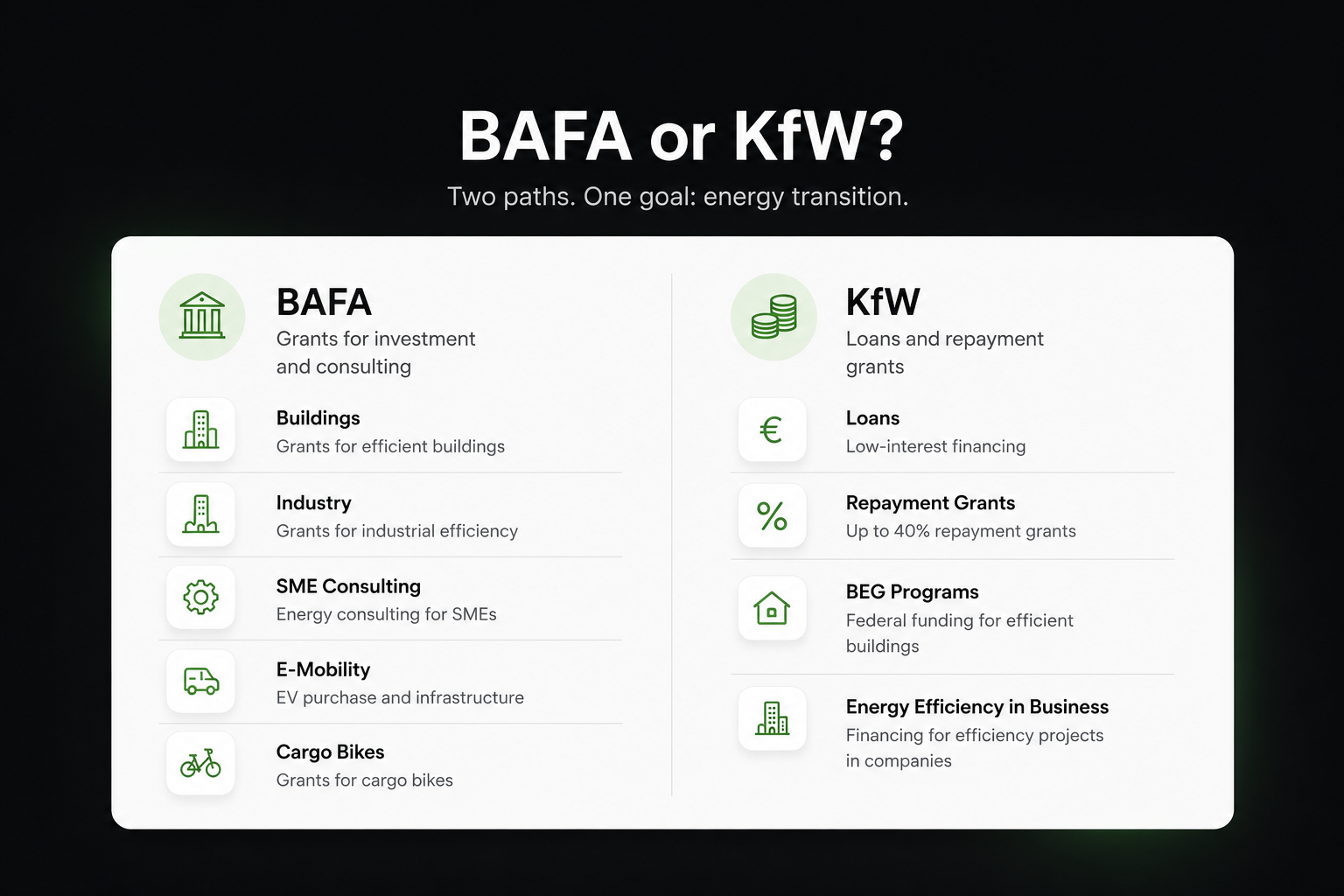
BAFA and KfW are the two federal channels through which sustainable energy transitions in buildings, industry, and SMEs can be funded. They operate in parallel and are often combined within a single project's capital stack.
BAFA provides grants for energy-efficient buildings, renewable heating systems, insulation upgrades, and energy and resource efficiency in industry. Eligible investments range from energy-efficient motors, fans and pumps, and sensors to monitor energy consumption, to renewable process heat, transformation concepts mapping a route to climate neutrality, and grants for the purchase of electric vehicles and cargo bikes for companies. BAFA also monitors Germany's mandatory energy audit regime - both the obligation on non-SMEs and the qualification of the auditors performing audits. One operational point that's easy to miss: BAFA applies only within Germany. Companies with cross-border operations need to scope which legal entity is eligible before they design the application.
KfW provides low-interest loans combined with repayment grants through programmes like the Federal Funding for Efficient Buildings (BEG) and the Federal Funding for Energy and Resource Efficiency in Business. The KfW Energy Efficiency Programme for production facilities (Product 292) offers low-interest loans for companies achieving minimum 10% energy savings, with over 10,000 projects already funded. The blended grant-and-loan structure is what makes KfW particularly attractive for capex-heavy renovations and process changes.
Funding levels depend on three things: company size (smaller companies get higher percentages), the technical ambition of the measure, and - critically - whether the company is part of an Energy Efficiency and Climate Protection Network. Network participants receive a higher funding rate in Module 5 - Transformation plans of the Federal Funding for Energy and Resource Efficiency in the Economy package. The Networks Initiative is far from a small club: monitoring in 2024 attributed annual savings of around 7,500 GWh of final energy and 2.7 million metric tons of CO2e to the 240 or so networks already audited.
This is where carbon markets enter the picture. Network membership doesn't only increase grant funding - it can also unlock compensation under Germany's national emissions trading scheme. Since 2021, the Carbon Leakage Regulation for Germany's national ETS allows aid for industrial companies to compensate for disadvantages in global competition caused by the scheme, and network participation is a possible criterion for receiving this compensation. The combined picture: grant funding rewards the upfront investment, while carbon credit and emissions trading mechanisms reward sustained performance over time. For larger industrial sites, the second revenue stream often outweighs the first.
A smaller but practically important programme: BAFA covers up to €4,000 in consulting costs for SMEs under its energy efficiency advisory programme. This is how most companies start - a consultant runs the initial audit, identifies eligible measures, and shapes the application before any capex is committed.
What Are the Programmes Asking For?
One of the most strategically important of these programmes is BAFA Module 5: Transformation Plans. It sits upstream of the others: Module 5 funds the creation of the transformation plan, which then becomes a required input for the capex-focused modules (1-4 and 6) that fund the actual implementation. A transformation plan is a long-term roadmap to significantly higher energy efficiency or near-climate-neutrality. BAFA co-funds the consulting cost of producing the plan itself - not the subsequent investments, which sit under modules 1-4 and 6 - at 40-60% depending on company size, up to a base maximum of €60,000.
Module 5 matters hugely because the plan it produces becomes the foundation for every subsequent funding application. A weak plan caps the company's access to capex grants downstream. A strong plan unlocks additional funding opportunities.
The plan Module 5 funds you to produce needs to contain four core elements:
A detailed analysis of the company's current energy consumption and emissions. Site-level where multiple sites exist, with a defensible measurement methodology. Spend-based proxies are acceptable where better data isn't yet available.
Specific, measurable targets aligned with German government climate legislation. Targets need to be quantified, time-bound, and reconcilable with the federal climate trajectory.
An action plan describing how the targets will be reached. Including technical measures, sequencing, expected savings per measure, and capex.
A monitoring framework with defined indicators. The plan has to be reviewable - by BAFA, by an auditor, and by the company itself over time.
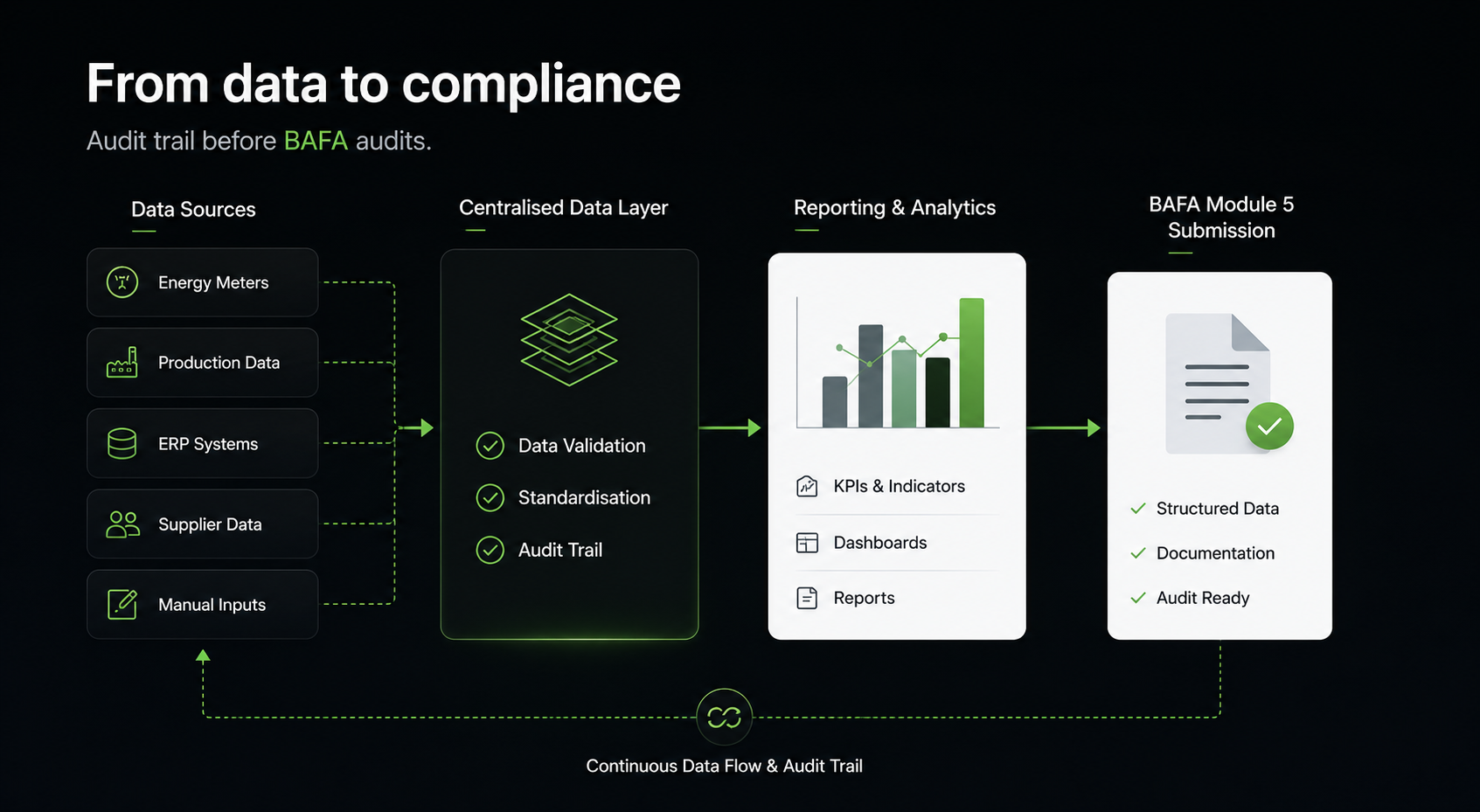
Each of these components depends on the same input: clean, traceable, structured data. The application must have a clear audit trail.
This is where most submissions break down. Energy and emissions data sits scattered across spreadsheets, utility bills, ERP systems, facility-level meters, and supplier records. Stitching it together by hand to meet BAFA's evidentiary standard takes weeks and introduces errors. These errors then translate directly into financial outcomes: a poorly evidenced plan rarely sinks the Module 5 grant itself - the grant funds the planning work either way - but it weakens every downstream capex application built on it, and the credibility of the transformation strategy with internal stakeholders.
Platforms like Footprint Intelligence, which centralise energy and emissions data across sites, departments, and suppliers, exist to remove that bottleneck. The data sits in one place, structured for audit, with versioned reporting trails. The same dataset that supports an internal decarbonisation review then supports the BAFA submission without rework.
What Does a Good Transformation Plan Look Like?
Five things separate a strong transformation plan from a weak one. None are strictly required - Module 5 will accept plans that lack them - but each materially strengthens what the plan can do, and how well it supports the downstream funding journey.
It demonstrates a high level of understanding of the company's current data. Where is energy actually being consumed - which sites, which processes, what time profile? Hourly and process-level granularity sharpens the plan, but it's best practice rather than a hard requirement. Which emissions are being measured directly, and which are being estimated by spend? Where are the data gaps, and what's the plan to close them? Without this baseline, every target downstream is guesswork. All company data should be recorded at a highly detailed, granular level and stored in a way that makes it easily accessible.
It uses a reporting system that allows data to be measured and compared over time. Manual reporting cycles, rebuilt each quarter from scratch, make this nearly impossible. The audit BAFA conducts on a transformation plan is not a one-off; the plan has to be live and reviewable. Spreadsheets remain permissible as long as the methodology is defensible and figures traceable - but they tend to fragment across cycles, and the cost of rebuilding the dataset each time compounds. Centralised reporting systems, such as the Footprint Intelligence platform, are often better equipped to deal with sustainability reporting workflows in their entirety, from data compilation to comparison and insight generation.
It integrates regulatory obligations into the transformation, not alongside it. Energy audit obligations under EDL-G, GHG reporting under CSRD for in-scope companies, and product-level requirements under CBAM or the EUDR all draw on the same underlying data (for more information on what this data is, take a look at our EUDR explainer). A transformation plan that treats them as separate workstreams duplicates cost. This is why it’s important to treat compliance as the baseline for transformation, as this approach gets two outcomes from one dataset.
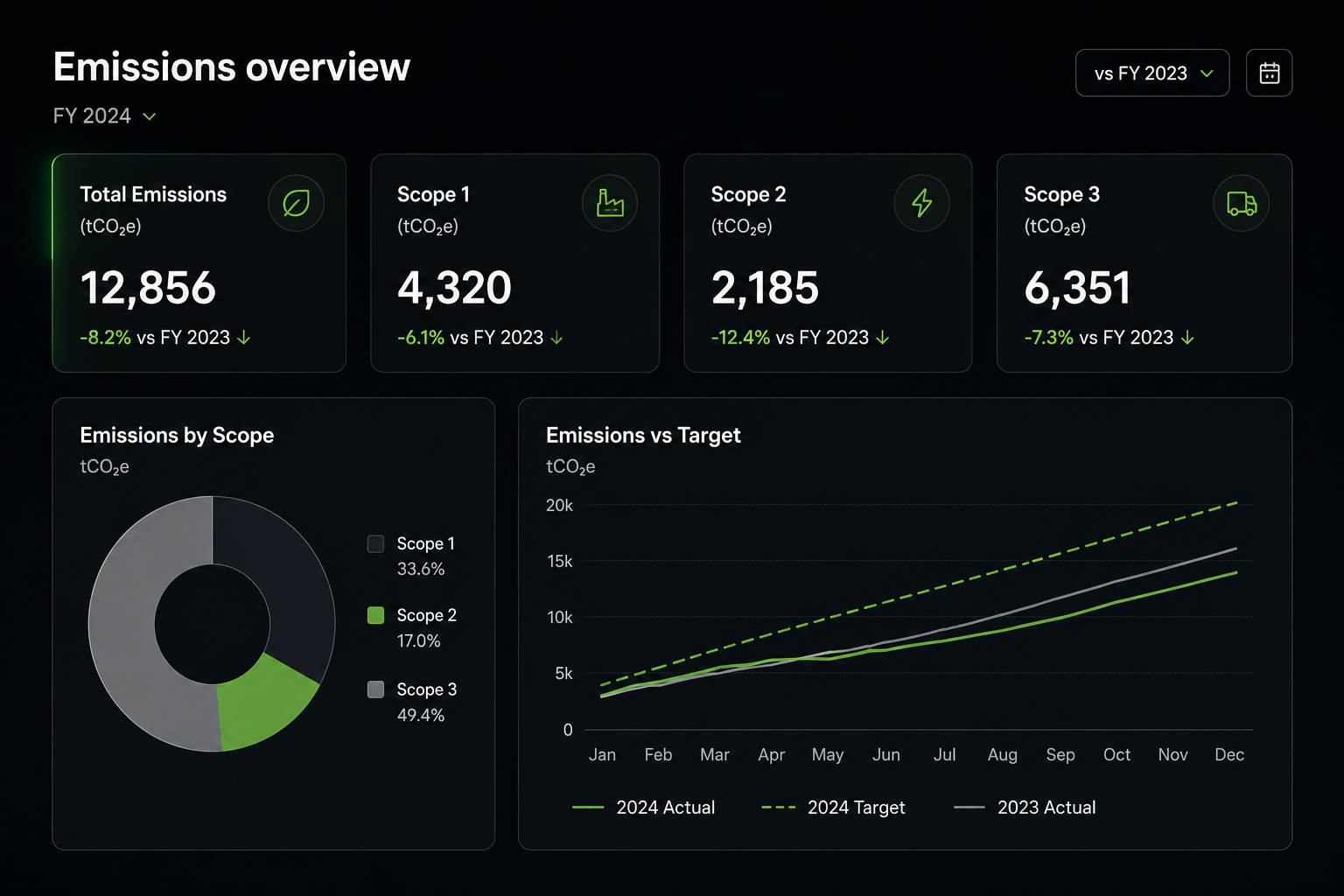
It is honest about where emissions actually sit. Scope 1 and 2 are the easier targets - direct combustion and purchased energy can usually be evidenced and reduced. Scope 3 is where the harder work lies, and where most plans tend to become vague. A credible plan names the largest scope 3 categories for the business, quantifies them, and identifies which categories are addressable in the next three to five years and which are not. (For a deeper look at scope 3 specifically, see our piece on supply chain decarbonisation.)
It defines how success will be measured. Indicators need to be specific - energy intensity per output unit, emissions per tonne produced, percentage of process heat from renewable sources. Increasingly, finance and sustainability teams are using AI agents to analyse this data as it comes in, flag drift against targets, and surface underperforming measures before the gap shows up in an audit.
The pattern across these five points: data quality is the lever. The transformation plan is only as good as the data underneath it.
Conclusion
BAFA and KfW funding is not unlimited. The programmes operate against defined annual budgets, and the 2023 federal budget freeze, which paused new financial commitments for projects from 2024 onwards for several months, showed how quickly the window can close. With federal climate finance projected to tighten further and the Social Climate Fund routing additional billions through national plans, the applications BAFA and KfW approve will increasingly be the ones that are best evidenced, not the ones that are best intentioned.
The regulatory perimeter around German companies is widening at the same time. CSRD reporting, the EU Energy Efficiency Directive, CBAM, and Germany's own national ETS each demand structured energy and emissions data. The companies that already have that data in audit-ready form can produce a transformation plan in weeks. The companies that don't will spend a quarter assembling it - and may miss the funding round entirely.
The strategic question is not whether to apply for BAFA Module 5. It is whether your reporting infrastructure can support the plan Module 5 funds you to produce - and the downstream capex applications under modules 1-4 and 6 that the plan is designed to unlock. If the answer is no, that gap is worth closing before the next budget cycle, not during it.