What Does the Data Center Innovation Initiative Mean?
The Data Center Innovation Initiative (DCII) is a deployment-focused investment programme launched in May 2026 by nonprofit investor Elemental Impact. The initiative has been set up in collaboration with tech giants Amazon, Google, Meta and Microsoft, who have committed to participating in the innovation of more sustainable data center operations. Elemental Impact will invest in early-stage startups whose energy, materials and cooling technologies can be tested inside live data centers and demonstration sites, with the aim of scaling these solutions across the wider energy and industrial economy to create significant sustainable change.
This initiative could prove to be a valuable mechanism for solving the problem that threatens the more widespread success of most climate technologies: not whether they work, but whether they can survive the transition from a controlled test environment to implementation in the wider commercial world. The DCII treats the data center build-out not as a sustainability liability to be offset, but as an emissions site that needs to be transformed in order to be maintained in the long term.
This article looks at three things: who is behind the DCII initiative and why, what it is actually trying to achieve, and how significant it is for the way industrial systems get decarbonized from here onwards.
The Origins
The driving factor behind the DCII is that the rapid growth of data centers has become one of the most powerful demand drivers of industrial decarbonization in modern history. The rise of artificial intelligence that we have witnessed in the past few years has meant that data centers are now one of the largest sources of new infrastructure demand: for power systems, for materials, for cooling, etc. As Elemental Impact point out in their press release for the DCII, corporate clean energy procurement is at a record high, and decarbonizing data centers as they grow in commercial significance positions itself as the next logical step in furthering this clean procurement mission.
Elemental's framing is that the growth of data centers can be steered. Rather than letting high demand lock in conventional, high-carbon infrastructure, the DCII uses it as an opportunity to implement the next generation of clean technologies. The larger goal here is that the initiative eventually carries these proven solutions outward to schools, hospitals, manufacturing sites, and local communities that need affordable and reliable energy.
The Key Players
The initiative is particularly interesting because it assembles four distinct groups to achieve its mission: an investor, the world's largest infrastructure buyers, the startups building the technology, and the philanthropic and legal partners who absorb early risk.
Elemental Impact is the convenor and investor of this project. A nonprofit organization with 17 years of experience, backed by 40 funders and with an impressive portfolio of 160 companies that have managed to secure $11.8 billion in additional funding and create more than 18,100 jobs. Elemental Impact tends towards first-of-a-kind and early-commercial projects when it comes to investment, and the DCII is no exception. Through the DCII, Elemental will invest $500,000 to $5 million per project in up to 10 startups through 2027, alongside hands-on support spanning financing, deployment strategy and workforce development.
Amazon, Google, Meta and Microsoft have been recruited to help identify the priority technology areas, provide strategic and technical input, pilot projects in their own environments, and share the results to accelerate adoption across the industry. As Amazon's Kara Hurst puts it, the goal is not only to prove sustainable technologies work at scale, but to also create "a shared playbook" that the rest of the industry can use to innovate and implement their own clean energy solutions.
The startups are at the core of the exercize. The DCII targets for-profit companies with new technology that can be used in or around data centre environments and then scaled beyond them. Selected companies typically run projects of 12 to 18 months, with the founder and at least one other leader expected to engage throughout the first two years. The objective is innovation and deployment rather than the cheque, and with success these projects should act as a live proof point that future adopters can use as a baseline for their own operations.
The philanthropic and legal partners manage the early risk. Breakthrough Energy Discovery, Builders Vision Philanthropy, Salesforce, and the Stolte Family Foundation have agreed to provide multi-year grant funding to fill gaps that commercial capital will not. Wilson Sonsini acts as legal partner, structuring the data-sharing frameworks and collaboration agreements that will hopefully allow competing companies to cooperate without friction.
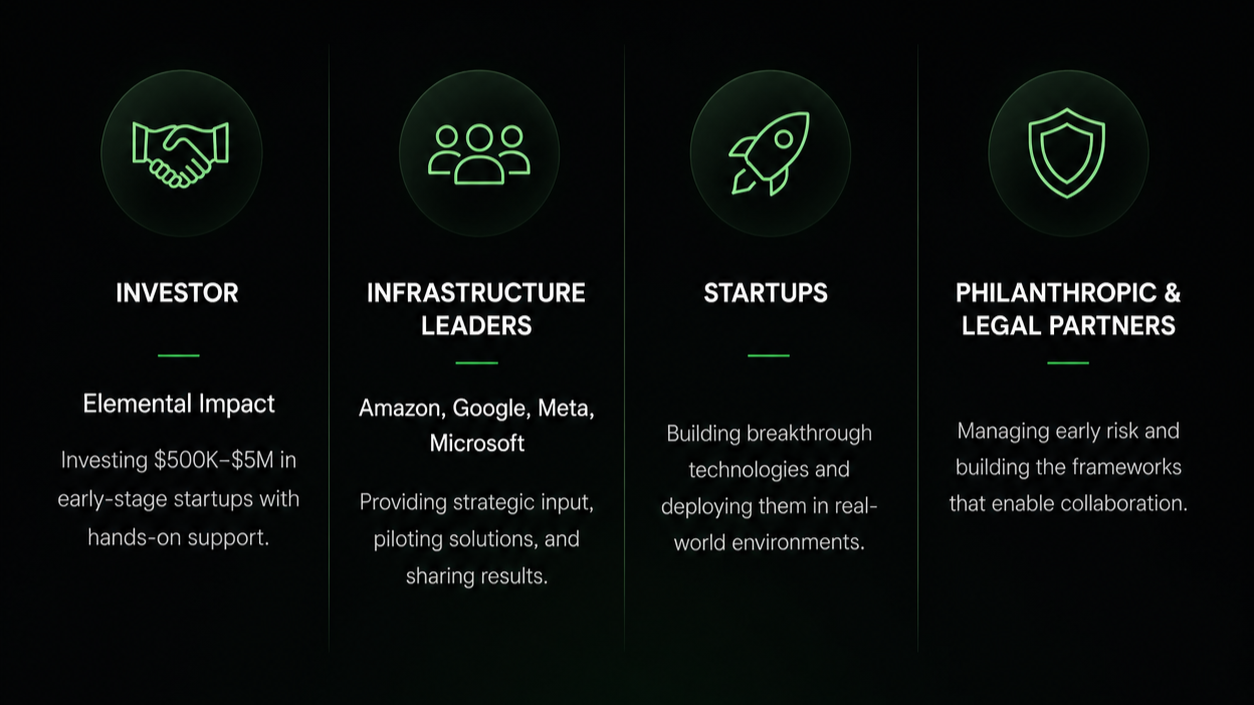
The four participating groups in the Data Center Innovation Initiative
What Is the Goal?
The stated aim is to investigate pathways for building and scaling industrial systems efficiently and sustainably with data centers as the launch point. Underneath that goal sits three distinct objectives.
Data centers as the center of gravity for corporate sustainability
For most large companies, data centers have become a problem when it comes to sustainable development goals. AI-driven demand is pushing power, water and material consumption up at a rate that could compromise the objectives those same companies have set for emissions reductions. The DCII reframes this problem as an opportunity for new sustainable solutions to emerge, and aims to provide the means for these solutions to be developed and implemented.
The implication for sustainability teams is a shift in the direction of reporting. They will go from reporting on data center impact retrospectively to shaping the infrastructure decisions that influence these reported figures. The four focus areasmap directly onto the biggest line items in a data center's footprint: energy storage for reliable clean power, advanced electrical systems for efficiency and resilience, novel industrial cooling to cut energy and water use, and low-carbon materials to reduce the embodied carbon of new construction.
Measuring and Proving Efficient Scaling
The DCII has attached fixed efficiency thresholds to some of the problem areas. For example, low-carbon concrete is expected to cut embodied carbon by at least 30%, low-carbon metals by at least 50% on a lifecycle basis, and storage and power solutions to deploy within roughly 12 months while reducing reliance on diesel generators. Every process and piece of technology will be tested in operating data centers or specific demonstration sites in order to make local energy more available and reliable in the long-term, improve how materials and land are used, and to reduce emissions at scale.
The importance of documentation cannot be understated here. Technical, operational, commercial and impact data is what is going to show that a technology can move from early adoption or theoretical testing to widespread commercial use, therefore lowering the risk for the buyer. Implementation is only as feasible (and scalable in the long-term) as the evidence it produces is credible and auditable. Platforms built to manage emissions and impact data exist because that evidence base is what unlocks the next decision, whether that is a procurement sign-off or a follow-on investment.
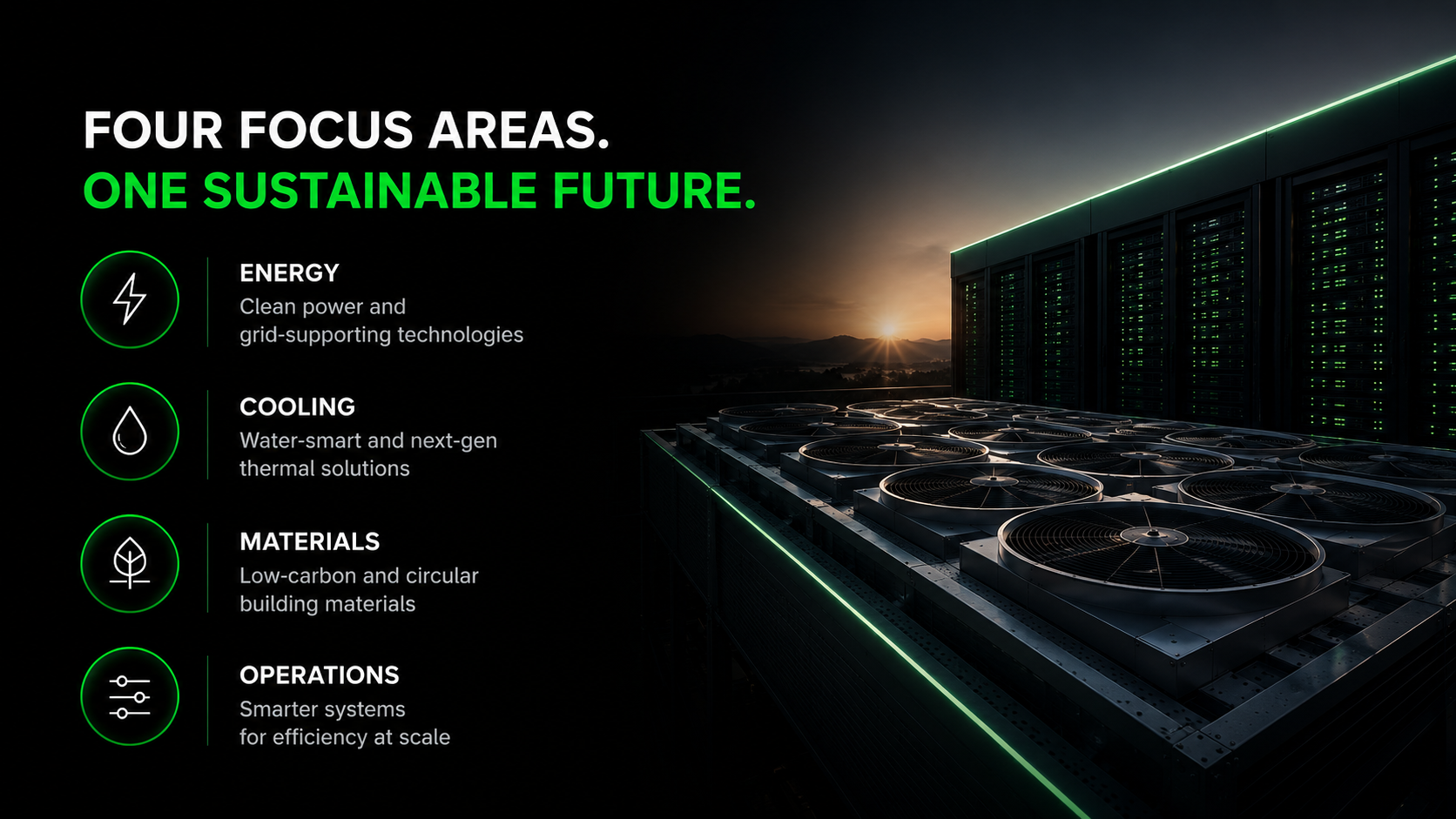
The four important technological focus areas that the initiative seeks to target
Potential impact
There are two potential layers to the intended impact of this initiative. Specific to the data centers, success will look like cleaner power, lower water use, less embodied carbon, and more resilient operations overall.
Looking beyond the centers themselves, success will be measured by the adoption and implementation of the newly innovated technologies in areas such as manufacturing, public buildings and wider community energy access. Elemental's track record emphasizes the local dimension: 98% of its current portfolio companies report that community partners have been incredibly significant to their success, and the DCII builds that engagement into the model from the outset.
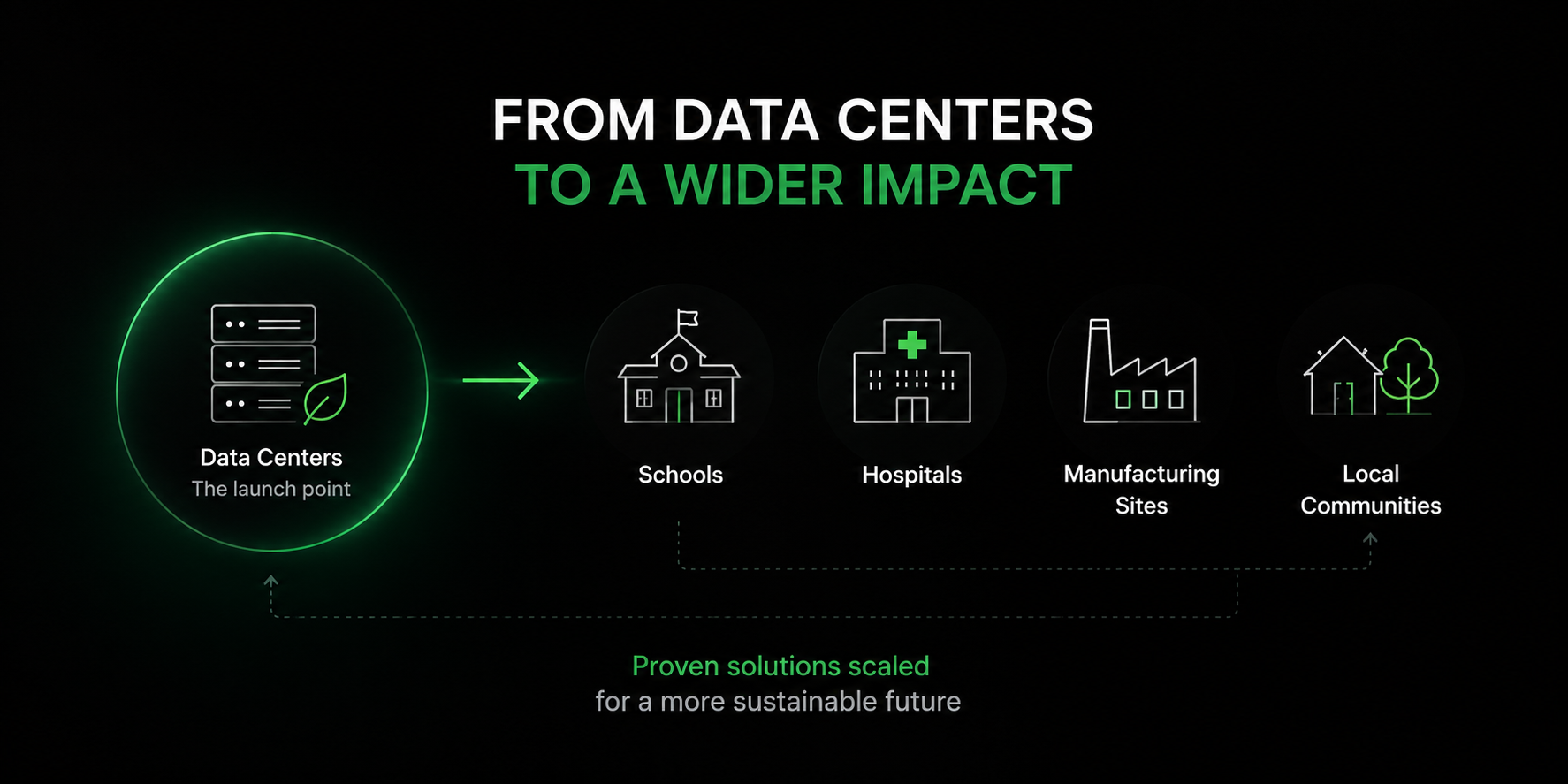
The impact of the project should go beyond the data centers themselves
Conclusion
So how significant is this initiative? The DCII is deliberately built around a current problem. As Wilson Sonsini's Bob O'Connor frames it, many technologies fail to scale not on technical performance but in the transition to early deployment capital, and the DCII has been designed to close exactly that gap. The significance is therefore less about the headline capital, which is modest at up to 10 projects, and more about the template the initiative proposes: industry leaders, investors and new innovators joining forces for a first-of-a-kind project and publishing what they learn.
The more difficult question is whether a programme that supports up to 10 projects through 2027 is large enough to really impact an industry growing as fast as this one. The DCII's own answer is that it is not trying to fund the entire transition, but instead trying to produce specific proof points that should make the rest of the capital flow more easily. If data center growth requires industrial decarbonization to be sustainable and scalable in the long-term, then the real test has to be how many other companies or initiatives adopt what these projects prove. The playbook is the product, and the measure of success is who decides to read from it.