Digital Media and Net Zero: The Scope 3 Problem
The sustainability landscape keeps getting more complex as reporting rules multiply and digital infrastructure expands at the same time. A sector feeling that pull sharply is the digital services and media industry, which sits between an obligation to cut emissions and a commercial responsibility to keep up with everything the digital economy is throwing at them — which with more streaming, more AI, more content and more compute, is a lot. Companies have to be strategic about which problem areas they target, aligning with their climate commitments while working inside real budget and capacity constraints.
The decarbonization struggle in digital media is largely due to hidden Scope 3 emissions, buried in rented cloud capacity, in the networks that move content, and in the devices audiences watch on. In this article, we look more closely at this challenge.
To aid our investigation, we took a data sample from the most recent annual and sustainability reports — 2024 and 2025 — of 10 of the largest digital media companies operating in Europe, spanning streaming, publishing, gaming, technology distribution, and logistics-adjacent media. The sample cannot capture the full nuance of the sector, but it does surface a consistent picture of where these companies are setting targets, where they are making progress, and where roadblocks arise.
The sample comprised the following:
assets.contenthub.wolterskluwer.com/...wolters-kluwer-2025-annual-report
annualreport.postnl.nl/app/uploads/2026/02/PostNL-Annual-Report-2025.pdf
annualreport.springernature.com/2025/files/sn-ar-25-combined-non-financial-report.pdf
paloaltonetworks.co.uk/...panw-fy25-cr-report.pdf | paloaltonetworks.com/about-us/corporate-responsibility
riotgames.com/darkroom/original/...riot-sustainabilityreport-2024.pdf
s21.q4cdn.com/109490932/files/doc_presentations/2025/TD-SYNNEX-Corporate-Citizenship-Report.pdf
media.hachette.fr/11/pdf-file/2025-07/2504-064_rapport_rse_def2_pageapage.pdf
This article presents what those reports tell us about sustainable development in the digital sector — and why the sector's hardest emissions are the ones it can least control.
What We Found: Report Themes
The reports in our sample were published against a now-familiar stack of frameworks such as the CSRD and its ESRS standards, the GHG Protocol, and SASB, alongside broader ESG commitments on workforce diversity and eradicating pay gaps. Here is what we found out:
Climate and net-zero targets. Net-zero commitments are in place across the sample, but the deadlines have been pushed back slightly. The net zero horizon now lands between 2040 and 2050, with the later dates likely tied to the difficulty of cutting supply chain emissions. The encouraging signal sits underneath the headline: most of these companies are either validated by the Science Based Targets initiative (SBTi) or on a stated path to validation, which means their interim targets are externally checked rather than self-declared.
Net-zero deadlines fall between 2040 and 2050.
The majority of the sample is SBTi-validated, with most of the remainder stating an intention to validate soon.
The sample's average near-term Scope 3 reduction commitment is roughly ranges from 32.5% to 55% by 2030
Renewable-energy targets sit between 2025 and 2030 window, with several companies already at or near 100% on purchased electricity.
GHG emissions. Scope 3 has been shown to be the most difficult category to tackle. Across the sample, value-chain emissions accounted multiple times for around 90% of the total footprint. This large figure aligns with CDP's finding that Scope 3 typically represents the overwhelming majority of corporate emissions and can impinge on the efficiency of overall company operations. For digital media specifically, that Scope 3 mass tends to concentrate in the computing the business depends on but does not directly own: rented cloud and data-center capacity, content networks, and the energy audiences burn on their own devices.
Scope 3 is the single largest emissions category for nearly every company in the sample.
It averages roughly around the 90% mark of total reported emissions, Scope 1 and 2 operational emissions making up a much smaller figure in comparison.
Renewable energy. The reported figures tell a success story in this sector. Companies have either reached 100% renewable electricity in some capacity or have committed to do so by 2030, and buildings and offices are where the transition has gone furthest. Some companies sit at or near 100% renewable on their own premises, highlighting that decarbonization efforts are easier to realize when they are on premises directly owned by the company.
Most of the sample has reached 100% renewable electricity or targets it by 2030.
Owned workspaces and buildings are a successful site of transition, with many companies at or near the 100% renewable figure.
The remaining two themes round out the picture but carry less of the strategic weight. On workforce and diversity, women in leadership and management roles sat between the 30s and 50s across the sample, alongside widespread commitments to closing the gender pay gap. On ESG governance, almost every company has set up a dedicated sustainability or governance committee, signalling that climate sits at board level rather than in a side office.
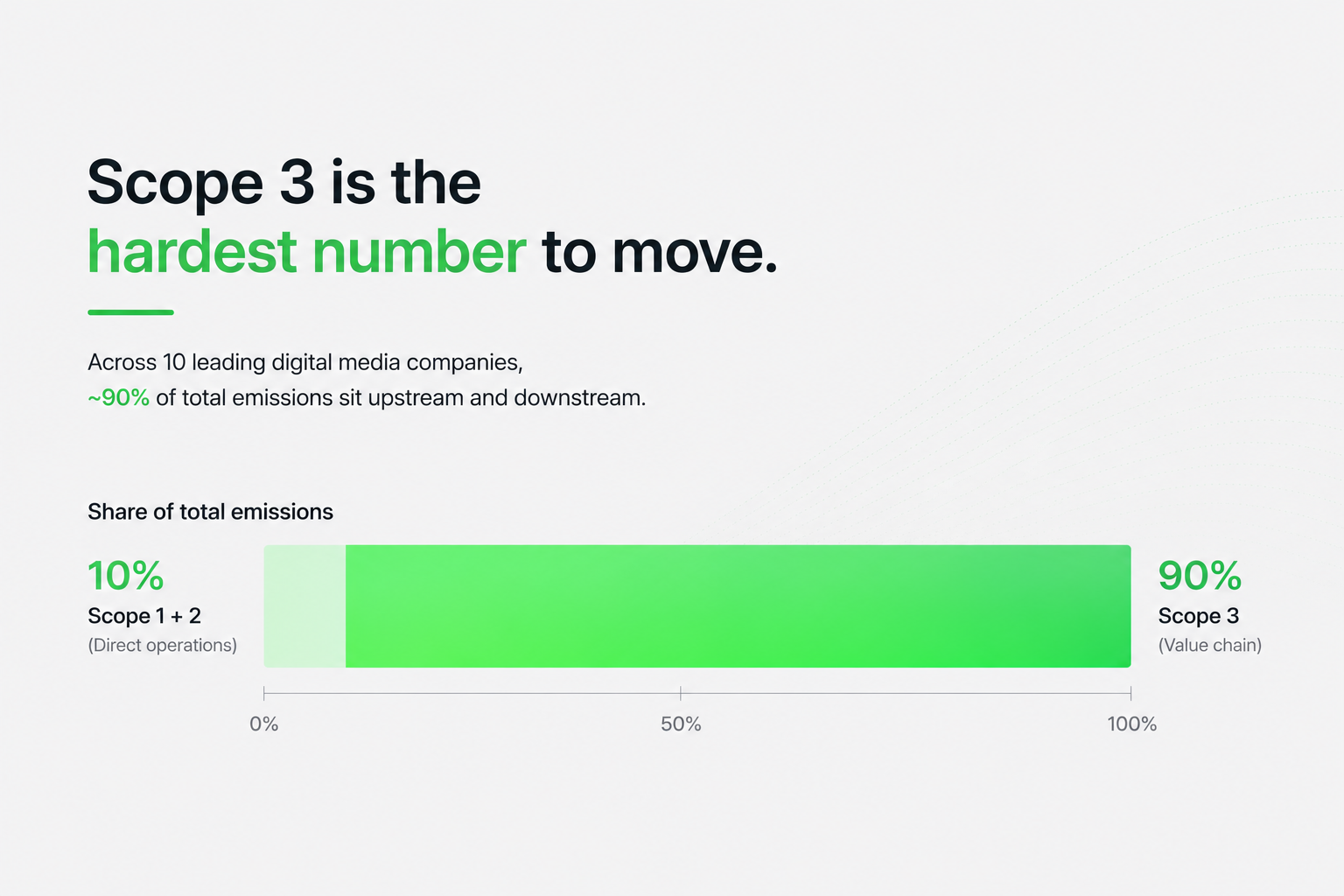
Scope 3 emissions average
Why Scope 3 Is the Hardest Number to Move
For digital media, three forces make that general problem acute.
The carbon footprint of content consumption. The IEA's own analysis equated one hour of streaming video to roughly 36 grams of CO2 in 2019 and showed that some widely circulated estimates had exaggerated the climate impact by up to 90 times, while steady efficiency gains in data centers, networks, and devices are actively lowering the number. The issue is the huge scale of content consumption. Even if the per-stream footprint is relatively small, when its multiplied across billions of viewing hours and pushed toward ever-higher resolutions, it adds up to a much larger figure, most of which lands in Scope 3 transmission networks and the user devices the company never touches.
AI and the cloud. This is the force that has the most power to drastically reshape the sector’s footprint. The IEA projects that global data-center electricity demand will roughly double from about 415 TWh in 2024 to around 945 TWh by 2030, growing near 15% a year. This is on average more than four times faster than overall electricity demand, with AI as the primary driver of this rapid growth. Within that, electricity use by AI-focused servers is growing faster still. In the EU alone, data-center consumption is expected to climb from roughly 70 TWh in 2024 to about 115 TWh by 2030. Data centers still make up a relatively modest share of total emissions today in comparison to other categories, but they are one of the few sectors where the trajectory is up rather than dwindling. For a digital media company renting that capacity, this flows straight into Scope 3.
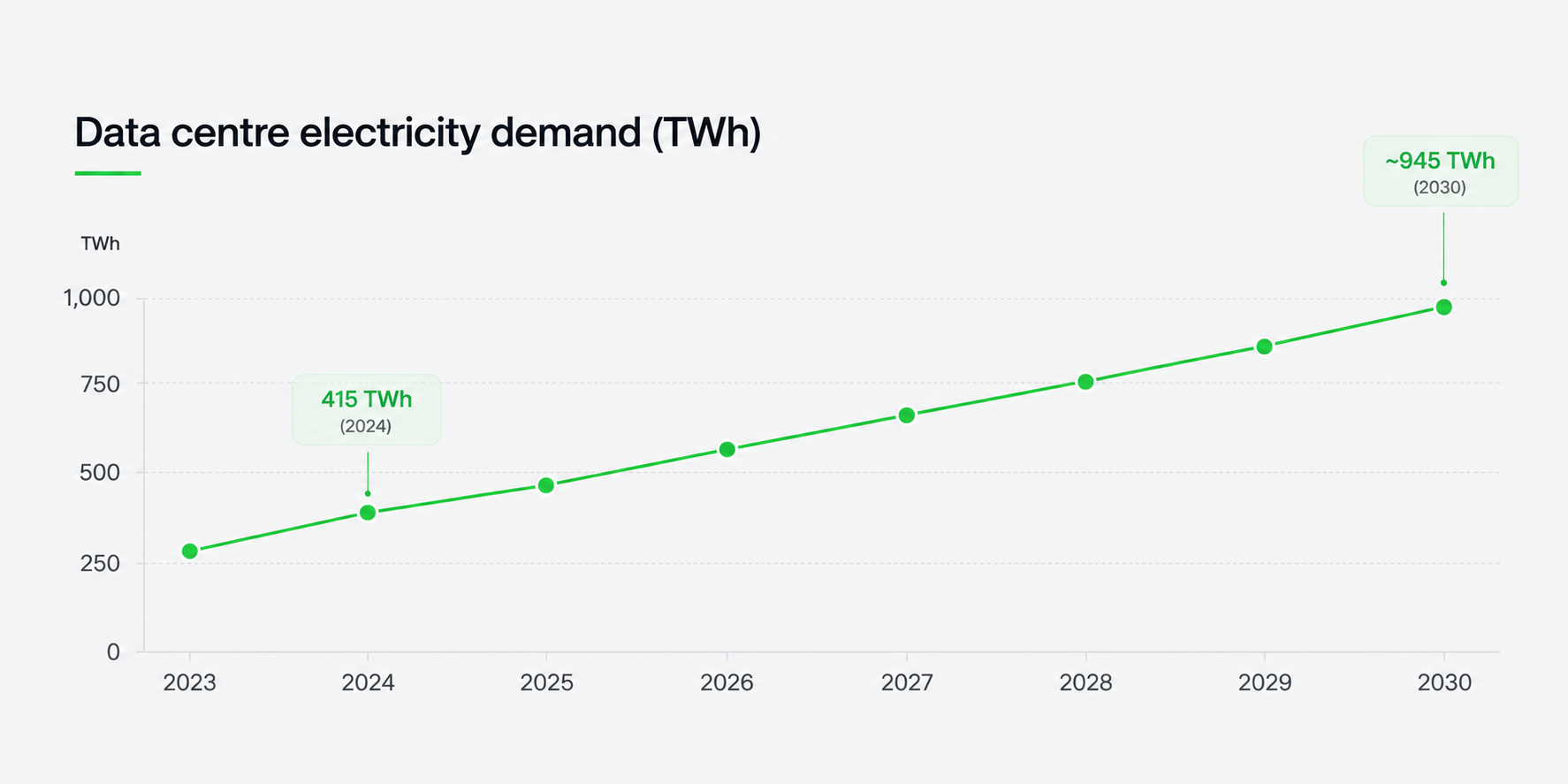
Data center electricity demand according to the IEA
Rising demand for content production. The commercial incentive for increased content production as a result of increasing audience demand points one way — produce and serve more. However, the climate target points in the opposite direction, as elements like recommendation algorithms and personalization all consume energy and contribute to emissions. A company can decarbonize its own offices to 100% renewable and face a growing carbon footprint, because the growth is happening one layer down in the infrastructure it buys rather than the infrastructure it owns.
The problem is that the progress these companies are reporting is concentrated in the 10% of the footprint they control. The 90% Scope 3 problem figure resides under the very business model that funds the targets.
Moving Forward: From Targets to Verified Data
If Scope 3 is the problem, then the next phase of decarbonization relies heavily on two things the reports are already gesturing toward: external verification and better data quality.
SBTi validation and double materiality raise the bar on both. SBTi validation forces companies to set Scope 3 targets when supply chain emissions are material — which, for digital media sector, they often are. Double materiality under the CSRD pushes in the same direction, requiring companies to report not only the financial risks the climate poses to them but the impact their own operations are having on the climate, value chain included. Both of these regulatory elements shift the focus from stating a target to concretely evidencing one.
Which makes data quality the decisive constraint. Verifying progress on Scope 3 means sourcing and collecting emissions data from cloud providers, network operators, and a long list of suppliers. These figures then need to be kept up to date as those relationships change. Much of the Scope 3 number is still estimated rather than measured, modelled from spend rather than actual consumption due to the difficulty of exactly measuring this consumption. Moving forward, it is specific, audit-ready data that will manage a reduction, defend an audit, or survive the scrutiny that mandatory disclosure invites.
That is also where the reporting breakdown in our sample is most instructive. The frameworks are well covered, the governance is in place, and the renewable-energy figures are strong. However, it’s the granular, verifiable Scope 3 figures that are often the problem area of the report. Platforms built specifically to collect, structure, and track these emissions — Footprint Intelligence among them — are better suited to this work than spreadsheets and annual data calls, precisely because the task is continuous and highly collaborative rather than periodic and purely internal.
Clear, traceable Scope 3 data can transform a company’s emissions for the better. When supplier collaboration is built into the reporting system, tracing those emissions that seemed invisible becomes a more simple task. No figure is ever strictly third party. The data center operators will have access to the Terawatt hours of electricity they use even if to your company that figure seems obscure and difficult to reach.
Once this data is acquired, reduction becomes a realizable goal. Emissions are difficult to cut when they’re invisible. When the granular details emerge as a result of effective reporting, they can be more easily targeted through focused decarbonization plans. Reevaluating the cloud service provider set-up to reduce data center reliance, coordinating with the center operators to discuss feasible opportunities for reduced electricity use, cutting company electricity use more decisively in the Scope 1 and 2 areas to compensate for the value chain footprint — all of these actions are tied to a developed understanding of what Scope 3 emissions data looks like.
The sector's climate credibility will not be decided by how clean its offices are or how many governance committees it convenes. It will be decided by whether companies can produce hard, verifiable numbers for the majority of their footprint that sits outside their walls in the cloud, the network, and the screen. The targets are set and the frameworks have been successfully adopted, leaving the data to catch up.